
Commercial Sewer Services in Beverly, MA
Restaurants, offices, retail, and multi-unit buildings can't afford sewer downtime. Local specialists inspect commercial lines during off-hours, diagnose with cameras, and repair with trenchless methods that keep your doors open — call (833) 713-2101.
- 24/7 emergency line
- Local North Shore specialists
- Camera inspection first
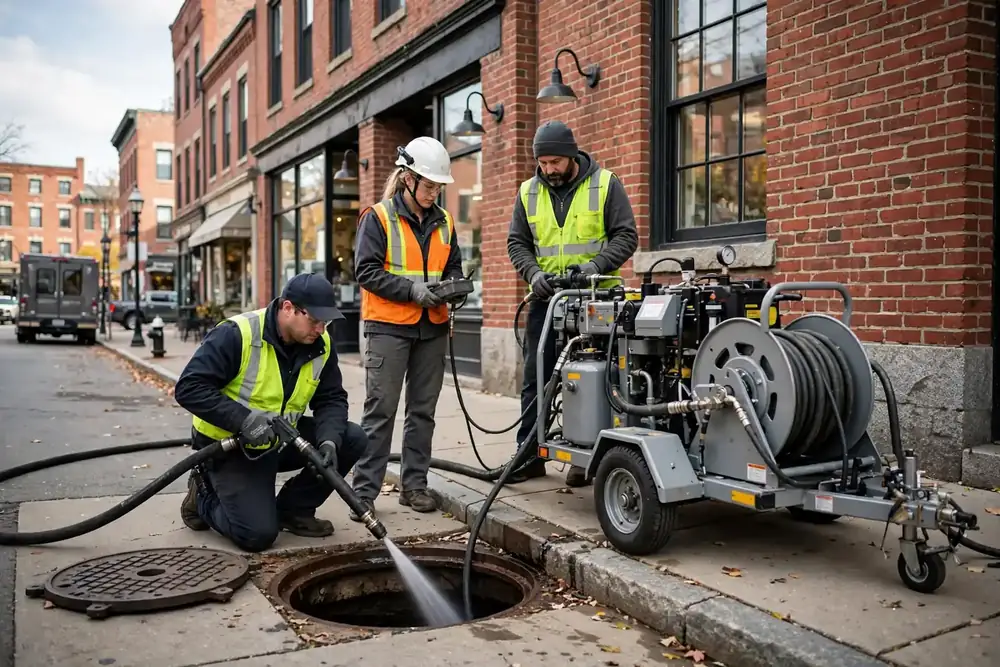
In short: Commercial sewer service in Beverly, MA 01915 starts with a camera inspection of the building's main line during off-hours when possible. Call (833) 713-2101 to describe the property and schedule the survey.
Signs a Commercial Property's Sewer Line Is Failing
Commercial sewer trouble rarely announces itself politely. In Beverly's downtown blocks, the first sign is often a restroom that backs up during the lunch rush or a floor drain in a kitchen that burps grey water when the dishwashers run. Restaurants along Cabot Street deal with a specific enemy: grease. Even with traps in place, fats, oils, and grease cool and plate onto the inside of the building sewer, narrowing it month by month until a busy service overwhelms the remaining capacity. Office buildings and retail spaces show different symptoms — slow drainage across multiple restrooms, persistent sewer odor in a stairwell or basement corridor, and toilets that need double flushing on the ground floor while upper floors behave normally, which points to a restriction in the lower lateral rather than any single fixture.
Multi-unit residential buildings add a diagnostic twist: when tenants on different floors report simultaneous backups, the common line is the culprit, and the building owner needs a camera survey before authorizing any work. Parking lots deserve attention too. A sinkhole or settled patch of asphalt above the sewer's path, soggy ground that never dries, or a cleanout cap that weeps during heavy use all suggest the line below has broken or separated. Because commercial failures interrupt revenue, the threshold for calling is lower than in a home — if two fixtures misbehave at once, the line gets inspected.
What Causes Commercial Sewer Failures
Grease is the leading cause in food service, and it is cumulative: every service day adds a thin layer until the pipe's effective diameter collapses. Non-food businesses face different culprits. Older commercial blocks in downtown Beverly and Salem run on clay or cast-iron building sewers that are simply past their design life, with joints opened by decades of settlement and root intrusion from street trees. Improper disposals are the wildcard — wipes marketed as flushable, paper towels, mop strings, and hygiene products enter commercial restrooms constantly and snag on any roughness inside the pipe, seeding blockages that grow between cleanings. Construction and renovation debris is another: grout, drywall compound, and concrete washout poured down a floor drain can set up like rock inside a lateral. Finally, heavy vehicle loading over shallow lines in delivery alleys and parking lots can crack or crush pipe, especially older clay and Orangeburg segments.
How Commercial Sewer Service Works, Step by Step
Off-hours assessment
The visit is scheduled to minimize disruption — early morning before opening, or after close. The specialist reviews the building's plumbing history, locates cleanouts and the building sewer path, and identifies which fixtures share the troubled line. For restaurants, this includes checking grease trap maintenance records, since a neglected trap accelerates line fouling.
Camera survey of the full run
A commercial-grade camera with a self-leveling head travels from the cleanout to the municipal connection or septic tank, recording grease buildup depth, root intrusion points, offsets, bellies, and breaks. A locator maps each defect's position and depth, which matters enormously under parking lots and landscaped setbacks where excavation costs multiply.
Cleaning to expose the true condition
Heavy grease and scale are jetted or mechanically cleared so the camera can see the pipe wall itself rather than the buildup. This step often restores flow immediately, which buys time to plan a permanent fix without operating in crisis mode.
Repair plan matched to the business
Options are presented with downtime spelled out: trenchless lining that keeps the doors open, bursting that replaces the line under the parking lot without trenching it, or open-cut replacement where collapse demands it. Phasing is planned around the business calendar — a restaurant's slow days, a retailer's off-season.
Scheduled execution and verification
The work is performed in the agreed window, the line is camera-verified afterward, and the footage is kept on file for the property's maintenance records. A maintenance schedule is proposed so the problem does not recur on the busiest weekend of the year.
Equipment and Materials Used
Commercial jobs run on heavier equipment than residential ones. High-flow jetters with root-cutting and descaling heads clear grease and mineral scale from 4-inch and 6-inch building sewers. Commercial camera systems use larger, self-leveling heads with longer push rods or crawlers to cover the longer runs typical of commercial sites. For repairs, cured-in-place lining installs a structural epoxy liner inside the existing pipe — ideal under slabs and parking lots where excavation would shut the business down. Pipe bursting pulls a new HDPE line through the old one's path, upsizing where needed. Where open-cut is unavoidable, SDR-35 or Schedule 40 PVC replaces failed clay, cast iron, or Orangeburg, bedded in compacted stone to handle vehicle loading. Cleanouts are brought up to grade and capped for future access, because a commercial line without accessible cleanouts is a line that cannot be maintained.
Safety on Commercial Sites
Commercial sewer work happens around employees, customers, and the public, so the safety perimeter is wider than on a residential job. Work zones in parking lots and alleys are coned and signed, with spotters when equipment operates near traffic. Confined-space protocols govern any entry into manholes or deep pits — atmospheric testing, ventilation, and an attendant at the surface, without exception. Sewage exposure controls include wash stations, disinfection of affected surfaces, and proper disposal of contaminated material rather than washing it into storm drains. Grease and chemical cleaners sometimes present in commercial lines are identified before jetting, because pressurized unknown chemistry is a hazard. The crew briefs the property manager on the day's plan each morning so staff and customers are never surprised by equipment or odors.
Local Factors: Commercial Sewers on the North Shore
Beverly's commercial core is old. The downtown business district's 19th-century blocks, Salem's converted commercial buildings, and Gloucester's waterfront properties run building sewers that predate modern materials — clay and cast iron with a century of settlement behind them. Shared laterals are common where buildings were subdivided, which means one tenant's backup can originate in a neighbor's section of pipe; camera locating untangles responsibility before anyone pays for work. Coastal groundwater affects commercial lines the same way it affects residential ones: high water tables near Beverly Harbor, Salem Harbor, and the Danvers River infiltrate failed joints, and during nor'easters that infiltration can overwhelm a line already narrowed by grease. Parking-lot lines deserve special mention — shallow burial under asphalt plus delivery-truck loading is a recipe for crushed Orangeburg and cracked clay, and trenchless replacement under pavement is almost always cheaper than saw-cutting and repaving. Finally, many North Shore commercial properties sit in historic districts where open excavation faces permitting constraints; trenchless methods keep both the street and the schedule intact.
Frequently Asked Questions
How do you inspect a commercial sewer line without closing the business?
Inspections are scheduled during off-hours — before opening, after close, or on slow days. The camera enters through an existing cleanout, so there is no digging and no disruption to operations. Most surveys take under two hours, and you receive the footage and a written summary the same day. Call (833) 713-2101 to arrange a time that fits your schedule.
Why do restaurant sewer lines clog more often than other buildings?
Fats, oils, and grease cool as they travel and plate onto the pipe wall, narrowing the line a little with every service day. Even well-maintained grease traps let some grease through, and high-volume dishwashing adds food solids and detergents that combine into stubborn deposits. Regular jetting on a schedule — not just when flow slows — is how restaurants stay ahead of it.
Can a sewer line be repaired under our parking lot without tearing it up?
Usually, yes. Pipe lining creates a new pipe inside the old one through small access points, and pipe bursting replaces the line underground while pulling in new pipe — neither requires trenching the asphalt. A camera inspection first confirms the line qualifies. Open-cut is only needed where the pipe has fully collapsed or lost its grade.
Who is responsible when a shared lateral serves multiple tenants?
It depends on the property's plumbing layout and lease terms, which is why camera inspection with locating comes first: it shows exactly whose section holds the defect. Building owners typically own the common building sewer, while tenant-caused blockages from improper disposals may be handled differently. The footage gives everyone a factual basis instead of an argument.
How often should a commercial sewer line be maintained?
Food-service lines generally need jetting and inspection on a recurring schedule dictated by volume — high-volume kitchens more often. Office and retail buildings with older clay or cast-iron lines benefit from annual camera checks to catch root intrusion and joint offsets early. The right interval comes from what the first inspection shows, not a generic calendar.
What happens if grease has been building up for years?
Years of grease form a thick, sometimes rock-hard lining inside the pipe that standard snaking cannot remove. High-flow hydro jetting with descaling heads cuts it back to the pipe wall, and the camera then reveals whether the pipe beneath is sound or damaged. If the pipe is sound, a maintenance jetting schedule prevents recurrence; if it is damaged, lining or replacement is planned from accurate footage rather than guesswork.
Sewer Line Problems Don’t Wait. Neither Should You.
Call now and reach a local sewer line specialist serving Beverly, MA and nearby North Shore communities — 24/7.
(833) 713-2101Free to call · No obligation · 24/7 emergency line