
Sewer Line Installation in Beverly, MA
Adding bathrooms, rebuilding, or replacing a failed line? New sewer lines designed for North Shore soil, depth, and frost — routed, permitted, and installed right. Call (833) 713-2101 to plan.
- 24/7 emergency line
- Local North Shore specialists
- Camera inspection first
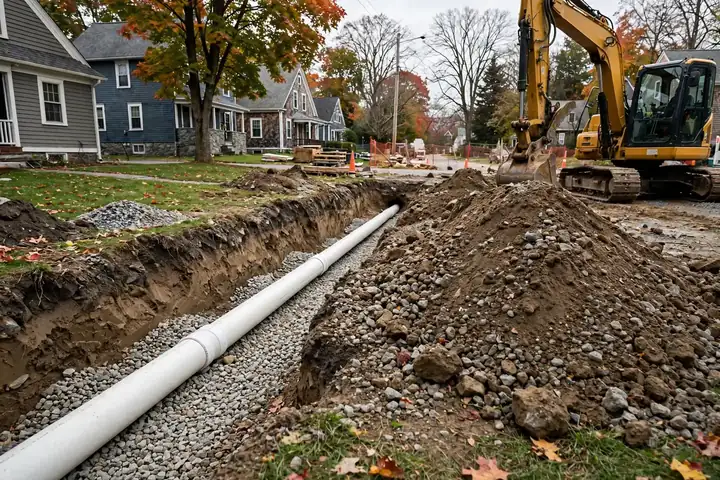
In short: Sewer line installation in Beverly, MA 01915 covers new building sewers for additions, rebuilds, and full replacements — designed for local soil, depth, and code. Call (833) 713-2101 to plan the route before you build.
When a New Sewer Line Is Needed
New sewer lines are born in a handful of situations. Home additions that add bathrooms or a kitchen below the existing drain level need new drainage routing tied into the building sewer — and sometimes the old lateral cannot handle the added load, so a new line is designed from the start. Full replacements after collapse or chronic failure are effectively new installations: the failed line is abandoned and a new pipe goes in on the best available route, which is not always the old line's path. New construction and major rebuilds need complete building sewers from the foundation to the municipal connection or septic tank. Conversions — a barn to living space in Hamilton, a commercial-to-residential change downtown — trigger new sewer requirements when the use changes the waste load. And some properties need a new line simply because the old one was never right: wrong grade, wrong depth, or a route through ground that has since proven unstable. In each case, installation is a design exercise first and a digging exercise second.
What Determines the Installation Plan
Every installation plan answers the same questions. Route: the shortest practical path from the building drain to the connection point that avoids ledge, respects setbacks, and minimizes surface disruption — on North Shore lots, that often means threading between stone walls, mature trees, and existing utilities. Depth: below the frost line with proper cover, deeper where vehicle loading crosses, and consistent with the municipal main's invert elevation at the connection. Grade: the pipe must fall continuously toward the main — too flat and solids settle, too steep and water outruns solids — so the route is surveyed for a steady, code-compliant slope. Material: modern PVC (SDR-35 or Schedule 40) for gravity sewers, sized to the building's fixture load. Connection: the tap into the municipal main or the inlet to the septic tank, each with its own requirements. And permits: the municipality's rules on excavation, street opening, and inspection govern the schedule as much as the soil does.
How Sewer Line Installation Works, Step by Step
Site survey and design
The route is walked and surveyed: existing utilities located and marked, soil conditions noted, the municipal main's depth and location confirmed with the city, and setbacks checked. The plan specifies pipe size, material, grade, bedding, and the connection detail — on paper before any machine arrives.
Permits and utility clearance
Municipal permits are secured and the dig-safe utility markout is completed. On North Shore streets this step also covers any street-opening or sidewalk permits when the connection lies under pavement.
Excavation and bedding
The trench is opened on the designed line and grade, with shoring where depth requires it. The trench bottom is prepared with compacted stone bedding so the pipe rests on uniform support — the step that prevents future bellies and offsets.
Pipe laying and connection
Pipe is laid from the downstream end upward, each joint checked for alignment and grade with a level or laser. The connection to the municipal main uses the approved tapping method; septic connections tie into the tank inlet with proper seals. Cleanouts are installed at required intervals and brought to grade.
Testing, backfill, and restoration
The new line is tested — water or air testing per local requirements — and camera-verified for grade and joint integrity. The trench is backfilled in compacted lifts to prevent settlement, and the surface is restored: loam and seed, pavement patch, or hardscape as it was.
Equipment and Materials
Installation equipment is earthmoving plus precision. Mini and full-size excavators open the trench; where ledge intrudes — Gloucester, Marblehead, Swampscott — rock-handling capability or alternative routing decides the plan. Trench boxes and shoring protect workers in deeper cuts, laser levels and grade rods hold the pipe to its designed slope, and compaction equipment beds the trench in lifts that will not settle. The pipe itself is modern PVC: SDR-35 for most gravity building sewers, Schedule 40 where extra wall strength is warranted, joined with gasketed or solvent-welded fittings as specified. Bedding stone — clean, compactable aggregate — supports the pipe uniformly; filter fabric separates bedding from native soil where fines would migrate. Connection fittings, risers, and cleanout assemblies complete the system, all brought to finished grade and capped. Every material is chosen for decades of buried service in local soil and water conditions.
Safety During Installation
New-line installation is construction work with construction hazards, managed accordingly. Underground utilities are located and marked before excavation — striking gas, electric, or water is the nightmare scenario, prevented by procedure. Trenches deeper than the safe threshold get shoring, sloping, or trench boxes; no one works in an unprotected cut, and spoil piles stay set back from the edge. Heavy equipment operates with spotters and clear communication, especially on tight North Shore lots where the swing radius approaches structures and fences. Traffic control — cones, signage, flaggers where needed — protects the crew and the public when work reaches the street. Dewatering handles the high water table common near the coast: pumps keep the trench workable and prevent trench-wall collapse in saturated soils. The site is secured each evening, and open excavations are never left unprotected.
Local Factors: Installing Lines on the North Shore
North Shore installations contend with ground that fights back. Ledge is the headline constraint: in Gloucester, Marblehead, and Swampscott, bedrock sits shallow enough that routing must either go around it or budget for rock work — and the route survey happens before commitments, not after. High groundwater near the coast and rivers means trenches need dewatering and pipes need proper bedding that will not wash out; in marsh-edge Essex and lake-fed Wenham, seasonal water levels shape the construction window. Frost depth governs burial: lines go below the freeze line with margin, because a shallow installation that freezes is a failed installation. Historic districts — downtown Beverly, Marblehead, Salem — add permitting layers when the route crosses streets or sidewalks, and the restoration standard is higher where the streetscape is protected. On septic-fed properties in Topsfield, Essex, and Hamilton, installation includes the tank inlet and respects the leach field's location and setbacks; the building sewer and the disposal system are designed as one. Long rural runs get extra attention to grade control, because a belly in a 200-foot run is a maintenance problem for the life of the house.
Frequently Asked Questions
How deep does a new sewer line need to be buried?
Below the local frost line with proper cover, and deeper where vehicles cross — the exact depth follows the municipal main's elevation at the connection point and the required grade between the house and the street. The route survey establishes these numbers before excavation begins. Call (833) 713-2101 to have your property's route evaluated.
Can a new sewer line take a different path than the old one?
Often, and sometimes it should. If the old route crosses ledge, runs under a new addition, or threads ground that has proven unstable, the new line is designed on the best available path — avoiding obstacles the original installers could not. The old line is properly abandoned. Route design is part of every installation plan.
Do I need permits for a sewer line installation?
Yes — municipalities govern sewer work through permits covering excavation, street or sidewalk opening where applicable, and inspection of the installation. Permit requirements and inspection stages vary by community, and the schedule is built around them. This is handled as part of the project, not left to the homeowner to navigate alone.
How long does a sewer line installation take?
Most residential installations complete in days, not weeks — the variables are trench length, depth, soil and rock conditions, weather, and permit inspection scheduling. Ledge, high groundwater requiring dewatering, and street-opening work extend the timeline. You will receive a realistic schedule with the plan, not a guess.
What pipe material is used for new sewer lines?
Modern PVC — typically SDR-35 for gravity building sewers, Schedule 40 where extra strength is specified — with gasketed or solvent-welded joints. It resists corrosion, roots cannot penetrate its fused joints the way they exploit clay bells, and its smooth interior maintains flow. Bedding stone and proper compaction matter as much as the pipe itself.
Will installation destroy my landscaping or driveway?
The route is designed to minimize surface disruption, and trenchless methods like pipe bursting can sometimes install the new line along the old path with only two access pits. Where open-cut is necessary, the disturbed area is restored — loam and seed, pavement patch, hardscape — and you will know the full extent of disruption before work begins.
Sewer Line Problems Don’t Wait. Neither Should You.
Call now and reach a local sewer line specialist serving Beverly, MA and nearby North Shore communities — 24/7.
(833) 713-2101Free to call · No obligation · 24/7 emergency line