
Sewer Line Repair in Salem, MA
Old clay under tight urban lots, shared laterals, brick sidewalks — Salem needs camera untangling and trenchless repairs that protect the historic city. Call (833) 713-2101.
- 24/7 emergency line
- Local North Shore specialists
- Camera inspection first
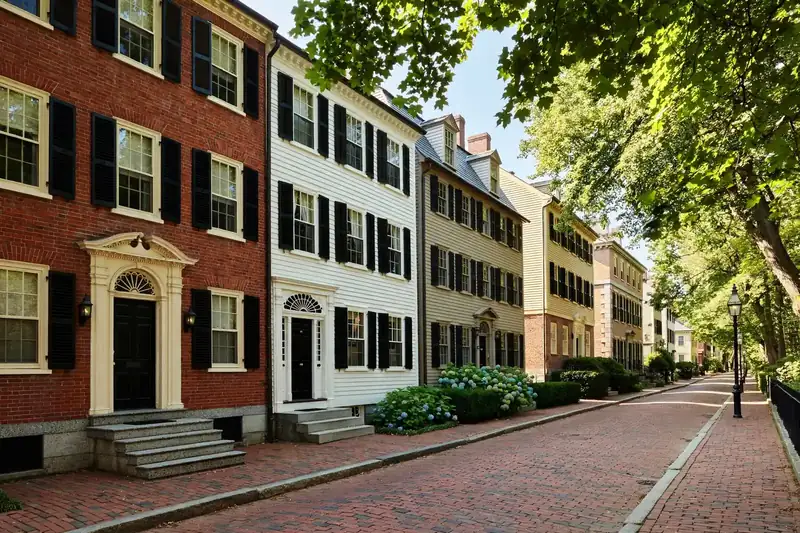
In short: Sewer line repair in Salem, MA 01970 starts with a camera inspection with locating — critical for shared laterals in the city's dense multi-family conversions. Call (833) 713-2101 to schedule.
Sewer Lines in Salem, MA 01970
Salem runs on old clay under tight urban lots. The median home was built around 1930, more than half of homes date before 1939, and nearly 38 percent of units are duplexes or small multi-family buildings — the densest multi-family stock in the fleet. The McIntire Historic District holds 1866 Victorians like 170 Federal Street; 1757 antiques like 15 River Street still stand on stone and brick foundations; 1930 colonials and 2021–2025 infill complete the range.
The sewer story is density plus age: root intrusion and offset joints from 90-plus years of settlement in clay laterals, shared laterals serving converted duplexes where nobody knows whose pipe is whose, and narrow historic streets with brick sidewalks that trenchless methods must protect. Public sewer is universal across the sourced listings. Here the approach is camera-with-locating as the untangler — of shared responsibility, of closely spaced lines, of the urban subsurface — followed by trenchless repairs that leave the historic streets alone.
Area Facts
- ZIP code
- 01970 (verified — listings at Federal St, Pearl St, West Terrace)
- Housing stock
- Median built ~1930; 50.95% before 1939; 37.97% duplexes/small multi-family; 1757 antiques to 2025 infill
- Era-typical pipe materials
- Clay tile dominant (possibly oldest brick/combined); shared/closely spaced laterals in multi-family conversions; public sewer universal
- Foundations
- Full basements standard — concrete, stone, or brick by era; many unfinished
- Soil & drainage
- Coastal city on Salem Harbor/Sound; historic fill downtown; high water table; Forest River corridor; low-lying flood exposure
- Landmarks
- McIntire Historic District; Salem Common; Forest River Park; Salem Harbor ferry to Boston; Salem MBTA station; Federal St, Essex St, Bridge Street Neck
Sewer Challenges in Salem
Shared laterals are the defining challenge. In a city where nearly 38 percent of units are duplexes or small multi-family — many converted from older single-family homes — the building sewers are often shared, closely spaced, or undocumented. One household's backup can originate in a neighbor's section; a landlord's line can serve three units with no map. Camera inspection with locating untangles it: tracing each lateral, marking each defect, establishing whose pipe is whose before anyone authorizes work. Without that step, Salem repairs are guesswork with legal consequences.
Age is the second challenge. Over half the housing predates 1939, and the clay-tile laterals have the full catalog of century-scale decline: root intrusion from mature street trees, offset joints from 90-plus years of settlement, infiltration where the harbor-adjacent water table meets failed bells. The 1757 antiques on stone and brick foundations add the masonry dimension — sewer exits through historic fabric that demands care. The 1930 colonials contribute the transition-era variety: clay giving way to iron, each with its own failure mode.
Density is the constraint. Narrow historic streets, brick sidewalks, zero-lot-line blocks, and the protected character of the McIntire district and downtown — open excavation here is impractical, restricted, or simply destructive. The fill soils downtown add subsurface uncertainty. Trenchless methods are the urban answer: lining that renews shared and individual laterals from existing access, bursting that replaces failed runs through small pits, all without touching the brick sidewalks above.
How Sewer Service Works in Salem
The inspection does triple duty: diagnosing the pipe, mapping the urban subsurface, and untangling responsibility. The camera travels each accessible lateral while the locating sonde marks paths and defects against the dense blocks above — establishing which fixtures drain where, which sections are shared, and where each defect lies relative to property lines. Findings are documented for sharing: landlords, tenants, neighbors, associations all get the factual basis.
Trenchless repairs follow the map. Lining renews clay laterals — shared or individual — sealing roots and infiltration in one watertight barrier without disturbing streets, sidewalks, or the historic districts. Bursting replaces deformed or collapsed runs along their corridors through small pits. The harbor-adjacent water table and downtown fill are factored into every plan; the brick sidewalks and narrow streets are protected by method choice, not by luck.
Coordination is built into Salem service: multi-party notification where shared lines are involved, business-aware scheduling near the downtown commercial blocks, and documentation that serves landlords' records as well as homeowners'. The city's density demands it, and the service delivers it.
Streets and Landmarks We Serve in Salem
Local specialists serve all of Salem: Federal Street and the McIntire Historic District; Essex Street and the downtown commercial blocks; Bridge Street Neck; The Point and North Salem; the Salem Common area; the Forest River Park neighborhoods; the Salem Harbor waterfront and ferry district; Vinnin Square; and the residential streets around the Salem MBTA station on the Newburyport/Rockport Line. Landlords, condo owners, and homeowners in the city's historic and multi-family stock all start the same way — call (833) 713-2101 for the camera-and-locating inspection that untangles the lines before anything is planned.
Whose Pipe Is It? Salem's Shared Laterals
Salem's sewers are old clay under tight urban lots, and the ownership question comes up on nearly every multi-family call. More than half the housing was built before 1939 — the median year built is 1930 — and nearly 38 percent of units are duplexes or small multi-family buildings: 1850s Bridge Street Neck homes, 1866 McIntire Historic District Victorians like 170 Federal Street with its full basement and brick-and-granite foundation, 1757 antiques like 15 River Street on stone and brick. Converted duplexes and triple-deckers across the Point, North Salem, and the downtown often share lot lines, driveways, and — undocumented in anyone's records — sewer laterals.
Camera inspection with locating untangles shared-lateral responsibility, and for two- and three-family owners that untangling is the whole job. The camera maps each lateral's actual path; the sonde marks it on the surface; the footage shows which building's fixtures feed which pipe. Disputes between co-owners, between owner and tenant, and between neighbors over a backup get settled with video rather than argument — and the repair proposal can then be directed at the right party with the right scope. No responsible contractor prices shared-line work without this step.
The physical conditions are pure old-city coastal: clay tile worked by 90-plus years of settlement into offset joints, root intrusion from mature street trees, high water table near the harbor, and historic fill under the downtown and waterfront blocks. Public sewer is universal, but the laterals are private and aging. Trenchless methods avoid tearing up the narrow historic streets and brick sidewalks around the McIntire District, Salem Common, and the Essex Street corridors — lining seals the joint system, bursting replaces collapsed runs, both from small access points. From Forest River Park to the ferry terminal and the Peabody Essex Museum district, start with the camera and the locator. Call (833) 713-2101.
Frequently Asked Questions
How do we handle a lateral shared between units?
The camera-and-locating inspection maps which fixtures drain to which lateral and where each defect lies, establishing the factual basis for shared responsibility. Findings are documented for all parties — landlords, tenants, neighbors — so cost-sharing and authorization rest on evidence. Call (833) 713-2101 for the untangling inspection.
Will repairs damage the brick sidewalks or historic streets?
No. Trenchless lining needs only existing access points; bursting needs two small pits — neither trenches through streets or sidewalks. Method choice here is explicitly about protecting the historic urban fabric, and the plan is designed to that constraint.
Are Salem's 1700s-era lines repairable?
Condition decides, not century. Antique clay laterals with joint damage but sound barrels line beautifully; collapsed sections burst or replace. The camera classifies each line individually — many of Salem's oldest lines are excellent trenchless candidates precisely because their barrels survive.
What if the backup is coming from the neighbor's section?
Then the locating survey shows it: the defect's position relative to property lines is marked from above ground. That factual map is what prevents paying for work on the wrong section — and what makes the conversation with the neighbor productive instead of adversarial.
Does the harbor water table affect downtown lines?
Yes — the harbor-adjacent water table and downtown's historic fill keep the ground wet, so failed joints infiltrate continuously. Lining seals the joints watertight against it, which is why infiltration assessment is part of every Salem inspection.
Do you work with landlords and property managers?
Yes. Multi-unit properties get documented findings suitable for records and tenant communication, coordinated scheduling that respects occupants, and maintenance programs built for the building's actual pipe — shared or individual, clay or converted.
Sewer Line Problems Don’t Wait. Neither Should You.
Call now and reach a local sewer line specialist serving Beverly, MA and nearby North Shore communities — 24/7.
(833) 713-2101Free to call · No obligation · 24/7 emergency line