
Sewer Line Repair in Beverly, MA
When drains back up, toilets gurgle, or sewage smells drift up from the basement, Beverly homeowners need answers fast — and they need them from people who know North Shore sewer lines. One call to (833) 713-2101 connects you with local specialists who diagnose with a camera first, explain what they find in plain language, and fix it with the least disruption your property allows.
- 24/7 emergency line
- Local North Shore specialists
- Camera inspection first
- Trenchless options available
Old Pipes, Coastal Ground, and Why Local Knowledge Matters
Beverly, Massachusetts grew up in layers, and its sewer lines grew with it. A 17th-century farmhouse in Beverly Farms may still drain through clay tile laid when the street was dirt. A 1940 Cape in North Beverly likely sits on original clay at the end of its service life. A 1962 ranch in Ryal Side or a split-entry in Peabody could be running on Orangeburg, the bituminized fiber pipe of the postwar boom that slowly ovalizes underground. Each material fails differently, and each demands a different fix — which is why a camera inspection comes before any recommendation, every time.
The ground itself is half the story. Much of Beverly and the surrounding North Shore sits on glacial till, and in Gloucester, Marblehead, and Swampscott the till is thin over Cape Ann granite ledge. Coastal neighborhoods from Beverly Cove to Manchester-by-the-Sea live with a high water table that rises with tides and nor'easters. Marsh-adjacent lots in Essex and Beverly Farms, riverfront homes along the Danvers River in Ryal Side, and lake-fed ground in Wenham all push groundwater against aging clay joints. A sewer line here is not just a pipe; it is a pipe in a dynamic, wet, rocky environment, and repairs planned without that context tend to fail twice.
Then there are the trees. Beverly's mature canopy — the oaks and pines of Beverly Cove's shore lots, the woodland of Hamilton's estate acreage, the street trees of Salem's historic districts — sends roots hunting for moisture every growing season. Clay-tile joints, packed with mortar or oakum a century ago, are exactly the weak points roots exploit. Year after year, fine root hairs enter a joint, thicken, and eventually mat into a blockage that snags paper and grease until the line chokes. Regular camera checks catch this cycle early, when a cleaning and a lining plan cost far less than an emergency excavation.
That is the approach behind every visit: diagnose first with a camera, locate the problem precisely, and match the repair to the pipe, the soil, and the property. Trenchless lining seals a root-invaded clay lateral without trenching through a landscaped yard. Pipe bursting replaces a deformed Orangeburg line in place. Open-cut replacement remains the right answer for collapsed sections and lines that have lost grade. The method follows the evidence — and the evidence starts with what the camera shows on the day of the visit.
Sewer Services for Beverly Homes and Businesses
Every service below starts the same way: a camera inspection that shows what is actually wrong, followed by a plain-language explanation of your options. Choose a service to learn how it works, when it is the right call, and what to expect on the day.
Commercial Sewer Services
Sewer service for Beverly-area businesses, restaurants, and multi-unit properties.
Learn moreEmergency Sewer Repair
Fast response when sewage backs up, lines break, or drains fail without warning.
Learn morePipe Bursting
Trenchless pipe replacement that fractures the old line and pulls in a new one.
Learn morePipe Lining
Cured-in-place lining that creates a new pipe inside the old one, no digging.
Learn moreSewer Camera Inspection
High-resolution camera surveys that show exactly what is wrong inside your line.
Learn moreSewer Leak Detection
Pinpointing hidden leaks with acoustic, smoke, and camera diagnostics.
Learn moreSewer Line Cleaning
Clearing blockages, grease, and scale so wastewater flows freely again.
Learn moreSewer Line Installation
New sewer line design and installation for additions, rebuilds, and new connections.
Learn moreSewer Line Replacement
Full replacement of failed lines, trenchless or open-cut, done right.
Learn moreSewer Maintenance
Scheduled care that keeps lines clear and catches problems early.
Learn moreTree Root Removal
Cutting and clearing root masses that invade joints and block sewer flow.
Learn moreTrenchless Sewer Repair
Fixing sewer lines with minimal digging through lining and bursting.
Learn moreFrom Your First Call to a Working Sewer Line
You call (833) 713-2101
Describe what you are seeing — slow drains, gurgling, smells, a backup. A local specialist asks a few targeted questions: which fixtures are affected, when it started, how old the house is. That short conversation already narrows the likely cause, because a 1920s clay lateral and a 1970s Orangeburg line fail in recognizable patterns. If sewage is actively backing up, you will get immediate guidance on what to stop doing while help is arranged. The line is answered day and night, because sewer failures do not keep business hours.
Camera inspection and locating
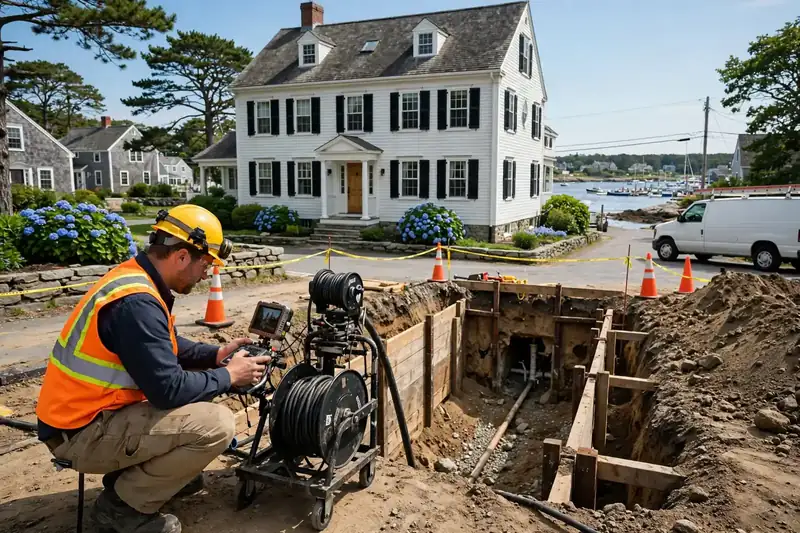
A high-resolution camera travels the length of your building sewer, showing cracks, offsets, root masses, bellies, and collapses on a monitor you can watch too. A locating sonde pinpoints each defect's depth and position from above ground, so the repair plan targets the real problem instead of guessing. On multi-acre lots in Hamilton or long estate runs in Prides Crossing, this mapping step is non-negotiable — you cannot plan a 200-foot repair without knowing where the pipe actually runs.
A plain-language plan with options
You see the footage, hear what it means, and learn which methods fit: spot repair, lining, bursting, or full replacement. Each option is explained in terms of what it solves, how much of your property it disturbs, and how it holds up in local conditions like ledge, high groundwater, or mature root systems. There is no pressure to decide on the spot; the footage and the explanation are yours to consider. Questions are welcome, because an informed homeowner makes better decisions.
The repair, done with minimal disruption
On the scheduled day, the crew protects your property, completes the agreed work, and verifies the result — usually with a second camera pass so you can see the finished line for yourself. Trenchless jobs typically need only small access pits; open-cut work is backfilled and graded. Before leaving, you will hear what was done, what to watch for, and how maintenance can extend the life of the repair. Then the drains run, the toilets flush, and the worry stops.
Built for North Shore Sewer Problems
Camera-first, always
Recommendations built on guesswork are how homeowners pay for the wrong repair. Every job here begins with a camera in the line and a locator above it, so the diagnosis is visual and the location is exact. You watch the same footage the technician watches. That single discipline — look before you dig, look before you line, look before you replace — prevents most of the expensive mistakes in this trade.
People who know these streets
The difference between a clay lateral in Marblehead's Historic District and an Orangeburg line in Peabody's 1960s subdivisions is not academic; it changes the tools, the method, and the price of getting it wrong. Local specialists carry that context into every visit: which neighborhoods sit on ledge, where the water table runs high, which eras used which materials, and where town sewer ends and private septic begins. Beverly is not interchangeable with anywhere else, and the service reflects that.
Trenchless when it fits, honest when it doesn't
Lining and bursting save yards, driveways, and historic streetscapes — but they are not universal answers. A collapsed section on Gloucester granite cannot be lined; a line that has lost its grade cannot be burst back into shape. You will hear which methods your line actually qualifies for and why, including when open-cut replacement is the honest recommendation. The goal is the right fix, not the most convenient one.
Around-the-clock response
Sewage backups happen at 2 a.m. on holidays, during nor'easters, and twenty minutes before guests arrive. The line at (833) 713-2101 is answered around the clock so a real conversation — not a voicemail maze — is always one call away. Emergency visits prioritize stopping the damage: containing the backup, relieving the blockage, and stabilizing the situation before the full repair is planned in daylight.
Straightforward communication
No jargon walls, no mystery line items, no vanishing after the deposit. You get the camera footage, a clear explanation of options, and straight answers about what happens next. If a second opinion would serve you better than a sale, you will hear that too. Trust in this business is built one explained inspection at a time.
Respect for your property
North Shore properties are not easy to dig: Olmsted-era gardens in Prides Crossing, stone walls in Hamilton, narrow colonial streets in Marblehead, condo common areas in Beverly Point. Crews plan access to disturb as little as possible, protect landscaping and hardscaping along the work path, and leave the site clean. Trenchless methods exist precisely for properties where a trench would do more harm than the repair is worth.
What North Shore Ground Does to Sewer Lines
Clay tile and the century of roots
Vitrified clay tile was the standard building sewer for the first half of the 20th century, and Beverly has more of it than most places — in 1890s Colonials in Beverly Cove, worker housing in Goat Hill, antiques in Essex and Marblehead, and Victorians across Salem. Clay itself lasts; its joints do not. Each bell joint is a seam where roots enter, soil shifts, and groundwater seeps. After 80 or 100 years, a clay lateral is less a pipe than a series of segments negotiating with the earth, and the camera usually shows the negotiation going badly at the joints.
Orangeburg's quiet deformation
From the 1950s through the 1970s, many North Shore homes got Orangeburg — bituminized fiber conduit that was cheap, light, and unfortunately oval-prone. Buried under driveways in Centerville, under lawns in Montserrat, under subdivisions in Danvers and Peabody, Orangeburg slowly flattens under soil load and root pressure. It cannot be lined once deformed; it must be burst or replaced. Because the pipe looks fine from the surface until it suddenly doesn't, camera inspection is the only way to know its true shape.
Ledge, till, and frost
Gloucester and Marblehead sit on granite that makes open trenching brutally expensive — excavation hits rock fast, and a collapsed section sitting on ledge cannot simply be re-graded. Inland, glacial till heaves with the freeze-thaw cycle, rocking shallow laterals at the foundation exit. Winter lows around 20°F from December through February, plus nor'easter snow loads, punish any pipe already weakened by age. Repairs here must account for ground movement, not just the pipe defect.
Water from every direction
The North Shore is wet below grade. Coastal neighborhoods contend with a high water table; marsh-edge lots in Essex and Beverly Farms see tidal influence; Ryal Side's Danvers River frontage and Wenham's lake-fed ground keep soils saturated; spring melt and nor'easter surge add seasonal peaks. Groundwater entering through failed clay joints overloads lines and, where septic systems are involved, the entire disposal field. Sump pumps in listing after listing across Wenham, Essex, and Ryal Side are the visible proof. Sealing a lateral against infiltration is often the highest-value repair a homeowner here can make.
Septic versus sewer: know before you call
Not every North Shore home is on town sewer. Outlying lots in Essex, Topsfield, Hamilton, and Wenham commonly run private septic, and some Beverly Farms outskirts may as well. A failed building sewer feeding a septic tank is a different job than a town-sewer lateral — the tank, distribution box, and leach field all enter the picture. Confirming the disposal type per address, before the camera even goes in, avoids planning the wrong repair entirely.
Density, history, and access
Downtown Beverly's 19th-century commercial blocks, Salem's converted duplexes with shared laterals, Goat Hill's tight waterfront grid, and Marblehead's narrow colonial streets all constrain excavation. Condo associations in Beverly Point and Swampscott add approval layers. Historic-district streetscapes cannot simply be trenched open. These constraints are exactly why camera-first diagnosis and trenchless methods dominate North Shore sewer work: the right repair is the one that fixes the pipe without breaking everything around it.
Proudly Serving Beverly and the North Shore
From the harbor-front condos of Beverly Point to the farm roads of Topsfield, local specialists serve every neighborhood below. Choose your area for hyperlocal guidance on the pipe materials, soil, and water conditions your street is known for.
Beverly Cove, 01915
Housing mixes 1890s hip-roof Colonials (an 1890 Colonial stands on E. Lothrop St) with 1960s family homes, 197…
Learn moreBeverly Farms, 01915
A historic seaside village whose stock includes a circa-1673 antique on Hale St and a 1904 Guy Lowell-designed…
Learn moreBeverly Point, 01915
A harbor-side neighborhood mixing waterfront condos on Front St and Water St with the Fish Flake Hill Historic…
Learn moreCenterville, 01915
Mostly mid-1900s stock: Colonial Revivals, sprawling ranch-style homes, and stately Cape Cods, with the Thaxto…
Learn moreDanvers, 01923
The typical Danvers home was built around 1960, with about 23 percent of homes dating to 1939 or earlier and a…
Learn moreDowntown Beverly, 01915
The Beverly Center Business District, listed on the National Register in 1984, holds more than 100 significant…
Learn moreEssex, 01929
Deeply historic stock includes the 1690 Benaiah Titcomb House, a circa-1686 farmhouse on Choate St, and an 180…
Learn moreGloucester, 01930
The median Gloucester home is about 74 years old, with more than half of units built before 1939 and dense 2-4…
Learn moreGoat Hill, 01915
One of Beverly's oldest working-class neighborhoods, settled in 1839 with the railroad and built out in the 18…
Learn moreHamilton, 01936
Settled in 1638 as The Hamlet of Ipswich, Hamilton mixes 17th-18th century farmhouses with 1950s Capes and Gil…
Learn moreIpswich, 01938
The median Ipswich home was built around 1964, yet more than a third of homes date to 1939 or earlier, includi…
Learn moreManchester-by-the-Sea, 01944
A classic coastal village of 1900s and 1940s village colonials, elegant Federal colonials, and 1990s-2000s wat…
Learn moreMarblehead, 01945
The median Marblehead home was built in 1947, with more than 46 percent of homes dating before 1939, including…
Learn moreMontserrat, 01915
A commuter pocket around the Montserrat MBTA station, which opened in 1874 and now offers a 117-space park-and…
Learn moreNorth Beverly, 01915
The typical North Beverly home was built around 1949, sitting exactly on the clay-to-cast-iron pipe transition…
Learn morePeabody, 01960
The median Peabody home was built in 1966, with 1880s-1920s in-town housing alongside big 1950s-1970s suburban…
Learn morePrides Crossing, 01965
A Gilded-Age estate enclave of oceanfront mansions, including 15 Paine Ave (Sunset Rock, with Olmsted-designed…
Learn moreRyal Side, 01915
A waterside family neighborhood of 1,694 homes with a median year built of 1940, mixing mid-century Capes and …
Learn moreSalem, 01970
The median Salem home was built around 1930, with more than half of homes dating before 1939 and the densest m…
Learn moreSwampscott, 01907
The median Swampscott home was built in 1953, mixing 1880s Humphrey St condos with 1900 Olmsted District colon…
Learn moreTopsfield, 01983
The median Topsfield home was built in 1967 on rural-suburban lots, with about 90 percent owner-occupied housi…
Learn moreWenham, 01984
The median Wenham home was built in 1960, ranging from the circa-1697 Gott-Porter House to 2024 new constructi…
Learn moreAreas we serve by ZIP: 01907, 01915, 01923, 01929, 01930, 01936, 01938, 01944, 01945, 01960, 01965, 01970, 01983, 01984.
Sewer Know-How for Beverly Homeowners
Practical, local, and jargon-free: recent articles on the problems North Shore sewer lines actually develop.
Signs Your Sewer Line Needs Repair
Slow drains in several fixtures at once, gurgling toilets, and sewage smells are the classic warnings — learn to read them before a backup forces the issue.
Learn moreTrenchless vs Traditional Sewer Repair
When does lining or bursting beat open-cut replacement, and when is a trench the honest answer? A side-by-side look for North Shore homeowners.
Learn moreTree Roots in Your Sewer Line
Why Beverly's mature canopy keeps finding clay-tile joints, how roots actually enter a line, and what stops them for good.
Learn moreWhat to Do During a Sewer Backup
The first ten minutes matter most. Immediate steps to limit damage while help is on the way — day or night.
Learn moreFrequently Asked Questions
What does sewer line repair involve in Beverly, MA?
It starts with a camera inspection that shows the inside of your line on a screen, so the problem is identified before any digging is discussed. From there the fix depends on what the camera found: a localized break may need a spot repair, widespread root intrusion may call for lining or bursting, and a fully collapsed line usually needs replacement. In Beverly, where clay-tile laterals from the early 1900s sit beside Orangeburg lines from the 1960s, the camera step matters more than anywhere because the right method depends entirely on the pipe material and its condition. Call (833) 713-2101 and a local specialist will walk you through what the inspection shows.
How do I know if my sewer line is failing or just clogged?
A single slow drain is usually a fixture clog. When several fixtures slow down at once, toilets gurgle, sewage smells rise from drains, or water backs up in a tub when the washer runs, the problem is in the main line, not the fixture. In North Shore homes, these whole-house symptoms most often trace to root intrusion at clay-tile joints or a deformed Orangeburg lateral. A camera inspection settles the question in one visit instead of repeated drain cleanings that never quite fix it.
Can sewer lines be fixed without digging up my yard in Beverly?
Often, yes. Trenchless methods like pipe lining and pipe bursting repair or replace a line through small access points instead of an open trench. Lining works when the old pipe is still roughly round and stable; bursting replaces lines that have lost their shape, including Orangeburg. They are especially valuable on the North Shore, where ledge in Gloucester and Marblehead, historic landscaping in Beverly Farms and Prides Crossing, and narrow lots in Salem and Goat Hill make open trenching expensive or impractical. A camera inspection determines whether your line qualifies.
What pipe materials are common in Beverly-area sewer lines?
Homes built before about 1950 almost always have vitrified clay-tile building sewers with cast-iron drain piping indoors. The 1950s through 1970s brought cast iron and Orangeburg, a bituminized fiber pipe that deforms over decades. Homes from the 1980s onward generally use PVC. Beverly's housing spans all of these eras, from 17th-century antiques in Beverly Farms and Essex to 2020s infill in Centerville, so the material under your lawn depends on when your house was built and whether the line was ever replaced.
Does the high water table on the North Shore affect sewer lines?
Yes, and it is one of the most overlooked factors here. Coastal neighborhoods like Beverly Cove, Beverly Point, Ryal Side, and Swampscott sit near the water table, and marsh-adjacent lots in Beverly Farms and Essex see groundwater rise with tides and nor'easters. Every failed joint in a clay-tile lateral below that water level admits groundwater, which overloads the line and, on septic-fed properties, the system beyond it. Sealing those joints with lining is often as much about keeping water out as keeping sewage in.
What should I do first if sewage is backing up into my home?
Stop running water, avoid flushing, and keep people and pets away from the backup. If you know where your main cleanout is, note whether sewage is visible there, but do not open anything you are unsure about. Then call (833) 713-2101: the line is answered around the clock, and a specialist can talk you through immediate steps and arrange a visit. Do not keep plunging or running fixtures hoping it clears, because each flush adds volume behind the blockage.
Do you serve towns beyond Beverly itself?
Yes. The service area covers Beverly's neighborhoods, from Beverly Cove and Beverly Farms to Centerville, Goat Hill, Montserrat, North Beverly, Prides Crossing, and Ryal Side, plus nearby North Shore communities including Danvers, Essex, Gloucester, Hamilton, Ipswich, Manchester-by-the-Sea, Marblehead, Peabody, Salem, Swampscott, Topsfield, and Wenham. Verified ZIP codes served include 01907, 01915, 01923, 01929, 01930, 01936, 01938, 01944, 01945, 01960, 01965, 01970, 01983, 01984. Call (833) 713-2101 to confirm coverage for your street.
Sewer Line Problems Don’t Wait. Neither Should You.
Call now and reach a local sewer line specialist serving Beverly, MA and nearby North Shore communities — 24/7.
(833) 713-2101Free to call · No obligation · 24/7 emergency line
Serving Beverly, MA and the North Shore: 01907, 01915, 01923, 01929, 01930, 01936, 01938, 01944, 01945, 01960, 01965, 01970, 01983, 01984