
Sewer Camera Inspection in Beverly, MA
Stop guessing what's wrong underground. A high-resolution camera shows the inside of your sewer line live — roots, cracks, collapses, offsets — with exact locations marked. Call (833) 713-2101 to schedule.
- 24/7 emergency line
- Local North Shore specialists
- Camera inspection first
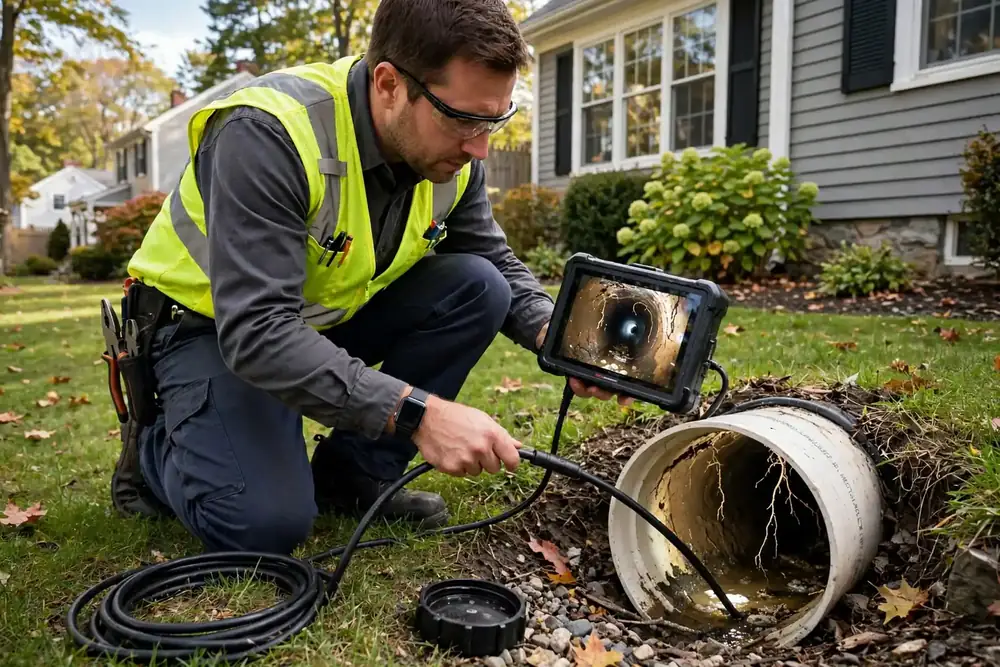
In short: A sewer camera inspection in Beverly, MA 01915 sends a high-resolution camera through your building sewer and shows you the footage live. Call (833) 713-2101 — it is the first step before any repair decision.
Signs You Need a Camera Inspection
The camera answers the question every other method guesses at: what is actually wrong inside the pipe. Recurring clogs are the top trigger — if a line has been professionally cleaned twice and still misbehaves, the problem is structural and only the camera shows it. Whole-house symptoms (multiple slow fixtures, gurgling toilets, sewage odors) point to the main line, and the camera distinguishes a root mass from a collapse in minutes, which changes the entire repair plan and its cost. Homebuyers in Beverly's older neighborhoods use pre-purchase inspections to avoid inheriting a failed lateral — a 1920s clay line in Salem or an Orangeburg lateral in Peabody can look fine from the surface while failing underground. After any major ground disturbance — construction next door, a nor'easter, heavy equipment on the lot — a camera check confirms the line survived. And before any trenchless repair, the camera is not optional: lining and bursting both require measured, verified knowledge of the pipe's condition, diameter, and path.
What the Camera Typically Finds
Footage from North Shore lines tells familiar stories. Root intrusion appears as fine white tendrils at a joint in early stages, progressing to dense brown mats that fill the pipe — the camera shows exactly which joints and how far the masses extend. Offsets show as steps where one pipe segment has shifted relative to the next, often with paper and debris snagged on the lip. Bellies appear as standing water in a sagged section, where solids settle out of the flow. Cracks run lengthwise or spider across clay and cast iron; in Orangeburg the camera reveals the telltale ovalization — a pipe that has gone from round to egg-shaped — and in advanced cases delamination where the fiber layers separate. Collapses show as soil or broken pipe intruding into the bore. Infiltration is visible as water seeping through joints, often pulsing with the tide cycle in coastal neighborhoods. Each finding maps to a specific fix, which is why the inspection drives every recommendation that follows.
How a Camera Inspection Works, Step by Step
Access through a cleanout
The camera enters through an existing cleanout — the capped access pipe in your basement, yard, or near the foundation. If no cleanout exists, one may need to be installed, or the camera can sometimes enter through a removed toilet. No digging is required for the inspection itself.
Camera travel with live footage
A waterproof, high-resolution camera on a push rod or crawler travels the line while you watch the live feed. The technician narrates what appears: pipe material changes, joints, defects, and distances. Self-leveling heads keep the image upright so the orientation of every defect is clear.
Locating from above ground
A sonde in the camera head emits a signal picked up by a surface locator, marking each defect's exact position and depth on the ground above. On long estate runs in Hamilton or Prides Crossing, this mapping is what makes a repair plan possible at all.
Recorded footage and findings
The full inspection is recorded. You receive the footage plus a plain-language summary: what was found, where, how serious it is, and which repair methods fit. The recording becomes part of your property's records — useful for insurance, real estate transactions, and future maintenance comparisons.
Recommendations, not pressure
Findings are explained with options: what needs action now, what bears watching, and what can wait. A line with minor root intrusion gets a cleaning and monitoring plan; a collapsed Orangeburg section gets a replacement proposal. The footage belongs to you either way.
Equipment and Materials
Modern inspection rigs center on the camera head: high-resolution, waterproof, with bright LED lighting and a self-leveling image sensor so defects read correctly regardless of the camera's rotation. Push-rod systems handle residential laterals up to about a hundred feet; crawler units with motorized wheels cover longer commercial and estate runs. The locating sonde — a small transmitter in the camera head — pairs with a surface receiver that displays depth and position, letting the technician spray-mark defect locations on the lawn or pavement. Recording systems capture the full run with distance counters overlaid, so every defect is logged by footage mark. Pre-inspection, the line may need a preliminary clearing if it is fully blocked; the camera cannot see through a solid blockage. No repair materials are involved — inspection is purely diagnostic, which is exactly its value.
Safety During Camera Inspections
Camera inspection is the lowest-risk sewer service, but it is not casual work. Cleanout caps are opened carefully — a pressurized or surcharged line can release sewage and gas when opened, so the technician checks for pressure signs first. If the inspection follows a backup, the area is treated as a biohazard zone with appropriate protective equipment. Electrical safety applies around the recording and locating equipment, particularly in wet basements. When inspection requires entering a crawl space or pit to reach a cleanout, confined-space awareness governs. For the homeowner, the main safety note is simple: let the technician open and handle the cleanout, and keep children and pets clear of the equipment path through the house.
Local Factors: Inspections on the North Shore
On the North Shore, the camera inspection carries extra weight because the housing stock spans every pipe era. A single street in Ipswich can hold a 1690 colonial on clay and a 1985 subdivision Cape on PVC — the inspection tells you which era your pipe belongs to, and the repair path follows the era. In coastal neighborhoods, inspections are sometimes timed with the tide: infiltration through failed joints shows best at high water, when groundwater pressure peaks. Pre-purchase inspections are especially valuable in Marblehead, Salem, Essex, and downtown Beverly, where 19th-century laterals are common and a failed line is a five-figure surprise no buyer should inherit. For condo owners in Beverly Point and Swampscott, camera locating untangles shared-lateral questions before associations argue about responsibility. And on septic-fed properties in Topsfield, Wenham, and Essex, the inspection maps the building sewer all the way to the tank — because the tank, not just the pipe, may be the problem.
Frequently Asked Questions
How long does a sewer camera inspection take?
Most residential inspections take under an hour once the camera is in the line — longer runs on estate properties or commercial sites take more. If the line is fully blocked, a preliminary clearing comes first so the camera can travel. You watch the live footage during the inspection and receive the recording and a written summary afterward. Call (833) 713-2101 to schedule.
Will the camera damage my pipes?
No. The camera is a smooth, blunt instrument that travels inside the existing pipe — it cannot damage sound pipe. If the line is already collapsed, the camera simply cannot pass, which itself is diagnostic information. The inspection is purely observational.
Do I need to be home during the inspection?
It helps. Watching the live footage with the technician's narration is the fastest way to understand your line's condition, and you can ask questions in the moment. If you cannot be present, the recorded footage and written summary cover everything found.
Can the camera find exactly where the problem is in my yard?
Yes — the locating sonde in the camera head transmits a signal that a surface receiver picks up, marking each defect's position and depth on the ground above. This is how repair plans target the real problem instead of excavating exploratory trenches.
Should I get an inspection before buying an older Beverly home?
Strongly recommended. Sewer laterals are invisible during a standard home inspection, yet a failed clay or Orangeburg line is among the most expensive surprises a buyer can inherit — especially in neighborhoods with 19th and early-20th century stock like Salem, Marblehead, Essex, and downtown Beverly. A pre-purchase camera inspection is inexpensive insurance against that surprise.
What if the camera finds multiple problems?
That is common in older lines, and the footage lets them be prioritized: structural failures that threaten collapse come first, root intrusion that can be managed gets a cleaning and monitoring plan, minor defects are noted for future comparison. You will hear what needs action now versus what bears watching — not a demand to fix everything at once.
Sewer Line Problems Don’t Wait. Neither Should You.
Call now and reach a local sewer line specialist serving Beverly, MA and nearby North Shore communities — 24/7.
(833) 713-2101Free to call · No obligation · 24/7 emergency line