
Pipe Bursting in Beverly, MA
A deformed or collapsed sewer line doesn't always mean a trenched yard. Pipe bursting fractures the old pipe underground and pulls in a seamless new line through two small pits — call (833) 713-2101 to see if your line qualifies.
- 24/7 emergency line
- Local North Shore specialists
- Camera inspection first
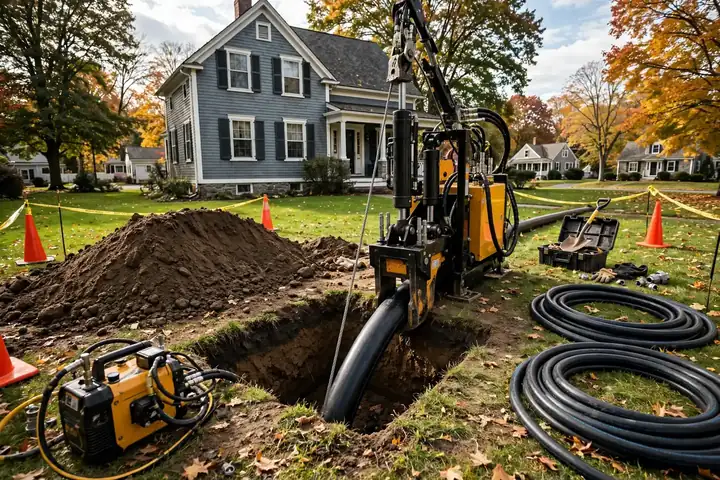
In short: Pipe bursting in Beverly, MA 01915 replaces a failed sewer line by fracturing it underground while pulling in new HDPE pipe. Call (833) 713-2101 for a camera inspection to confirm your line qualifies.
Signs Your Line Needs Bursting, Not Just Cleaning
Pipe bursting is a replacement method, so the signs pointing to it are the signs of a line that is structurally finished. Recurring blockages that return within months of each professional cleaning suggest the pipe itself — not the debris in it — is the problem. Multiple bellies or offsets visible on a camera inspection, where the pipe sags or steps at the joints, indicate the line has lost the shape that lining requires. Orangeburg pipe is the classic bursting candidate: once the fiber conduit ovalizes, no cleaning restores its round profile, and the camera shows a flattened or ridged interior that only replacement fixes. Sections where the pipe has collapsed or separated entirely, yet the overall path remains viable, are ideal — bursting follows the old pipe's route, so it threads the same corridor without a new trench. If your line needs frequent rescue visits and the camera shows deformation rather than mere buildup, bursting deserves a serious look.
What Causes the Damage Bursting Fixes
Bursting addresses structural failure, and structural failure has structural causes. Age and material lead the list: Orangeburg's bituminized fiber softens and deforms under decades of soil load; clay tile's joints open as mortar and packing deteriorate, letting soil pressure and roots work segments out of alignment; cast iron corrodes from the inside where wastewater chemistry and from the outside where soils are aggressive. Ground movement accelerates everything — frost heave in Beverly's inland till, settlement in coastal fill near the harbor, and the slow creep of saturated marsh-edge soils in Essex and Beverly Farms. Root pressure is both cause and consequence: roots enter through failing joints and then wedge them further apart as they thicken. Heavy surface loading crushes shallow pipe under driveways and parking areas. Bursting is the answer when these forces have changed the pipe's shape beyond what lining can bridge.
How Pipe Bursting Works, Step by Step
Camera inspection and qualification
The line is camera-inspected end to end and the footage reviewed for collapses, offsets, material, and diameter. Bursting needs a viable path — the bursting head follows the old pipe, so severe collapses that have lost the corridor, or lines with unmapped utility conflicts, may redirect the plan. Depth and location are mapped with a locator.
Access pits at both ends
Two small pits are excavated: an entry pit where the new pipe feeds in and a pulling pit where the bursting equipment sets up. Compared with open-cut replacement, which trenches the entire run, these pits are the only excavation — typically a fraction of the disturbed area.
Head insertion and cable threading
A hardened steel bursting head, slightly larger than the old pipe's diameter, is attached to a pulling cable or rod threaded through the existing line. The new HDPE pipe — fused into a single seamless length — connects behind the head.
The burst and pull
Hydraulic power draws the head through the old pipe. The head fractures the existing line outward into the surrounding soil while the new HDPE pipe slides into the void immediately behind it. The operator monitors pulling force continuously; a sudden spike signals an obstruction that needs investigation rather than brute force.
Connection and verification
The new line is connected to the building drain and the municipal main or septic tank with proper fittings, the pits are backfilled and compacted, and a final camera pass verifies a clean, continuous, properly graded new pipe. You watch the new line on the monitor — smooth, jointless, and round.
Equipment and Materials
The bursting head is the heart of the operation — a conical hardened-steel tool sized to the pipe being replaced, designed to split clay, cast iron, Orangeburg, and PVC outward without compacting the soil so tightly that the new pipe cannot follow. Hydraulic pulling units, either cable-winched or rod-based, provide controlled, measurable force; static bursting (steady pull) suits most residential laterals, while pneumatic heads serve specific soil conditions. The replacement pipe is HDPE — high-density polyethylene — fused into one continuous length with no joints for roots to exploit. HDPE's flexibility navigates minor alignment quirks, and its smooth interior resists scale and grease adhesion. Upsizing is a genuine advantage of bursting: the head can expand the bore slightly, allowing a larger-diameter replacement where the original line was undersized for the building's load. Locating sondes, cable machines for pre-cleaning, and compaction equipment for the pits round out the kit.
Safety During Pipe Bursting
Bursting is powerful work done near other buried utilities, so utility location comes before anything else — gas, electric, water, and communications lines are marked and the burst path is planned to maintain safe separation. Pulling forces are monitored against the equipment's ratings; if resistance exceeds the plan, work stops and the camera goes back in rather than risking damage to neighboring utilities or structures. Excavation safety governs the access pits: proper shoring or sloping for depth, spoil piles set back from the edge, and barricades keeping the work zone clear of foot traffic. On North Shore streets with narrow lots — Salem's dense blocks, Goat Hill's tight grid — the work zone is compact and clearly marked. Neighbors are notified when equipment will occupy shared access, and the site is secured at day's end.
Local Factors: Bursting on the North Shore
Pipe bursting may be the single most valuable trenchless method for Beverly's housing stock, because the area's dominant failure mode — deformed Orangeburg and offset clay — is exactly what bursting fixes and lining cannot. Centerville's 1950s–70s ranches and Capes, Montserrat's mid-century laterals, Danvers' and Peabody's postwar subdivisions: these are bursting territory, where camera inspections routinely show ovalized fiber pipe that must be replaced, not lined. The method shines on long runs too — Hamilton's estate laterals stretching 150 to 300 feet across pasture and woodland, Prides Crossing's mansion drives — where open-trenching would destroy landscaping, stone walls, and specimen trees. In ledge areas like Gloucester and Marblehead, bursting avoids the rock excavation that makes open-cut replacement punishingly expensive, though depth-to-ledge is mapped first because a line sitting directly on granite needs careful evaluation. High groundwater, the North Shore's constant companion, is manageable: the new HDPE line is jointless and watertight, sealing out the infiltration that plagued the old clay joints from day one.
Frequently Asked Questions
How is pipe bursting different from digging a new trench?
Bursting replaces the pipe along its existing underground path, fracturing the old line outward while pulling in new pipe — only two small access pits are dug. Open-cut replacement trenches the entire run, disturbing landscaping, driveways, and anything above the line. Bursting typically disturbs a fraction of the surface area. Call (833) 713-2101 for a camera inspection to see which your property needs.
What pipe materials can be burst?
Clay tile, cast iron, Orangeburg, concrete, and PVC can all be burst — the head is sized to the existing pipe and soil conditions. The key qualification is not material but path: the old line's corridor must be intact enough for the head to follow. A camera inspection confirms this before any commitment.
Can pipe bursting increase the size of my sewer line?
Yes — upsizing is one of bursting's genuine advantages. The bursting head can expand the bore slightly as it travels, allowing a larger-diameter HDPE replacement where the original line was undersized. This is valuable for buildings whose fixture load has grown since the original line was installed.
Will bursting damage my yard, driveway, or nearby utilities?
Surface disruption is limited to the two access pits. Nearby utilities are located and marked before work begins, and the burst path is planned to maintain safe separation. Pulling force is monitored continuously, and work stops for investigation if resistance spikes unexpectedly rather than pushing through blindly.
How long does the new HDPE pipe last?
HDPE is a fused, jointless pipe that resists root intrusion, corrosion, and scale buildup — the three forces that destroyed its predecessor. Its smooth interior and flexible strength suit North Shore soils, from glacial till to coastal sand. The final camera verification shows you the new line's condition on day one.
When is pipe bursting NOT the right choice?
Bursting is wrong when the old pipe's path is lost — severe collapses with major soil voids, lines that have wandered far off grade, or corridors blocked by unmapped utility conflicts. It is also unnecessary when the existing pipe is still round and stable, where lining achieves the fix with even less disruption. The camera inspection is what separates the two cases.
Sewer Line Problems Don’t Wait. Neither Should You.
Call now and reach a local sewer line specialist serving Beverly, MA and nearby North Shore communities — 24/7.
(833) 713-2101Free to call · No obligation · 24/7 emergency line