
Sewer Line Repair in Gloucester, MA
Granite ledge, 74-year-old housing, and Atlantic storms — Gloucester's sewers demand depth-to-ledge mapping and trenchless methods that beat rock excavation. Call (833) 713-2101.
- 24/7 emergency line
- Local North Shore specialists
- Camera inspection first
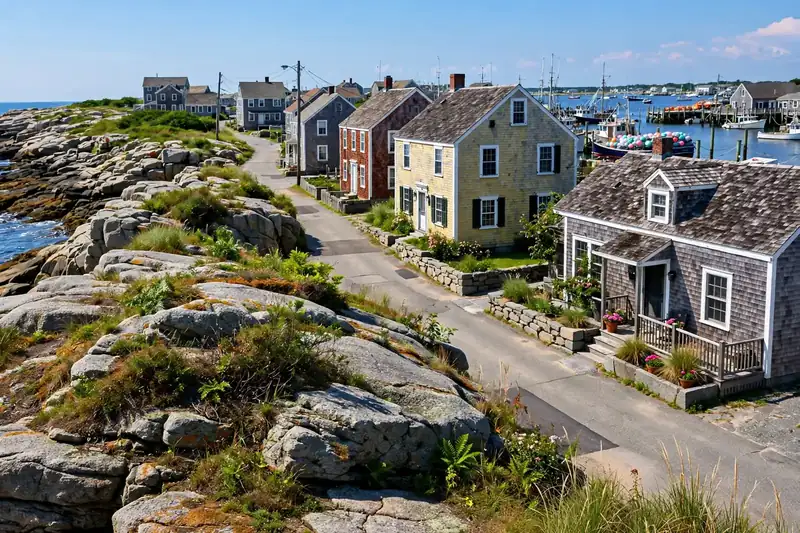
In short: Sewer line repair in Gloucester, MA 01930 starts with a camera inspection that maps depth-to-ledge — critical where granite makes every dig a rock job. Call (833) 713-2101 to schedule.
Sewer Lines in Gloucester, MA 01930
Gloucester is the ledge capital of the service area. Cape Ann granite bedrock is exposed at the surface across the city, with thin discontinuous glacial till over it and the Dogtown Common boulder field's 3,953 acres of terminal-moraine boulders as the geologic exclamation point. The housing stock is nearly as rugged: the median home is about 74 years old, more than half of units were built before 1939, and nearly a third of units are 2–4 family buildings — the densest multi-family stock in the region.
That combination — old clay laterals in thin soil over immovable granite, frost heave rocking shallow pipes against bedrock, roots exploiting every joint in the thin till — makes Gloucester's sewers a special case. Open-trench replacement here is brutally expensive because excavation hits ledge fast, which makes trenchless pipe bursting or lining not just convenient but economically decisive. And the camera inspection must map depth-to-ledge, because a collapsed section sitting on granite cannot be re-graded — only replaced or lined.
Area Facts
- ZIP code
- 01930 (verified — primary Gloucester ZIP; 01931 also serves parts)
- Housing stock
- Median home age ~74 years; 50%+ built before 1939; 32.5% of units in 2–4 family buildings; fishing-port housing, Magnolia, East/West Gloucester
- Era-typical pipe materials
- Clay tile laterals + cast-iron DWV (dominant pre-war); cast iron/Orangeburg (mid-century infill); shared/closely spaced laterals in multi-family
- Geology
- Cape Ann granite bedrock exposed at surface; thin discontinuous till; terminal-moraine boulder fields — hardest digging in the fleet
- Weather
- Full Atlantic exposure; nor'easters; 47 inches annual precipitation; freeze-thaw plus salt air corroding exposed cast iron
- Landmarks
- Route 128 northern terminus; Route 127 coastal loop; Gloucester Harbor; Good Harbor Beach; Stage Fort Park; Dogtown Common
Sewer Challenges in Gloucester
Ledge is the headline. Clay laterals laid in thin soil over exposed Cape Ann granite have nowhere to settle gracefully — frost heave rocks shallow pipes against immovable bedrock, stressing joints that roots then exploit in the thin till. When a section collapses sitting on granite, it cannot be re-graded; the rock dictates the pipe's elevation absolutely. Open-trench replacement means rock excavation, with costs that multiply against any other town in the fleet — which is why the trenchless question here is economic, not aesthetic.
Age and density compound it. With most homes pre-war, clay-tile laterals dominate, many past their design life, with joints opened by decades of frost action against the ledge. The dense 2–4 family stock means shared or closely spaced laterals where responsibility blurs — one building's backup can originate in a neighboring line, and camera locating untangles it before the wrong pipe gets attention. Salt air adds the corrosion chapter: exposed cast iron in the marine environment deteriorates faster than inland, and the camera is calibrated to spot it.
Water comes from the sky in volume — 47 inches of annual precipitation, nor'easters with full Atlantic exposure — and from the ground where the thin till saturates quickly. Infiltration through failed joints spikes with storms, and the shallow soil profile means there is little buffer between the surface weather and the pipe. Gloucester's lines live a hard life, and the camera usually shows it.
How Sewer Service Works in Gloucester
The inspection here has an extra dimension: depth-to-ledge mapping. The camera locates every defect by depth and position, and the plan accounts for where the pipe meets granite — because that determines what is even possible. A collapsed section on ledge cannot be re-graded; it must be burst, lined (if the path survives), or replaced with the rock reality priced in from the start. No honest plan here is made without knowing where the rock is.
Trenchless methods carry the load. Pipe bursting replaces failed lines along their existing corridors — threading the same thin-soil path without rock excavation — and is often dramatically less expensive than open-cut here. Lining renews joint-damaged clay without disturbing the boulder-strewn ground at all. For the multi-family stock, camera locating maps shared and adjacent laterals first, so each building's responsibility is factual. Open-cut, when truly required, is planned with the ledge explicitly in the design: route, depth, and method chosen with the granite, not against it.
Salt-air corrosion gets its own check on any exposed cast iron, and storm-driven infiltration is assessed with the city's heavy precipitation in mind. The through-line of every Gloucester visit: respect the rock, map everything, and let trenchless methods do what trenching cannot afford to.
Streets and Landmarks We Serve in Gloucester
Local specialists serve all of Gloucester: the downtown and harbor waterfront; the Route 127 coastal loop through Magnolia, East Gloucester, and West Gloucester; the neighborhoods around Good Harbor Beach and Stage Fort Park; Eastern Point and Annisquam; the West Gloucester MBTA station area; and the inland blocks toward Dogtown Common. From the northern terminus of Route 128 to the working waterfront, the first step is the same — call (833) 713-2101 for the camera inspection that maps your line's condition and its depth to ledge.
Why Gloucester's Ledge Makes Trenchless the Smart Money
Gloucester is the ledge capital of the service area, and that single fact reorganizes every sewer repair decision. Cape Ann granite breaks the surface across the city — Dogtown Common's 3,953-acre boulder field is the famous example, but the thin, discontinuous glacial till over bedrock is the everyday reality. Excavation here hits ledge fast. Open-trench replacement means rock excavation: slow, loud, and expensive, with costs that scale with every foot of granite. On a line that runs forty feet through shallow ledge, the rock work alone can eclipse the pipe work.
That economic reality is what makes trenchless methods decisive in Gloucester rather than merely convenient. Pipe bursting replaces a failed line along its existing corridor through two small pits — no trench through granite. Cured-in-place lining renews a sound-but-leaky pipe from the inside with no digging at all. The camera inspection that precedes either method has a Gloucester-specific job: mapping depth-to-ledge along the run, because a collapsed section sitting directly on granite cannot be re-graded, only replaced or lined. Knowing where the rock is shapes the method choice.
The housing stock multiplies the need. Gloucester's median home age is 74 years, more than half the units were built before 1939, and nearly a third are two-to-four-family buildings — the densest multi-family stock in the region, with shared or closely spaced laterals. Pre-war clay tile dominates, worked by frost heave rocking shallow pipes against immovable bedrock and by roots exploiting every joint in the thin till. Forty-seven inches of annual precipitation and full Atlantic nor'easter exposure keep the ground moving. From the harbor and Good Harbor Beach to Magnolia, East Gloucester, and the Route 127 loop, the message is the same: camera first, map the ledge, and let the rock decide the method. Call (833) 713-2101.
Frequently Asked Questions
Why is sewer work more expensive on ledge?
Because open-trench excavation hits Cape Ann granite fast, and rock excavation multiplies cost against normal digging. That is exactly why trenchless methods — bursting along the existing corridor, lining inside the existing pipe — are economically decisive in Gloucester: they avoid the rock entirely. Call (833) 713-2101 for a camera inspection that maps depth-to-ledge.
Can a collapsed pipe on granite even be fixed?
Yes — but it cannot be re-graded, since the rock fixes the pipe's elevation. Bursting replaces it along the same corridor; lining renews it if the path survives. The camera inspection determines which is viable, with the ledge explicitly mapped into the plan.
Do the old fishing-port houses share sewer lines?
Many do, or run closely spaced individual laterals with no documentation — nearly a third of Gloucester units are in 2–4 family buildings. Camera inspection with locating maps which fixtures drain where and whose section holds each defect, settling responsibility factually before any work.
Does salt air really damage sewer pipes?
It accelerates external corrosion of exposed cast iron — the marine environment is harder on metal than inland air. Buried pipe is largely shielded, but any exposed sections and the corrosion they reveal on camera inform the repair plan.
How does frost heave affect lines on ledge?
Frost heave rocks shallow pipes against immovable bedrock, stressing joints that cannot settle away from the rock. Over decades this opens clay joints for roots and infiltration. The camera shows the joint condition directly, and repairs account for the heave cycle in their design.
Will trenchless work hold up in Gloucester's ground?
Yes — fused HDPE from bursting and structural epoxy liners are both well suited to thin-soil, high-moisture, freeze-thaw conditions. They are jointless and watertight, addressing exactly the joint failure and infiltration that plague Gloucester's clay laterals. The final camera verification shows the finished work.
Sewer Line Problems Don’t Wait. Neither Should You.
Call now and reach a local sewer line specialist serving Beverly, MA and nearby North Shore communities — 24/7.
(833) 713-2101Free to call · No obligation · 24/7 emergency line