
Sewer Line Cleaning in Beverly, MA
Slow drains throughout the house? Roots, grease, and scale narrow your line a little every month. Professional cleaning restores full flow in one visit — call (833) 713-2101.
- 24/7 emergency line
- Local North Shore specialists
- Camera inspection first
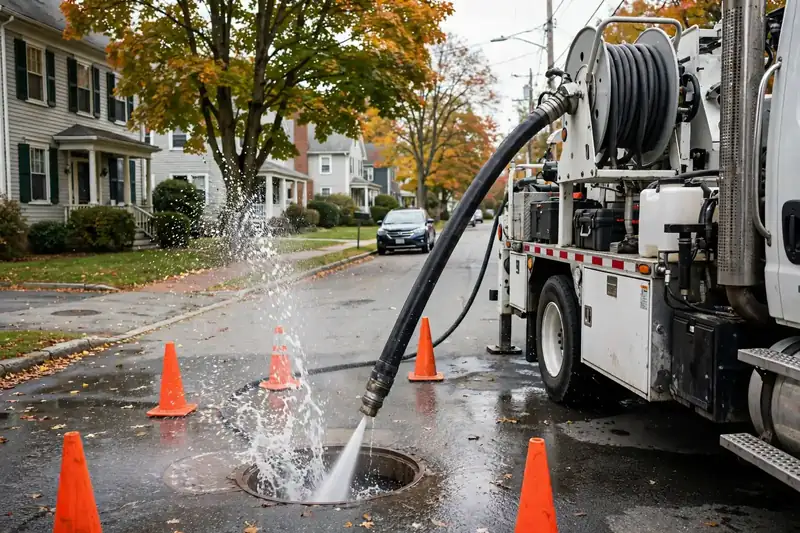
In short: Sewer line cleaning in Beverly, MA 01915 clears roots, grease, scale, and debris from your building sewer, restoring full flow. Call (833) 713-2101 — most cleanings finish in a single visit.
Signs Your Sewer Line Needs Cleaning
Cleaning addresses blockages, not broken pipe — and the signs are about flow, not structure. Drains throughout the house running slower than they used to, especially when several fixtures are affected together, suggest buildup narrowing the line. Toilets that gurgle when the washing machine drains, or a shower that fills while the toilet flushes, indicate a partial restriction downstream of the fixtures. Foul odors rising from drains point to decomposing buildup coating the pipe interior. Water backing up into a basement floor drain or a first-floor tub during heavy use is the advanced warning — the line is nearly closed and the next flush could finish the job. Outdoors, a cleanout cap that weeps or overflows during normal household use means the restriction is between the cleanout and the street. If these symptoms appeared gradually over months, cleaning is the likely answer; if they arrived suddenly after years of trouble-free service, a camera should check for structural causes first.
What Builds Up Inside Sewer Lines
Four materials do most of the clogging. Tree roots lead in Beverly — fine root hairs enter clay-tile joints seeking moisture, then thicken into mats that snag everything passing by. Grease is the kitchen's contribution: fats, oils, and grease cool as they travel, plating onto pipe walls in layers that narrow the bore month by month, then catch food solids and paper. Scale and mineral deposits roughen cast-iron interiors, creating the texture that snags debris and seeds blockages. Foreign objects complete the picture — so-called flushable wipes that do not break down, paper towels, hygiene products, and children's toys, all of which lodge at joints, offsets, or root masses and accumulate material until flow stops. In older lines these buildups compound: roots catch grease, grease catches paper, and the resulting mass hardens into something no plunger was ever going to move.
How Sewer Line Cleaning Works, Step by Step
Assessment and access
The technician locates the main cleanout and assesses the blockage's likely nature from your symptoms — root-related slowdowns feel different from grease chokes. If no cleanout exists, access may be through a pulled toilet or a newly installed cleanout, which also serves all future maintenance.
Mechanical clearing
A sectional cable machine feeds a rotating cable with the appropriate head — root-cutting blades for root masses, retrieving heads for objects — through the line. The technician feels the blockage through the cable: roots give a fibrous resistance, grease a slick drag, objects a hard stop. Multiple passes clear the full diameter.
Hydro jetting for thorough cleaning
Where buildup coats the pipe wall — grease, scale, sludge — high-pressure water jetting scours the interior back to the pipe surface. Different nozzles serve different jobs: penetrating nozzles open the initial path, flushing nozzles wash debris downstream, and descaling heads strip mineral buildup from cast iron.
Flow test and camera check
Fixtures are run to verify restored flow, and a camera pass confirms the line is clear — and reveals whether the blockage was merely buildup or a symptom of structural damage. If the camera shows broken pipe beneath the cleared debris, you will see it and hear the options before anyone leaves.
Equipment and Materials
Cleaning runs on two machine families. Sectional cable machines — the classic drain snake grown up — drive rotating cables with interchangeable heads: spiral root cutters that shred root masses, saw blades for heavy roots, retrievers for solid objects, and grease cutters for soft blockages. Cable diameter and head choice match the pipe: 4-inch residential laterals get different tooling than 6-inch commercial lines. Hydro jetters are the second family: truck or cart-mounted pumps delivering high-pressure water through hoses with specialized nozzles. Penetrating nozzles punch through the initial blockage; rotating nozzles scour the full circumference; descaling chains strip tuberculation from cast iron. Water does the cutting, so jetting cleans without the pipe-wall damage that aggressive mechanical work can cause on fragile old pipe. Camera equipment verifies results, and cleanout fittings — installed where none existed — make every future cleaning faster and cheaper.
Safety During Sewer Line Cleaning
Cleaning looks straightforward, but pressurized equipment and contaminated water demand discipline. Cable machines store enormous rotational energy — operators keep hands clear of the spinning cable, wear gloves and eye protection, and never force a bound cable, which can kink violently or break. Jetters operate at pressures that cut skin and inject water into tissue; nozzles are never pointed at people, hoses are inspected for wear, and the work zone is kept clear. Sewage exposure is managed with waterproof protective gear, and any backsplash during clearing is disinfected — wastewater is a biohazard, not just dirty water. Chemical drain cleaners already in the line are identified before work begins, because mixing pressurized jetting with caustic chemistry endangers the operator. Homeowners are asked to keep fixtures off during the work so the technician controls exactly what flows through the line being cleaned.
Local Factors: Cleaning North Shore Lines
Beverly's lines clean differently by neighborhood because they clog differently. Clay-tile laterals in Beverly Cove, North Beverly, Salem, and Goat Hill clog on root masses at the joints — root-cutting heads followed by jetting, on a recurring schedule, because the roots grow back until the joints are sealed by lining. Postwar Orangeburg in Peabody, Danvers, and Montserrat demands gentleness: aggressive cabling can damage already-deformed fiber pipe, so the camera often precedes the cable to confirm the pipe can take it. Grease-heavy lines near Beverly's restaurant corridors need jetting, not just cabling — a cable punches a hole through grease that reseals within weeks, while jetting scours the wall. Coastal infiltration complicates cleaning in Ryal Side and Beverly Point: water entering through joints during high-water periods can mask the true blockage location, so timing matters. And on septic-fed properties in Essex, Topsfield, and Wenham, cleaning stops at the tank — jetting a line into a full or failing tank solves nothing, so the tank's condition is confirmed first.
Frequently Asked Questions
How often should a sewer line be cleaned?
It depends on what clogs it. Lines with root intrusion at clay joints typically need clearing on a recurring cycle until the joints are sealed — the roots grow back. Grease-heavy lines need scheduled jetting. A line that stays clear for years after one cleaning probably just needed that one cleaning. The camera footage after your cleaning shows which pattern yours follows. Call (833) 713-2101 to discuss a schedule.
Will drain cleaning damage my old pipes?
Properly done, no — but method matters. Fragile Orangeburg and badly deteriorated clay need gentler approaches than sound cast iron or PVC, which is why the technician matches the tool to the pipe. When the camera shows a line too fragile for mechanical cleaning, you will hear about repair options instead of watching someone force a cable through it.
What's the difference between snaking and hydro jetting?
A cable machine (snake) punches through blockages and cuts roots — it restores flow. Hydro jetting scours the entire pipe wall with high-pressure water, removing grease, scale, and sludge that a cable leaves behind — it restores capacity. Grease and scale problems need jetting; root masses often need both, cable first then jetting.
Can you clean the line if there's no cleanout?
Usually, yes — through a pulled toilet or another access point. But a line without a cleanout is a line that is expensive to service every time, so installing one during the visit is often recommended. A proper cleanout at grade turns future cleanings into quick, affordable visits.
The line was cleaned last year and it's slow again — why?
Because cleaning removes the blockage, not its cause. Roots grow back through unsealed joints, grease re-plates on unjetted walls, and scale keeps accumulating. Recurring clogs within a year or two signal that the line needs diagnosis — a camera inspection — and likely a permanent fix like lining rather than another cleaning.
Do you clean commercial kitchen lines too?
Yes. Restaurant and food-service lines with heavy grease buildup are jetted on schedules matched to their volume, often during off-hours to avoid disrupting service. Grease-trap maintenance records are reviewed as part of the visit, since the trap and the line work as a system.
Sewer Line Problems Don’t Wait. Neither Should You.
Call now and reach a local sewer line specialist serving Beverly, MA and nearby North Shore communities — 24/7.
(833) 713-2101Free to call · No obligation · 24/7 emergency line