
Sewer Line Replacement in Beverly, MA
Collapsed, deformed, or chronically failing? Full sewer line replacement — trenchless bursting or open-cut, matched to your property — done right and verified on camera. Call (833) 713-2101.
- 24/7 emergency line
- Local North Shore specialists
- Camera inspection first
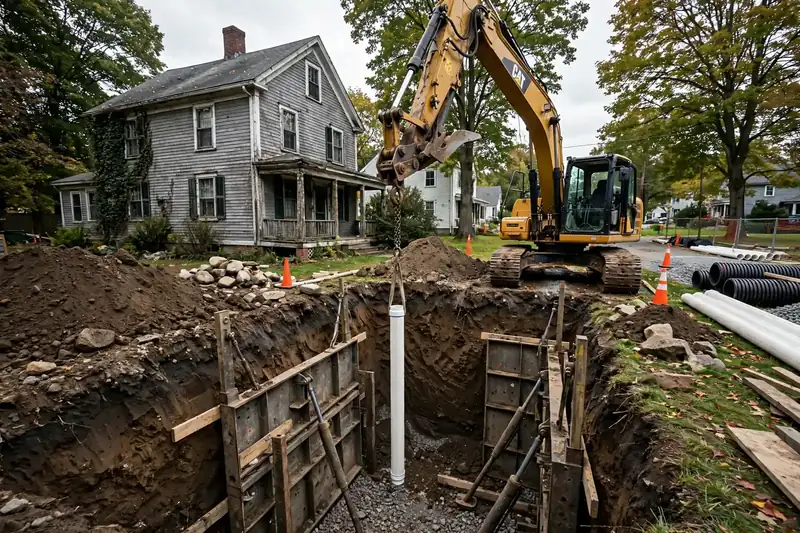
In short: Sewer line replacement in Beverly, MA 01915 becomes necessary when the old line is collapsed, severely deformed, or beyond lining. Call (833) 713-2101 for a camera inspection that shows whether trenchless or open-cut fits your property.
Signs the Line Needs Replacement, Not Repair
Replacement is the answer when the pipe itself is finished. A camera showing collapsed sections — where the bore is gone and soil intrudes — leaves no alternative; nothing lines or bursts a void. Orangeburg that has ovalized along most of its run cannot be restored to round, and spot fixes on deformed fiber pipe fail in sequence as each weakened section gives way. Clay tile with offsets at every joint, missing segments, or root intrusion so advanced the pipe wall is fractured, has crossed from repairable to replaceable. Chronic history matters too: a line that has needed emergency clearing twice a year for several years, with each camera showing progressive deterioration, is telling you the economics have flipped — continued rescue visits cost more than replacement within a few seasons. Back-to-back failures after heavy rain, where infiltration overwhelms the line every storm, signal systemic joint failure. When the camera shows the pipe's structure gone rather than merely damaged, replacement is the honest recommendation.
What Destroys a Sewer Line Beyond Repair
Total failure has total causes. Material lifespan is the quietest: clay tile lasts roughly a century, cast iron half that or less in aggressive soils, Orangeburg mere decades — and Beverly's housing stock includes lines at or past every one of those horizons. Ground movement finishes what age starts: frost heave rocking shallow laterals, settlement in coastal fill, saturated marsh soils creeping in Essex and Beverly Farms, and ledge-adjacent frost action in Gloucester and Marblehead. Root systems exploit every weakness for decades until the pipe is more root than wall. Surface loading crushes shallow lines under driveways, parking areas, and construction traffic — Orangeburg and thin-wall clay are especially vulnerable. Chemical attack, from harsh drain cleaners or industrial discharge, can dissolve pipe walls from within. And original installation defects — poor bedding that let the pipe settle into bellies, joints never properly sealed — doom some lines from the day they were buried. Replacement resets all of it: new pipe, proper bedding, correct grade, on a surveyed route.
How Sewer Line Replacement Works, Step by Step
Camera diagnosis and method selection
The full run is camera-inspected, located, and measured. The footage determines the method: pipe bursting where the old path is viable, open-cut where collapse, grade loss, or utility conflicts demand it. You see the evidence behind the recommendation.
Route design and permits
The replacement route is designed — usually the existing corridor for bursting, a surveyed new line for open-cut — with depth, grade, bedding, and connection details specified. Municipal permits and utility markouts are completed before equipment arrives.
Trenchless replacement by bursting
Where bursting fits: access pits at both ends, a bursting head fractures the old pipe outward while new fused HDPE pipe is pulled into its place — possibly upsized. Only the pits are excavated; the yard, driveway, and landscaping above the run stay intact.
Open-cut replacement where needed
Where bursting cannot go: the trench is opened on the designed line and grade, the failed pipe removed, new PVC laid on compacted stone bedding with laser-verified grade, and connections made to the building drain and municipal main or septic tank. The trench is backfilled in compacted lifts.
Testing, verification, restoration
The new line is tested per local requirements and camera-verified end to end — you watch the new pipe on the monitor. Surfaces are restored: loam and seed, pavement, hardscape. The property is left clean, with the footage on file.
Equipment and Materials
Replacement draws on the full arsenal. For bursting: hardened steel bursting heads sized to the old pipe, hydraulic pulling units with monitored force, and fused HDPE replacement pipe — jointless, root-proof, corrosion-proof — in diameters matching or upsizing the original. For open-cut: excavators sized to the trench, trench boxes and shoring for worker safety, laser levels holding grade to the design, and compaction equipment bedding the trench in lifts. New gravity pipe is SDR-35 or Schedule 40 PVC with gasketed or solvent-welded joints, laid on clean stone bedding with filter fabric where native soils would migrate. Connection fittings tie into the building drain and the municipal tap or septic tank inlet; cleanouts rise to grade at required intervals. Backfill is placed and compacted in lifts — the unglamorous step that prevents the settlement and bellies that doomed the old line. Every material is specified for buried decades in North Shore soil and water.
Safety During Replacement
Replacement is the most invasive sewer service, and its safety planning is the most thorough. Utility location precedes every excavation — gas, electric, water, communications marked, with the work planned around them. Trench safety is non-negotiable: shoring, sloping, or trench boxes for cuts beyond safe depth, spoil set back, ladders for egress, and a competent person inspecting daily. Bursting operations monitor pulling force against ratings and stop for camera investigation at any anomaly rather than forcing through unknown resistance. In saturated coastal soils, dewatering keeps trenches stable; in winter, frozen ground procedures govern. Work zones are barricaded and signed, neighbors notified when shared access is affected, and open excavations are never left unprotected overnight. Sewage exposure controls — protective equipment, disinfection, proper waste disposal — apply throughout, because the old line being removed is a biohazard until it is gone.
Local Factors: Replacement on the North Shore
Replacement decisions on the North Shore are shaped by what lies above and below. Above: the things you cannot trench through — Olmsted-era gardens in Prides Crossing, 300-year-old stone walls in Hamilton and Essex, mature street trees in Salem and Marblehead, condo common areas in Beverly Point, narrow historic streetscapes downtown. Bursting exists for exactly these properties, replacing the line along its old corridor with two pits instead of a trench. Below: ledge that makes open-cut brutal in Gloucester, Marblehead, and Swampscott, where bursting or carefully routed new lines avoid rock excavation; high groundwater that demands dewatering and watertight new pipe in coastal neighborhoods; frost-heave till inland that requires proper depth and bedding. Material history guides the recommendation: ovalized Orangeburg across Peabody's, Danvers', and Montserrat's postwar stock bursts beautifully; shattered clay in Salem's and Essex's antique districts may need open-cut where the path is lost. Shared laterals in multi-family conversions get located and untangled before anyone's line is replaced. And on septic-fed lots, replacement includes the tank connection and respects the disposal field — the new line serves the whole system, not just the house.
Frequently Asked Questions
How do I know if I need replacement instead of a repair?
The camera decides. Collapsed sections, pipe that has lost its shape along most of its run, missing segments, and chronic failures that keep returning after repairs all point to replacement. A line with isolated damage and sound pipe elsewhere usually repairs well. You will see the footage and hear the honest distinction — call (833) 713-2101 for the inspection that answers it.
Will replacement destroy my yard?
Not necessarily. Pipe bursting replaces the line underground through two small access pits, leaving the yard, driveway, and landscaping above the run intact — it is the right method for most replacements on landscaped or constrained properties. Open-cut is used only where the old path cannot be followed, and disturbed areas are restored afterward.
What pipe goes in during a replacement?
For bursting: fused HDPE, a continuous jointless pipe that roots cannot penetrate and corrosion cannot touch — optionally upsized. For open-cut: SDR-35 or Schedule 40 PVC on compacted stone bedding with verified grade. Both are modern materials specified for decades of buried service, a generational upgrade over the clay, cast iron, or Orangeburg they replace.
How long does a sewer line replacement take?
Bursting jobs often complete quickly once pits are dug — the pull itself is measured in hours. Open-cut timelines depend on trench length, depth, soil and rock, dewatering needs, and permit inspections. Most residential replacements finish in days. You will receive a realistic schedule with the written plan.
Can you replace only part of the line?
Sometimes. If the camera shows one failed section with sound pipe elsewhere, a partial replacement or spot repair may be the right scope — there is no need to replace a healthy line. But when deterioration is systemic — every joint offset, the full run deformed — partial work just schedules the next failure. The footage shows which case yours is.
Does replacement fix recurring root problems permanently?
Yes, when the new pipe is jointless. Roots enter through joints — clay bells, separated couplings — and a fused HDPE line or properly joined PVC gives them no entry point. That is the fundamental difference between repeatedly clearing roots from an old line and replacing the line roots were exploiting.
Sewer Line Problems Don’t Wait. Neither Should You.
Call now and reach a local sewer line specialist serving Beverly, MA and nearby North Shore communities — 24/7.
(833) 713-2101Free to call · No obligation · 24/7 emergency line