
Trenchless Sewer Repair in Beverly, MA
Fix the line without destroying the yard. Trenchless lining and pipe bursting repair Beverly sewer lines through small access points — ideal for ledge, historic districts, and landscaped lots. Call (833) 713-2101.
- 24/7 emergency line
- Local North Shore specialists
- Camera inspection first
In short: Trenchless sewer repair in Beverly, MA 01915 fixes or replaces sewer lines through small access points — lining for damaged-but-round pipe, bursting for deformed pipe. Call (833) 713-2101 for the camera inspection that determines which fits.
Signs Trenchless Repair Fits Your Problem
Trenchless methods suit lines that are failing underground but live beneath surfaces worth preserving. The classic trigger is a camera showing root-invaded clay joints, cracked pipe walls, or infiltration — with the pipe still round — running under a landscaped yard, a new driveway, a patio, or mature trees: lining renews that line without disturbing any of it. Deformed Orangeburg or offset clay that has lost its shape but kept its corridor points to bursting, which replaces the line along the same path through two small pits. Properties where open excavation is impractical or restricted make the strongest case: historic-district streetscapes in Marblehead and downtown Beverly, condo common areas in Beverly Point, Olmsted-era grounds in Prides Crossing, narrow lots in Salem and Goat Hill, and anywhere ledge sits shallow — Gloucester, Marblehead, Swampscott — where trenching means rock work. If digging up the surface would cost as much as the pipe repair — or is simply not allowed — trenchless deserves the first look, and the camera determines which of the two methods your line qualifies for.
What Trenchless Methods Fix — and What They Can't
The two trenchless methods divide the work by the pipe's condition. Pipe lining — cured-in-place pipe, or CIPP — repairs deterioration: root-invaded joints, fine cracks, minor offsets, infiltration, and corroded interiors, in any pipe that remains round and stable. The epoxy liner becomes a structural, jointless pipe inside the old one, sealing every defect along the lined run. Pipe bursting replaces destruction: ovalized Orangeburg, offset or separated clay, and collapsed sections where the corridor survives. The bursting head fractures the old pipe outward while pulling in fused HDPE — optionally upsized — through two access pits. What neither method fixes: a line that has lost its grade (bellies too deep to bridge), severe collapses with major soil voids where the path is gone, and corridors blocked by unmapped utility conflicts. Trenchless is powerful within its qualifications and honest about its limits — the camera draws the line between the two.
How Trenchless Repair Works, Step by Step
Camera inspection and method selection
The line is inspected, measured, and located end to end. Round and stable with joint or wall damage — lining. Deformed or collapsed with a viable path — bursting. Neither — open-cut. The footage makes the call, and you see it.
Cleaning and preparation
Roots are cut, grease and scale are jetted, and the line is cleared to its true wall. For lining, this step determines adhesion; for bursting, it clears the head's path. Preparation is never rushed — trenchless success is built here.
Lining: invert, cure, reinstate
A resin-saturated liner is inverted into the old pipe, pressed against the wall, and cured — by ambient, hot water, steam, or UV — into a hard structural pipe-within-a-pipe. Robotic cutters reopen every branch connection from inside, verified on camera.
Bursting: fracture and pull
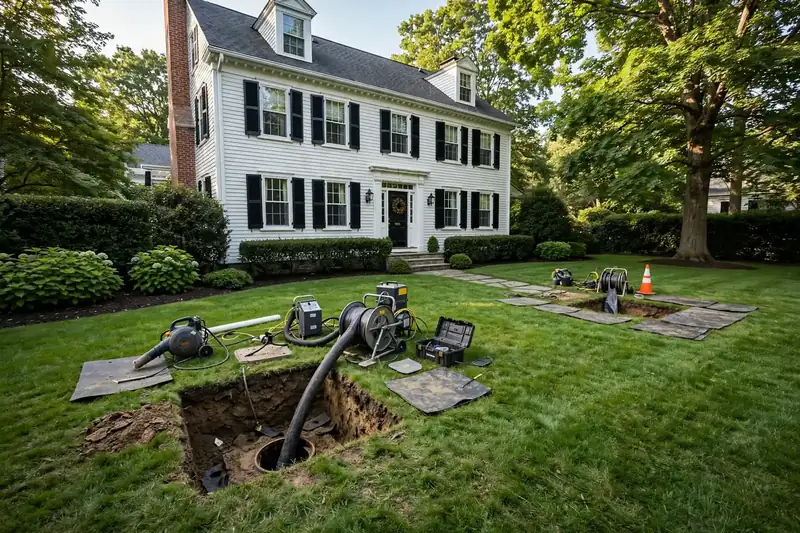
Access pits are dug at both ends, the bursting head is threaded through the old line with new fused HDPE pipe behind it, and hydraulic power pulls the assembly through — fracturing the old pipe outward while the new line takes its place.
Connection and final verification
The renewed line is connected to the building drain and the municipal main or septic tank, pits are backfilled and compacted, and a final camera pass verifies the finished work — smooth liner or clean new pipe, open branches, proper flow. You watch it happen.
Equipment and Materials
Trenchless work runs on specialized rigs. For lining: calibrated felt or fiberglass liners, two-part epoxy resins chosen for strength and chemical resistance, inversion equipment that drives the liner in under controlled pressure, curing systems — hot-water, steam, or UV light trains — and robotic reinstatement cutters that reopen branches with camera-guided precision. For bursting: hardened steel bursting heads sized to the existing pipe, hydraulic cable or rod pulling units with continuous force monitoring, and fused HDPE replacement pipe in seamless lengths — jointless, root-proof, corrosion-proof. Both methods share the diagnostic backbone: high-resolution cameras with locating sondes, jetters and descalers for preparation, and compaction equipment for restoring the small access points. The materials are modern and specified for decades; the equipment is precise because trenchless work happens blind — the camera and the instruments are the operator's eyes.
Safety During Trenchless Work
Working blind demands stricter procedure, not looser. Utility location precedes everything — bursting and lining both happen near gas, electric, water, and communications lines, which are marked and given safe separation in the plan. Bursting pull forces are monitored against equipment ratings, with work stopping for camera investigation at any anomaly rather than forcing through unknown resistance. Lining chemistry is handled with skin and respiratory protection during wet-out, ventilation at the work area, and rated, checked connections on heated curing circulation. UV systems add light-safety protocols. Access pits follow excavation safety — shoring or sloping, spoil set back, barricaded work zones. The line stays out of service during lining cure, and the household is briefed on exactly when fixtures return to normal. Compact work zones on tight North Shore lots are marked and secured, with neighbors notified when shared access is involved.
Local Factors: Going Trenchless on the North Shore
If any region was made for trenchless repair, it is this one. The constraints stack up: ledge in Gloucester, Marblehead, and Swampscott that makes open trenching brutally expensive; historic districts in downtown Beverly, Marblehead, and Salem where streetscapes cannot simply be opened; Olmsted-era gardens and specimen trees in Prides Crossing and Beverly Farms that no owner will sacrifice; condo common areas in Beverly Point and Swampscott requiring association approval for any disturbance; narrow lots and shared driveways in Goat Hill and Salem's conversions. The pipe stock cooperates too: Beverly's vast inventory of root-invaded but round clay tile — Beverly Cove, North Beverly, Ryal Side, Essex — is ideal lining territory, while the deformed Orangeburg of Peabody, Danvers, Montserrat, and Centerville is textbook bursting ground. Coastal groundwater, the area's constant companion, is sealed out by both methods' watertight results — lining's continuous epoxy barrier and bursting's jointless HDPE. The honest limits still apply: collapsed sections on Gloucester granite and lines that have lost grade need open-cut. But for most North Shore failures, trenchless is not the alternative to digging — it is the reason digging is unnecessary.
Frequently Asked Questions
How do I know if my line qualifies for trenchless repair?
A camera inspection determines it. Round, stable pipe with joint or wall damage qualifies for lining; deformed or collapsed pipe with a viable path qualifies for bursting. Lines that have lost grade or collapsed with major soil voids need open-cut. The footage shows which category yours falls in — call (833) 713-2101 for the inspection.
Is trenchless repair as durable as digging up and replacing the pipe?
It is a replacement or structural renewal by other means: lining creates a structural pipe-within-a-pipe, and bursting installs a brand-new fused HDPE line. Both are jointless and watertight — addressing the exact weaknesses (joints, corrosion, deformation) that destroyed the original. The final camera verification shows you the finished result.
How much of my property will be disturbed?
Far less than open-cut. Lining typically needs only existing cleanout access — no excavation at all. Bursting needs two small access pits at the ends of the run. Compare that with trenching the entire line through lawn, driveway, or garden, and the difference is why trenchless dominates on landscaped and constrained North Shore properties.
Can trenchless methods handle the ledge under my property?
Often, yes — and that is one of their biggest local advantages. Because lining works inside the existing pipe and bursting follows its corridor, neither requires excavating through the Cape Ann granite that makes open trenching in Gloucester, Marblehead, and Swampscott so expensive. Depth-to-ledge is still mapped during inspection to confirm the plan.
Will my drains be out of service during the work?
During lining's cure, the line stays out of service for hours — you will know the exact window beforehand. Bursting interruptions are similarly brief and scheduled. Either way the downtime is measured in hours on a planned day, not days of an open trench.
Why would anyone still choose traditional open-cut repair?
Because some failures demand it: collapsed sections with lost path, lines with severe grade problems, corridors with unmapped utility conflicts, and situations where the new route should differ from the old. An honest contractor recommends open-cut when the camera shows trenchless cannot succeed — the method follows the evidence.
Sewer Line Problems Don’t Wait. Neither Should You.
Call now and reach a local sewer line specialist serving Beverly, MA and nearby North Shore communities — 24/7.
(833) 713-2101Free to call · No obligation · 24/7 emergency line