
Tree Root Removal in Beverly, MA
Mature trees, old clay joints, and recurring clogs — Beverly's classic combination. Professional root cutting clears the mass, the camera maps every entry point, and you get a plan that ends the cycle. Call (833) 713-2101.
- 24/7 emergency line
- Local North Shore specialists
- Camera inspection first
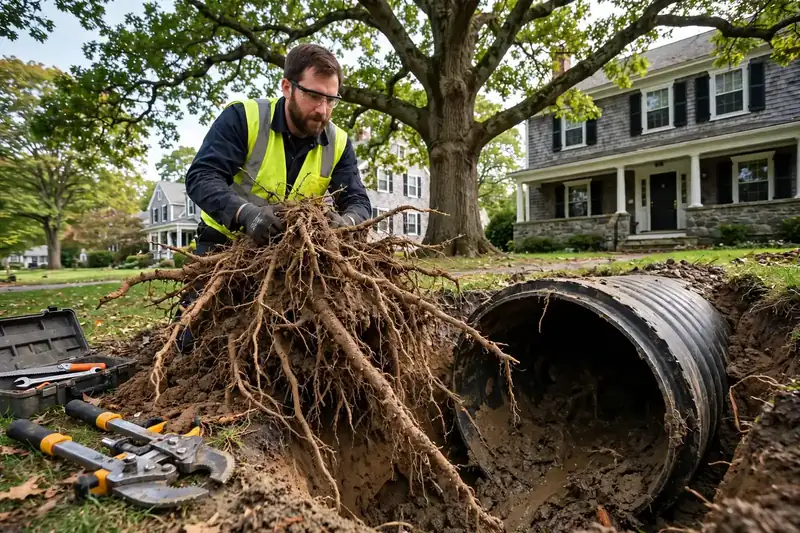
In short: Tree root removal in Beverly, MA 01915 cuts and clears root masses invading clay-tile joints, then verifies the line on camera. Call (833) 713-2101 — roots grow back until the joints are sealed, so the camera plan matters as much as the cutting.
Signs Roots Have Invaded Your Sewer Line
Root intrusion has a signature progression. It starts subtly: a toilet that gurgles occasionally, a drain that runs a little slower each month, a cleanout that needs attention every spring. Then the pattern sharpens — the same fixtures clogging on a seasonal cycle, worst during the growing season when roots actively seek moisture, easing in winter when growth pauses. A camera inspection makes the diagnosis unmistakable: fine white root hairs at a joint in the early stage, progressing to dense brown mats that fill the pipe and snag paper and solids. The location pattern matters too — root masses cluster at joints and at any crack, while the pipe barrel between joints stays relatively clear, which is exactly what the footage shows. If your home has mature trees within 30 feet of the sewer's path and the line is clay tile of any age, roots are the default suspect for recurring blockages until the camera proves otherwise.
How Roots Get In — and Why They Keep Coming
Roots do not break into sound pipe; they exploit weakness. A single root hair, finer than thread, follows moisture vapor escaping through a deteriorated clay-tile joint or a hairline crack. Once inside the nutrient-rich flow, it branches and thickens — and as it grows, it wedges the joint further open, admitting more roots in a self-reinforcing cycle. What began as a hair becomes a mat, and the mat becomes a dam that catches paper, grease, and solids until the line chokes. Beverly's canopy makes this cycle relentless: mature oaks, pines, and maples across Beverly Cove, Hamilton's estate woodlands, Salem's street trees, and the riverside willows of Ryal Side all send aggressive root systems toward the constant moisture of a sewer line. Clay tile is uniquely vulnerable because every joint is a potential entry; Orangeburg and cracked cast iron admit roots at their own failure points. Cutting removes the intrusion, but the entry points remain — which is why roots return on a predictable cycle until the joints are sealed by lining or the pipe is replaced.
How Tree Root Removal Works, Step by Step
Camera mapping of the intrusion
The line is camera-inspected to map every root entry point — which joints, how far the masses extend, and whether the pipe wall itself is damaged beneath the roots. This determines whether cutting suffices or the roots have fractured the pipe into a replacement case.
Mechanical root cutting
A sectional cable machine with root-cutting heads — spiral saws and blades sized to the pipe — is worked through each mass. The operator feels the cutting progress through the cable and makes multiple passes until the bore is clear. Heavy masses may require staged cutting from both directions.
Jetting the residue
High-pressure jetting flushes the cut root fragments downstream and scours the joint areas clean, so the camera can see the true condition of the pipe wall beneath. Skipping this step leaves fragments that seed the next blockage.
Post-clearing camera verification
The camera goes back in to verify full clearance and — critically — to assess the joints the roots entered through. Intact joints with minor intrusion get a monitoring plan; fractured or widely separated joints get a lining or replacement recommendation with footage to support it.
Long-term plan against regrowth
Because roots return, the visit ends with a plan: scheduled recutting intervals, a foaming root treatment to inhibit regrowth, or — the permanent answer — lining the line to seal every joint. You choose with full information.
Equipment and Materials
Root removal centers on cutting power matched to the pipe. Sectional cable machines drive root-cutting heads — spiral saws that shred masses, heavy-duty blades for established growth, sized so they clear the bore without gouging the pipe wall. Multiple cable passes, sometimes from both ends of the line, handle severe intrusions. Hydro jetters follow with high-pressure flushing: penetrating nozzles open the initial path through dense mats, rotating nozzles scour joint areas, and the water flow carries fragments out to the municipal main. Foaming root-control treatments may be applied after clearing — the foam fills the pipe, contacts the cut root ends at the joints, and inhibits regrowth for a season or more. Camera systems verify every stage, and where the post-clearing footage shows joints beyond saving, lining materials or bursting equipment stand ready for the permanent fix. The cutting tools are the immediate answer; the camera and the plan are the lasting one.
Safety During Root Removal
Root cutting combines the hazards of cable machines and jetters in one visit. Rotating cables under load demand the full discipline: gloves, eye protection, hands clear of the spinning cable, and no forcing a bound cutter — a stuck root saw stores energy that releases violently. Jetters add high-pressure water hazards: inspected hoses, controlled nozzles, clear work zones. Chemical root treatments, where used, are handled per their labeling — protective equipment during application, the line flushed as directed, and the household told exactly when normal use resumes. An important safety-adjacent note: never pour hardware-store root killer into a line on your own initiative without knowing the pipe's condition, because aggressive chemistry in a badly deteriorated line can worsen the damage. Professional application follows camera verification, not guesswork.
Local Factors: Roots on the North Shore
Beverly may be the North Shore's root-intrusion capital, because it pairs the region's oldest clay-tile laterals with its most mature canopy. Beverly Cove's shore oaks and pines on small lots hunt the same shallow moisture as the clay joints; Hamilton's estate woodlands send roots across 200-foot laterals; Salem's and Marblehead's street trees work century-old joints; Ryal Side's riverside willows and maples are famously aggressive. The growing season sets the calendar — intrusion accelerates spring through fall, which is why lines cleared in winter often clog again by the following autumn. Local soil matters: sandy coastal soils let roots travel fast toward the line, while till holds moisture that keeps roots active longer into the dry season. Properties where the sewer runs beneath specimen trees or historic landscaping — Prides Crossing's Olmsted-era grounds, Beverly Farms' wooded estates — face a choice between repeated cutting and lining, because removing the trees is not an option and the roots will not negotiate. The honest local advice: cut on schedule, treat to slow regrowth, and line when the camera shows the joints are done — that sequence has saved more North Shore yards than any other.
Frequently Asked Questions
Will cutting the roots damage my sewer pipe?
Properly done, cutting removes roots without harming sound pipe — the heads are sized to the bore and the operator works by feel. But cutting cannot fix what the roots broke: if the camera shows fractured or separated joints beneath the mass, those joints need lining or replacement, and cutting alone just schedules the next visit. Call (833) 713-2101 for a camera-mapped clearing.
How long before the roots grow back?
Typically one to three growing seasons, depending on the tree species, soil moisture, and how widely the joints have opened. Aggressive species near the line — willows, maples, oaks — regrow fastest. This predictable cycle is exactly why the visit ends with a long-term plan rather than just a clearing.
Can I just use chemical root killer myself?
Store-bought root killers can suppress regrowth temporarily, but they cannot clear an established mass — and in badly deteriorated pipe, harsh chemistry can worsen the damage. Professional foaming treatments are applied after mechanical clearing and camera verification, targeting the cut root ends at the joints. Chemistry follows the camera, not the other way around.
Do I need to remove the tree to stop root intrusion?
Rarely — and on North Shore properties with specimen trees or historic landscaping, removal is usually off the table. The practical answers are scheduled cutting, regrowth treatment, and ultimately lining the line to seal every joint. A sealed line and a standing tree coexist fine; it is the open joints that cannot coexist with roots.
Why do my drains clog every spring?
Because roots grow most aggressively in spring, sending new growth into the joints just as household water use rises. A line with known root intrusion that clogs each spring is following the classic cycle — scheduled pre-season clearing breaks it, and lining ends it.
Is root intrusion covered by homeowner's insurance?
Usually not as a maintenance matter — gradual root intrusion is considered wear and upkeep. Sudden damage caused by roots, like a collapse, may be treated differently depending on the policy. Keep your camera footage and service records; they document the line's history factually, which is what any coverage question turns on.
Sewer Line Problems Don’t Wait. Neither Should You.
Call now and reach a local sewer line specialist serving Beverly, MA and nearby North Shore communities — 24/7.
(833) 713-2101Free to call · No obligation · 24/7 emergency line