
Pipe Lining in Beverly, MA
A new pipe inside your old one — no trench through the yard, driveway, or garden. Cured-in-place lining seals roots, cracks, and leaking joints for good. Call (833) 713-2101 to see if your Beverly line qualifies.
- 24/7 emergency line
- Local North Shore specialists
- Camera inspection first
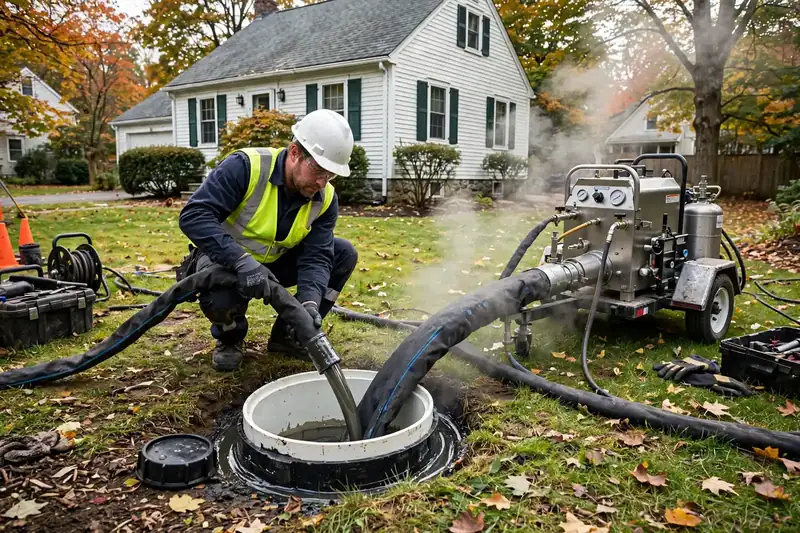
In short: Pipe lining in Beverly, MA 01915 installs a cured-in-place epoxy liner inside your existing sewer line through small access points. Call (833) 713-2101 for a camera inspection to confirm the old pipe is round and stable enough to line.
Signs Your Line Is a Lining Candidate
Lining fixes pipes that are damaged but still structurally coherent — and the signs reflect that. A camera inspection showing root intrusion at the joints, with the pipe barrel itself still round, is the textbook lining case: the liner bridges the joints and locks roots out permanently. Fine cracks along the pipe wall, minor offsets where segments have shifted slightly, and infiltration staining at the joints all respond well to lining, because the cured liner becomes a continuous structural pipe inside the old one. Recurring root blockages are the most common trigger in Beverly: homeowners in Beverly Cove, North Beverly, and Salem who have their clay lateral cleared every year or two are paying repeatedly for a problem lining solves once. Lines running under features you cannot bear to disturb — the Olmsted-era gardens of Prides Crossing, mature specimen trees in Hamilton, a new driveway in Centerville, condo common areas in Beverly Point — push strongly toward lining whenever the pipe qualifies. The deciding factor is always the camera: round and stable lines line beautifully; deformed or collapsed ones do not.
What Causes the Damage Lining Repairs
Lining addresses deterioration, not destruction. Clay-tile joints fail as their mortar and oakum packing age out, opening seams that admit roots and groundwater while the clay barrel remains intact — the perfect lining scenario. Cast iron corrodes from within, developing scale, tubercles, and pinholes while retaining its overall shape; a liner restores a smooth, sealed interior. Minor ground movement — frost heave nudging a joint, settlement under a coastal fill — creates small offsets that a structural liner bridges without excavation. Chemical attack from harsh drain cleaners or industrial discharge can etch pipe interiors, and lining covers the damaged surface with inert epoxy. What lining cannot fix is loss of shape: ovalized Orangeburg, fully collapsed sections, and bellies so deep the liner cannot hold grade all fall outside its capabilities, which is why honest qualification starts with measured camera footage rather than enthusiasm.
How Pipe Lining Works, Step by Step
Inspection and measurement
The line is camera-inspected and measured precisely — length, diameter, and the location of every branch connection. Lining is unforgiving of bad measurements: the liner is fabricated to the line's exact dimensions, and branch connections must be mapped so they can be reopened robotically afterward.
Thorough cleaning and descaling
Roots are cut, scale is removed, and grease is jetted until the camera shows the true pipe wall. Liner adhesion depends on a clean host pipe; this step is where lining jobs are won or lost, and it is never rushed.
Liner preparation and inversion
A felt or fiberglass liner is saturated with two-part epoxy resin, then inverted — turned inside out by air or water pressure — into the old pipe. Inversion presses the resin-saturated liner tightly against the host pipe wall along the entire run.
Curing
The resin cures into a hard, structural pipe-within-a-pipe. Depending on the system, curing uses ambient temperature, hot water, steam, or UV light. Cure times range from a few hours to under a day, during which the line stays out of service.
Branch reinstatement and final camera
A robotic cutter reopens each branch connection from inside the new liner, restoring flow to every fixture. A final camera pass verifies a smooth, continuous liner with open branches — and you watch it happen.
Equipment and Materials
Cured-in-place lining centers on the liner and resin system. The liner itself is a needle-punched felt or fiberglass tube, calibrated to the host pipe's diameter so it fits snugly without wrinkling. The resin — typically epoxy for its strength and chemical resistance — saturates the liner in a controlled wet-out process; resin choice matters because the cured liner must withstand wastewater chemistry, groundwater pressure, and soil loading for decades. Inversion equipment drives the liner in with calibrated air or water pressure, and calibration tubes or bladders hold it against the pipe wall during cure. Curing systems vary: hot-water and steam rigs circulate through the line, while UV systems pull a light train through for a fast, controlled cure. Robotic reinstatement cutters — small camera-guided milling heads — reopen branch connections with precision. Pre-lining, the same jetters, descalers, and root cutters used in cleaning prepare the host pipe; post-lining, the camera verifies every foot.
Safety During Pipe Lining
Lining chemistry demands respect. Two-part epoxy resins are handled with skin and respiratory protection during wet-out and inversion, and the work area is ventilated because uncured resin components are sensitizers. Hot-water and steam curing involve pressurized heated circulation — hoses are rated, connections are checked, and the work zone is kept clear of the equipment. UV curing adds light-safety protocols around the light train. As with all sewer work, confined-space rules govern any pit or manhole entry, and the line is kept out of service during cure so no wastewater contacts uncured resin. Homeowners are briefed on the cure timeline and when fixtures can return to normal use — using a drain too early can damage the liner before it hardens.
Local Factors: Lining on the North Shore
Lining is the historic-district-friendly answer for much of Beverly's oldest stock. Marblehead's 1850s antiques, Salem's McIntire-district Victorians, Essex's First Period farmhouses, and downtown Beverly's 19th-century blocks all sit on clay laterals under streets and lots where open excavation is impractical, restricted, or simply destructive — lining renews these lines without touching the streetscape. Coastal groundwater makes lining doubly valuable: the cured liner is a continuous watertight barrier, so the infiltration that plagued every clay joint in Beverly Cove, Ryal Side, Swampscott, and marsh-edge Essex stops at every lined foot. Where ledge makes digging brutal — Gloucester, Marblehead, Swampscott — lining avoids rock excavation entirely. The honest limits apply here too: lining cannot rescue the ovalized Orangeburg of Peabody's and Danvers' postwar subdivisions, nor collapsed sections sitting on Cape Ann granite. Qualification is everything, and qualification is what the camera is for.
Frequently Asked Questions
How long does a cured-in-place liner last?
A properly installed CIPP liner becomes a structural, jointless pipe inside the old one, resistant to roots, corrosion, and infiltration — the forces that damaged the original. Its smooth epoxy interior also resists scale and grease adhesion. The final camera verification shows you the finished liner's condition, and normal maintenance keeps it performing for decades. Call (833) 713-2101 to discuss whether your line qualifies.
Will lining reduce the diameter of my sewer line?
The liner adds a thin wall inside the existing pipe, so the internal diameter decreases slightly. In practice this rarely matters: the liner's smooth epoxy surface flows better than the old rough, scaled, or root-catch interior it covers, so hydraulic performance typically improves despite the marginally smaller diameter.
Can every branch connection be reopened after lining?
Yes — every mapped branch is reopened robotically from inside the cured liner with a camera-guided cutter. This is why precise pre-lining measurement matters: each connection's location is recorded during inspection so none is missed. The final camera pass confirms every branch flows.
How long will my drains be out of service during lining?
The line stays out of service during inversion and curing, typically a matter of hours depending on the curing method — UV systems cure fastest. You will be told the exact window before work begins and when each fixture can return to normal use. Planning the work for a convenient day keeps the interruption minor.
Is lining cheaper than digging up and replacing the line?
Cost comparisons depend on depth, length, surface features, and soil — but lining avoids the excavation, landscape restoration, driveway replacement, and street-work costs that dominate open-cut projects, especially on ledge or in historic districts. A camera inspection and a written plan let you compare real options for your property rather than generalities.
What happens if my line turns out not to qualify for lining?
Then you will hear so, with the footage to show why — deformed Orangeburg, collapsed sections, or lost grade all disqualify a line. The honest alternatives are pipe bursting, which replaces the line along the same path, or open-cut replacement where nothing else fits. Knowing lining won't work is valuable information, not a wasted inspection.
Sewer Line Problems Don’t Wait. Neither Should You.
Call now and reach a local sewer line specialist serving Beverly, MA and nearby North Shore communities — 24/7.
(833) 713-2101Free to call · No obligation · 24/7 emergency line