
Pipe Bursting in Danvers, MA
Danvers properties from the 01923 blocks to the far streets get pipe bursting from local specialists who understand North Shore soil, aging pipe, and tight lots. One call to (833) 713-2101 puts a plan in motion.
- 24/7 emergency line
- Camera-first diagnosis
- Trenchless options
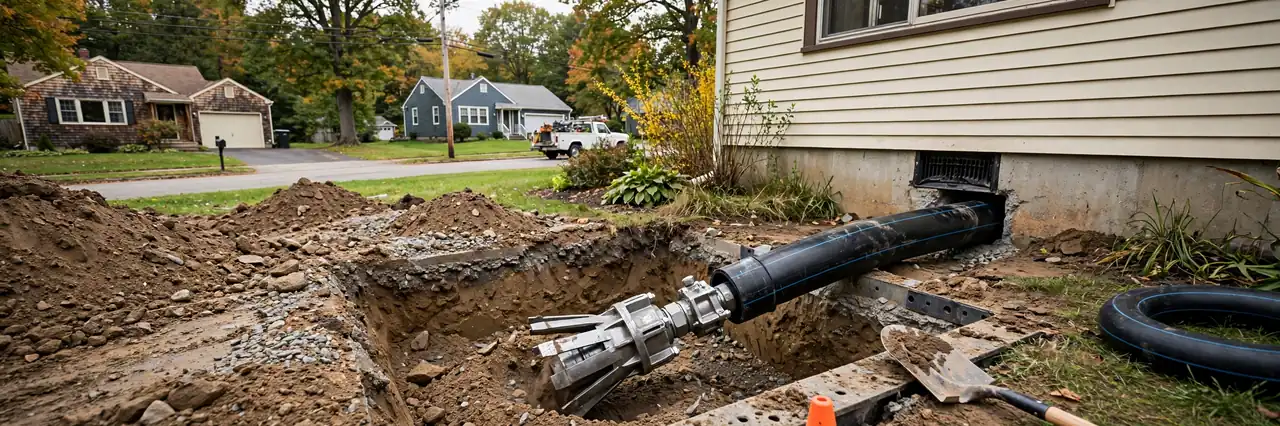
In short: Trenchless pipe replacement: a bursting head fractures the old pipe outward while pulling a new seamless HDPE pipe into its place, through two small access pits instead of an open trench. That is what pipe bursting means for Danvers, MA 01923 — a typical home built around 1960, blending 1880s–1900s Victorians with 1950s–80s suburban streets. Call (833) 713-2101 and the first step is a camera survey and utility locate of the failing line — no digging, no guessing, just a look inside the line.
Part of our pipe bursting coverage for the North Shore, this page focuses on Danvers, MA 01923. Find it via Services → Pipe Bursting, or through Areas → Danvers alongside our other work in town.
Pipe Bursting in Danvers, MA 01923: The Local Picture
Danvers (01923) is a place where pipe bursting rewards local knowledge. A typical home built around 1960, blending 1880s–1900s Victorians with 1950s–80s suburban streets. The 1950s–60s boom cohort carries Orangeburg risk, the pre-1940 stock leans clay tile and cast iron, and post-1980 homes run PVC — treat every line like a new subdivision pipe and you will recommend the wrong fix half the time.
That is why our approach in 01923 starts below the surface, not with a shovel. Full basements are common across all eras of Danvers housing. Inland glacial till and clay loams with scattered wetlands, and seasonal saturation near the Danvers River lowlands. A pipe bursting plan that ignores those two facts is a plan written for some other town.
How Danvers's Streets, Soil, and Pipe Eras Shape Pipe Bursting
The 1950s–60s boom cohort carries Orangeburg risk, the pre-1940 stock leans clay tile and cast iron, and post-1980 homes run PVC. Across Danvers — a typical home built around 1960, blending 1880s–1900s Victorians with 1950s–80s suburban streets — that era spread means two neighbors can need pipe bursting for opposite reasons: one fighting roots at clay joints, the other watching a fiber pipe ovalize.
Below grade, Danvers is demanding: inland glacial till and clay loams with scattered wetlands, and seasonal saturation near the Danvers River lowlands. Full basements are common across all eras of Danvers housing. For pipe bursting, that combination decides whether we are fighting infiltration, root mass, or both — and where the line can actually be reached.
With the typical home built in 1960 and a quarter of stock pre-1940, Danvers straddles both failure modes: collapsing Orangeburg on the 1950s–70s subdivisions and root-invaded clay on the older village stock — the fix path (bursting vs. lining vs. spot repair) is entirely era-dependent, so camera inspection here is really 'find out which era your pipe is'. If you live near the Route 128/I-95 and US 1 corridors, Danversport waterfront, Endicott Park and Routes 1A, 35 and 62 toward Beverly and Salem, that description probably sounds familiar — it is the reason pipe bursting in Danvers starts with diagnosis, not excavation.
Our Pipe Bursting Process in Danvers
Every pipe bursting job we run in Danvers, MA 01923 follows the same five phases below. The methods are standard; the judgment calls — where to dig, what to expect underground — are pure Danvers.
Camera survey and utility locate
Camera survey and utility locate. This is where Danvers's specifics enter the job: a camera survey plus a utility locate, because bursting a Danvers line demands knowing exactly what is in the ground in 01923 first. Done right, this phase makes the rest of pipe bursting in 01923 straightforward.
Dig two small access pits
Dig two small access pits. Two small access pits dug at the ends of the run — the only excavation a Danvers yard sees during the whole job. That is how this phase plays out during pipe bursting in Danvers — shaped by 01923's pipe eras and ground conditions rather than a generic checklist.
Burst the old pipe, pull the new one
Burst the old pipe, pull the new one. In Danvers, this phase of pipe bursting means the bursting head fracturing the old Danvers pipe outward while new seamless HDPE follows it through the same bore. For a 01923 property, that step sets up everything after it — skip it and the rest of the job is guesswork.
Reconnect and seal the ends
Reconnect and seal the ends. For pipe bursting in Danvers, expect this phase to account for local reality: reconnection at both ends with sealed, code-minded joints tying the new 01923 line into the existing system. 01923 properties reward crews that adapt here instead of rushing through.
Backfill, compact and flow-test
Backfill, compact and flow-test. Backfill, compaction, and a flow test proving the new Danvers line drains clean before the pits are restored. That is how this phase plays out during pipe bursting in Danvers — shaped by 01923's pipe eras and ground conditions rather than a generic checklist.
Pipe Bursting in 01923: The Local Variables
Three local factors change pipe bursting quotes and timelines in Danvers more than anything else. First, access: shared access and close-set homes around Danvers's older blocks. Second, the pipe era — the 1950s–60s boom cohort carries Orangeburg risk, the pre-1940 stock leans clay tile and cast iron, and post-1980 homes run PVC — which decides the method. Third, groundwater: inland glacial till and clay loams with scattered wetlands, and seasonal saturation near the Danvers River lowlands. In 01923, a crew that prices without seeing all three is pricing blind.
Season matters too. inland New England freeze-thaw with winter lows near 20°F and heavy nor'easter snow loads In Danvers, the smartest pipe bursting scheduling happens before the ground freezes or the spring melt arrives — the camera sees more, the soil cooperates, and the fix cures the way it should.
Frequently Asked Questions
Will pipe bursting destroy my Danvers yard or driveway?
That is the point of the method: no open trench. In Danvers, pipe bursting for a 01923 home needs only two small access pits — the new pipe travels the old pipe's path underground. Landscaping, driveways, and walkways stay intact, which matters on Danvers's established lots. Call (833) 713-2101 to see if your line qualifies.
Can you burst under my Danvers driveway or patio?
Yes, provided the camera shows a burstable host pipe. Bursting under Danvers driveways and patios is routine in 01923: the bore already exists, so the surface never opens. Call (833) 713-2101 — one inspection answers it.
What does Danvers's housing stock mean for pipe bursting?
Everything: a typical home built around 1960, blending 1880s–1900s Victorians with 1950s–80s suburban streets, and the 1950s–60s boom cohort carries Orangeburg risk, the pre-1940 stock leans clay tile and cast iron, and post-1980 homes run PVC. Pipe Bursting in Danvers is era-dependent work, which is why the first visit to a 01923 home is diagnostic. Two houses on the same street can need opposite fixes, and only the footage tells them apart. Call (833) 713-2101 to find out which era your line belongs to.
How long does the new pipe last after bursting in Danvers?
HDPE is jointless and root-proof at the seams because there are no seams — the exact weakness that fails Danvers's older pipe. For 01923 — inland glacial till and clay loams — that is a durable match. Call (833) 713-2101 for an honest assessment of your line.
How do Danvers's soil and groundwater conditions affect pipe bursting?
Inland glacial till and clay loams with scattered wetlands, and seasonal saturation near the Danvers River lowlands — and that shapes pipe bursting in Danvers from the first visit. Groundwater finds every failed joint, and roots follow the moisture straight to the pipe. Our 01923 approach pairs the camera footage with that ground reality, so the repair targets the actual failure instead of the symptom. Call (833) 713-2101 and the diagnosis starts from the soil up.
Are there digging or access constraints for pipe bursting in Danvers?
With the typical home built in 1960 and a quarter of stock pre-1940, Danvers straddles both failure modes: collapsing Orangeburg on the 1950s–70s subdivisions and root-invaded clay on the older village stock — the fix path (bursting vs. lining vs. spot repair) is entirely era-dependent, so camera inspection here is really 'find out which era your pipe is'. For pipe bursting in Danvers, those constraints rule out the 'just trench it' reflex. Our 01923 jobs are planned around the property's actual limits — access pits instead of open trenches, liners instead of excavations — and the camera survey at the start maps precisely where work can happen.
Area Facts
- ZIP code
- 01923
- Housing stock
- a typical home built around 1960, blending 1880s–1900s Victorians with 1950s–80s suburban streets
- Typical pipe eras
- the 1950s–60s boom cohort carries Orangeburg risk, the pre-1940 stock leans clay tile and cast iron, and post-1980 homes run PVC
- Soil & drainage
- inland glacial till and clay loams with scattered wetlands, and seasonal saturation near the Danvers River lowlands
- Basements
- full basements are common across all eras of Danvers housing
- Landmarks & routes
- the Route 128/I-95 and US 1 corridors, Danversport waterfront, Endicott Park and Routes 1A, 35 and 62 toward Beverly and Salem
More on Pipe Bursting in Danvers, MA
Pipe Bursting in Downtown Beverly, MA
Comparing neighborhoods? Our pipe bursting guide for Downtown Beverly, MA 01915 shows how the work changes a few streets over.
Learn morePipe Bursting
The complete pipe bursting service guide our Danvers (01923) crews work from — when it applies, when it does not, and what it costs in disruption.
Learn moreSewer Line Problems Don’t Wait. Neither Should You.
Call now and reach a local sewer line specialist serving Beverly, MA and nearby North Shore communities — 24/7.
(833) 713-2101Free to call · No obligation · 24/7 emergency line
Serving Danvers, MA 01923