
Pipe Bursting in Gloucester, MA
Slow drains, sewage odors, or soggy patches in Gloucester? Our 01930 crew handles pipe bursting for homes like yours every week. Call (833) 713-2101 for a straight answer about your line.
- 24/7 emergency line
- Camera-first diagnosis
- Trenchless options
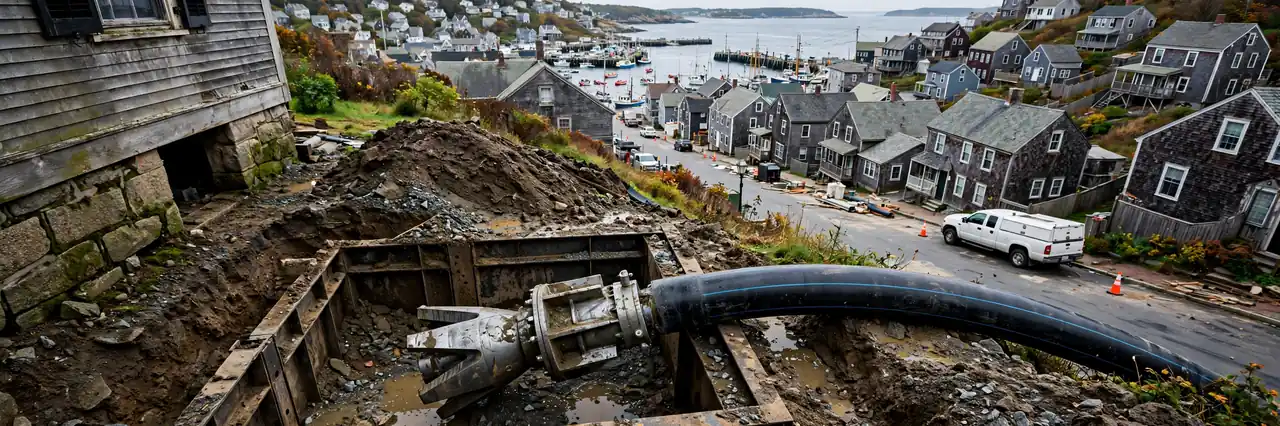
In short: Pipe Bursting is trenchless pipe replacement: a bursting head fractures the old pipe outward while pulling a new seamless HDPE pipe into its place, through two small access pits instead of an open trench. In Gloucester, MA 01930 — where a median home age of 74 years — 1900s fishing-port housing, dense 2–4 family stock and coastal neighborhoods from Magnolia to East Gloucester — the first step when you call (833) 713-2101 is a camera survey and utility locate of the failing line, so the repair plan matches the actual pipe, soil, and access on your property.
This pipe bursting guide covers Gloucester, MA 01930. Browse it two ways: Services → Pipe Bursting for the service itself, or Areas → Gloucester for everything we do in this community.
Why Gloucester Homes Need Pipe Bursting Done Differently
Pipe Bursting in Gloucester, MA 01930 has to fit the neighborhood: a median home age of 74 years — 1900s fishing-port housing, dense 2–4 family stock and coastal neighborhoods from Magnolia to East Gloucester. Dominantly pre-war stock keeps clay-tile laterals with cast-iron DWV, mid-century infill adds cast iron and Orangeburg, and dense conversions mean shared or closely spaced laterals, so the first question on every call is never 'how fast can we dig' but 'what is actually in the ground here.'
Before method comes mapping in Gloucester (01930). Full basements are typical, with stone and brick foundations under the oldest homes, which decides where we can access the line — and Cape Ann granite bedrock exposed at the surface, thin discontinuous glacial till over bedrock, and terminal-moraine boulder fields — the hardest digging in the service area, which decides how water and roots are already attacking it. Pipe Bursting here is a site-reading exercise first.
The Gloucester Ground Truth Behind Pipe Bursting
A median home age of 74 years — 1900s fishing-port housing, dense 2–4 family stock and coastal neighborhoods from Magnolia to East Gloucester — and dominantly pre-war stock keeps clay-tile laterals with cast-iron DWV, mid-century infill adds cast iron and Orangeburg, and dense conversions mean shared or closely spaced laterals. In Gloucester, the 'age of the house ≈ age of the pipe' rule holds more often than not, so a pipe bursting visit usually starts by confirming which generation of pipe is actually in the ground.
The ground in Gloucester does not forgive old pipe: Cape Ann granite bedrock exposed at the surface, thin discontinuous glacial till over bedrock, and terminal-moraine boulder fields — the hardest digging in the service area. Full Atlantic exposure — nor'easters, sea spray, 47 inches of annual precipitation, and freeze-thaw plus salt air that corrodes exposed cast iron. Any pipe bursting plan in 01930 has to be built for that ground, not for ideal conditions.
Put it together and Gloucester's signature looks like this: Gloucester is the ledge capital of the service area: clay laterals laid in thin soil over exposed Cape Ann granite, with frost heave rocking shallow pipes against immovable bedrock and roots exploiting every joint in the thin till — open-trench replacement is brutally expensive rock excavation, which makes trenchless bursting or lining economically decisive, and camera inspection must map depth-to-ledge because a collapsed section sitting on granite can't be re-graded, only replaced or lined. That is the pattern our crews watch for along the Route 128 northern terminus, the Route 127 coastal loop, Gloucester Harbor, Good Harbor Beach, Stage Fort Park and Dogtown Common whenever pipe bursting comes up.
How Pipe Bursting Works in Gloucester, MA 01930
Here is how pipe bursting typically unfolds for a Gloucester property in 01930 — the same five phases every time, adapted to local pipe eras, soil, and access.
Camera survey and utility locate
Camera survey and utility locate. For pipe bursting in Gloucester, expect this phase to account for local reality: a camera survey plus a utility locate, because bursting a Gloucester line demands knowing exactly what is in the ground in 01930 first. 01930 properties reward crews that adapt here instead of rushing through.
Dig two small access pits
Dig two small access pits. In Gloucester, this phase of pipe bursting means two small access pits dug at the ends of the run — the only excavation a Gloucester yard sees during the whole job. For a 01930 property, that step sets up everything after it — skip it and the rest of the job is guesswork.
Burst the old pipe, pull the new one
Burst the old pipe, pull the new one. The bursting head fracturing the old Gloucester pipe outward while new seamless HDPE follows it through the same bore. That is how this phase plays out during pipe bursting in Gloucester — shaped by 01930's pipe eras and ground conditions rather than a generic checklist.
Reconnect and seal the ends
Reconnect and seal the ends. In Gloucester, this phase of pipe bursting means reconnection at both ends with sealed, code-minded joints tying the new 01930 line into the existing system. For a 01930 property, that step sets up everything after it — skip it and the rest of the job is guesswork.
Backfill, compact and flow-test
Backfill, compact and flow-test. This is where Gloucester's specifics enter the job: backfill, compaction, and a flow test proving the new Gloucester line drains clean before the pits are restored. Done right, this phase makes the rest of pipe bursting in 01930 straightforward.
Pipe Bursting in 01930: The Local Variables
Three local factors change pipe bursting quotes and timelines in Gloucester more than anything else. First, access: shared access and close-set homes around Gloucester's older blocks. Second, the pipe era — dominantly pre-war stock keeps clay-tile laterals with cast-iron DWV, mid-century infill adds cast iron and Orangeburg, and dense conversions mean shared or closely spaced laterals — which decides the method. Third, groundwater: Cape Ann granite bedrock exposed at the surface, thin discontinuous glacial till over bedrock, and terminal-moraine boulder fields — the hardest digging in the service area. In 01930, a crew that prices without seeing all three is pricing blind.
Season matters too. full Atlantic exposure — nor'easters, sea spray, 47 inches of annual precipitation, and freeze-thaw plus salt air that corrodes exposed cast iron In Gloucester, the smartest pipe bursting scheduling happens before the ground freezes or the spring melt arrives — the camera sees more, the soil cooperates, and the fix cures the way it should.
Frequently Asked Questions
What does Gloucester's housing stock mean for pipe bursting?
Everything: a median home age of 74 years — 1900s fishing-port housing, dense 2–4 family stock and coastal neighborhoods from Magnolia to East Gloucester, and dominantly pre-war stock keeps clay-tile laterals with cast-iron DWV, mid-century infill adds cast iron and Orangeburg, and dense conversions mean shared or closely spaced laterals. Pipe Bursting in Gloucester is era-dependent work, which is why the first visit to a 01930 home is diagnostic. Two houses on the same street can need opposite fixes, and only the footage tells them apart. Call (833) 713-2101 to find out which era your line belongs to.
How long does the new pipe last after bursting in Gloucester?
Decades: the new HDPE line has no joints, so the root-intrusion cycle that destroys Gloucester's clay and fiber pipe cannot restart. In 01930, that jointless design directly answers the local ground conditions. (833) 713-2101 to confirm your line is a candidate.
Are there digging or access constraints for pipe bursting in Gloucester?
Often yes, and they are local: Gloucester is the ledge capital of the service area: clay laterals laid in thin soil over exposed Cape Ann granite, with frost heave rocking shallow pipes against immovable bedrock and roots exploiting every joint in the thin till — open-trench replacement is brutally expensive rock excavation, which makes trenchless bursting or lining economically decisive, and camera inspection must map depth-to-ledge because a collapsed section sitting on granite can't be re-graded, only replaced or lined. In 01930, that is exactly why pipe bursting leans trenchless — camera, locate, and minimal-dig methods that respect tight lots, mature landscaping, and shared access. Call (833) 713-2101 and we will map what your property allows before proposing anything.
Can you burst under my Gloucester driveway or patio?
Usually yes — that is where bursting earns its keep. The new pipe follows the old pipe's bore under the 01930 driveway or patio with no surface demolition. In Gloucester — a median home age of 74 years — saving the hardscape is often the deciding factor. Call (833) 713-2101 and the camera will map the crossing.
How do Gloucester's soil and groundwater conditions affect pipe bursting?
Cape Ann granite bedrock exposed at the surface, thin discontinuous glacial till over bedrock, and terminal-moraine boulder fields — the hardest digging in the service area — and that shapes pipe bursting in Gloucester from the first visit. Groundwater finds every failed joint, and roots follow the moisture straight to the pipe. Our 01930 approach pairs the camera footage with that ground reality, so the repair targets the actual failure instead of the symptom. Call (833) 713-2101 and the diagnosis starts from the soil up.
Will pipe bursting destroy my Gloucester yard or driveway?
The whole appeal is minimal digging: two access pits, and the 01930 property's surface stays essentially untouched. For Gloucester homes with mature landscaping or long driveways, bursting beats open-trench replacement on restoration alone. Call (833) 713-2101 — the camera decides in one visit.
Area Facts
- ZIP code
- 01930
- Housing stock
- a median home age of 74 years — 1900s fishing-port housing, dense 2–4 family stock and coastal neighborhoods from Magnolia to East Gloucester
- Typical pipe eras
- dominantly pre-war stock keeps clay-tile laterals with cast-iron DWV, mid-century infill adds cast iron and Orangeburg, and dense conversions mean shared or closely spaced laterals
- Soil & drainage
- Cape Ann granite bedrock exposed at the surface, thin discontinuous glacial till over bedrock, and terminal-moraine boulder fields — the hardest digging in the service area
- Basements
- full basements are typical, with stone and brick foundations under the oldest homes
- Landmarks & routes
- the Route 128 northern terminus, the Route 127 coastal loop, Gloucester Harbor, Good Harbor Beach, Stage Fort Park and Dogtown Common
Related Pipe Bursting Resources for Gloucester
Gloucester, MA
Your Gloucester, MA 01930 home base for sewer work: pipe bursting plus the full service lineup, area facts, and how Gloucester's pipe eras change each job.
Learn morePipe Bursting in Goat Hill, MA
See how pipe bursting plays out next door in Goat Hill, MA 01915 — same service, different ground, different pipe eras.
Learn moreSewer Line Problems Don’t Wait. Neither Should You.
Call now and reach a local sewer line specialist serving Beverly, MA and nearby North Shore communities — 24/7.
(833) 713-2101Free to call · No obligation · 24/7 emergency line
Serving Gloucester, MA 01930