
Pipe Bursting in Peabody, MA
Pipe Bursting in Peabody starts with knowing what is actually wrong underground. Our 01960 specialists camera the line, map it to the inch, and recommend the least invasive fix that fits the property — call (833) 713-2101 to get started.
- 24/7 emergency line
- Camera-first diagnosis
- Trenchless options
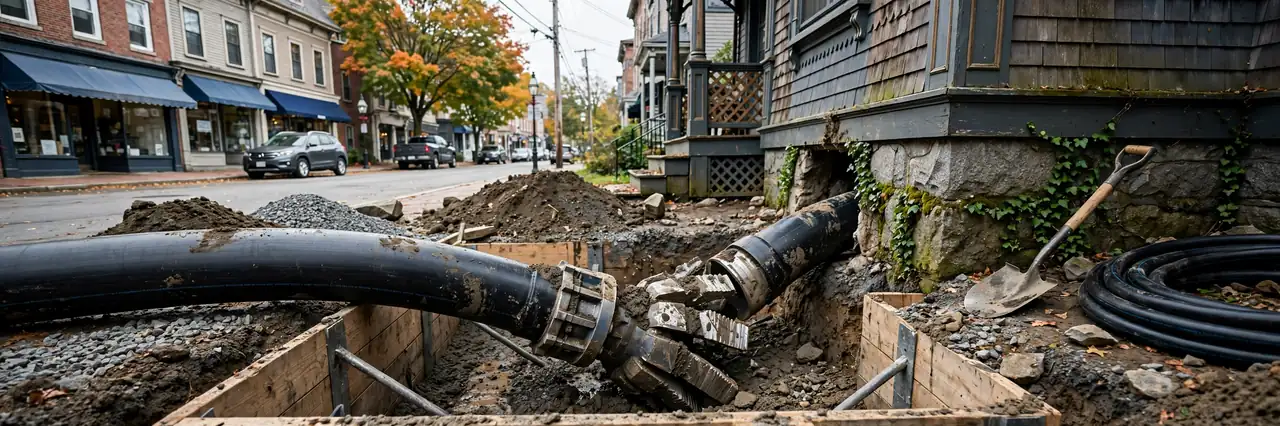
In short: For Peabody homes (01960), pipe bursting means trenchless pipe replacement: a bursting head fractures the old pipe outward while pulling a new seamless HDPE pipe into its place, through two small access pits instead of an open trench. A median year built of 1966 — 1880s–1920s in-town housing, 1960 split-entry suburbia and 1988-plus custom colonials. Every job begins the same way: call (833) 713-2101 and we start with a camera survey and utility locate of the failing line before recommending anything.
Part of our pipe bursting coverage for the North Shore, this page focuses on Peabody, MA 01960. Find it via Services → Pipe Bursting, or through Areas → Peabody alongside our other work in town.
Why Peabody Homes Need Pipe Bursting Done Differently
Homeowners in Peabody (01960) call about pipe bursting for the same symptoms everywhere — slow drains, gurgling fixtures, bad smells — but the causes track the local housing: a median year built of 1966 — 1880s–1920s in-town housing, 1960 split-entry suburbia and 1988-plus custom colonials. The big 1950s–70s suburban cohort makes Orangeburg and cast iron the prime risks, while pre-1940 in-town stock leans clay tile and cast iron, and that history shapes every recommendation.
Two things define pipe bursting in Peabody (01960) before anyone talks methods: full basements are common, from partially finished 1920s basements to full unfinished 1980s lower levels, and glacial till over Peabody Granite bedrock — same granite family as Cape Ann — with seasonal wetness in low spots near the North River. Get those wrong and even the right repair technique lands in the wrong place.
How Peabody's Streets, Soil, and Pipe Eras Shape Pipe Bursting
The big 1950s–70s suburban cohort makes Orangeburg and cast iron the prime risks, while pre-1940 in-town stock leans clay tile and cast iron. Across Peabody — a median year built of 1966 — 1880s–1920s in-town housing, 1960 split-entry suburbia and 1988-plus custom colonials — that era spread means two neighbors can need pipe bursting for opposite reasons: one fighting roots at clay joints, the other watching a fiber pipe ovalize.
Below grade, Peabody is demanding: glacial till over Peabody Granite bedrock — same granite family as Cape Ann — with seasonal wetness in low spots near the North River. Full basements are common, from partially finished 1920s basements to full unfinished 1980s lower levels. For pipe bursting, that combination decides whether we are fighting infiltration, root mass, or both — and where the line can actually be reached.
Peabody's 1966-median stock makes it Orangeburg ground zero: thousands of 1950s–70s split-entries and ranches whose fiber-conduit laterals are ovalizing under root pressure and soil movement, while the in-town Victorians add clay-tile root intrusion — two different pipe failures, one symptom (slow drains plus sewage smell), and only a camera tells them apart: sell the inspection as the diagnostic that decides between bursting (Orangeburg) and lining (clay). If you live near where Route 128/I-95 meets Route 1, Lowell St and Lynn St, the Northshore Mall corridor, Brown's Pond and Brooksby Farm, that description probably sounds familiar — it is the reason pipe bursting in Peabody starts with diagnosis, not excavation.
Our Pipe Bursting Process in Peabody
Every pipe bursting job we run in Peabody, MA 01960 follows the same five phases below. The methods are standard; the judgment calls — where to dig, what to expect underground — are pure Peabody.
Camera survey and utility locate
Camera survey and utility locate. This is where Peabody's specifics enter the job: a camera survey plus a utility locate, because bursting a Peabody line demands knowing exactly what is in the ground in 01960 first. Done right, this phase makes the rest of pipe bursting in 01960 straightforward.
Dig two small access pits
Dig two small access pits. Two small access pits dug at the ends of the run — the only excavation a Peabody yard sees during the whole job. That is how this phase plays out during pipe bursting in Peabody — shaped by 01960's pipe eras and ground conditions rather than a generic checklist.
Burst the old pipe, pull the new one
Burst the old pipe, pull the new one. In Peabody, this phase of pipe bursting means the bursting head fracturing the old Peabody pipe outward while new seamless HDPE follows it through the same bore. For a 01960 property, that step sets up everything after it — skip it and the rest of the job is guesswork.
Reconnect and seal the ends
Reconnect and seal the ends. In Peabody, this phase of pipe bursting means reconnection at both ends with sealed, code-minded joints tying the new 01960 line into the existing system. For a 01960 property, that step sets up everything after it — skip it and the rest of the job is guesswork.
Backfill, compact and flow-test
Backfill, compact and flow-test. On Peabody homes, pipe bursting lives or dies at this stage: backfill, compaction, and a flow test proving the new Peabody line drains clean before the pits are restored. It is unglamorous, but in 01960 it is the difference between a one-visit fix and a callback.
Pipe Bursting in 01960: The Local Variables
In Peabody, pipe bursting estimates hinge on access, pipe era, and water. Access first: shared access and close-set homes around Peabody's older blocks Then the pipe: the big 1950s–70s suburban cohort makes Orangeburg and cast iron the prime risks, while pre-1940 in-town stock leans clay tile and cast iron Then the ground: glacial till over Peabody Granite bedrock — same granite family as Cape Ann — with seasonal wetness in low spots near the North River. Any 01960 plan missing one of those three is a guess wearing a work order.
One more Peabody reality: inland freeze-thaw with winter lows near 20°F and frost heave working against shallow laterals Plan pipe bursting around that cycle in 01960 and everything downstream — diagnosis, access, restoration — gets easier.
Frequently Asked Questions
Will pipe bursting destroy my Peabody yard or driveway?
The whole appeal is minimal digging: two access pits, and the 01960 property's surface stays essentially untouched. For Peabody homes with mature landscaping or long driveways, bursting beats open-trench replacement on restoration alone. Call (833) 713-2101 — the camera decides in one visit.
How do Peabody's soil and groundwater conditions affect pipe bursting?
Directly: glacial till over Peabody Granite bedrock — same granite family as Cape Ann — with seasonal wetness in low spots near the North River. For pipe bursting in Peabody, that means the crew expects infiltration at weak joints, root systems hunting moisture, and access planning that respects a high or variable water table. In 01960, the camera survey is scheduled and interpreted with those ground conditions in mind — what looks like a minor joint offset on dry ground reads very differently in saturated soil.
How long does the new pipe last after bursting in Peabody?
HDPE is jointless and root-proof at the seams because there are no seams — the exact weakness that fails Peabody's older pipe. For 01960 — glacial till over Peabody Granite bedrock — that is a durable match. Call (833) 713-2101 for an honest assessment of your line.
Are there digging or access constraints for pipe bursting in Peabody?
Peabody's 1966-median stock makes it Orangeburg ground zero: thousands of 1950s–70s split-entries and ranches whose fiber-conduit laterals are ovalizing under root pressure and soil movement, while the in-town Victorians add clay-tile root intrusion — two different pipe failures, one symptom (slow drains plus sewage smell), and only a camera tells them apart: sell the inspection as the diagnostic that decides between bursting (Orangeburg) and lining (clay). For pipe bursting in Peabody, those constraints rule out the 'just trench it' reflex. Our 01960 jobs are planned around the property's actual limits — access pits instead of open trenches, liners instead of excavations — and the camera survey at the start maps precisely where work can happen.
What does Peabody's housing stock mean for pipe bursting?
Everything: a median year built of 1966 — 1880s–1920s in-town housing, 1960 split-entry suburbia and 1988-plus custom colonials, and the big 1950s–70s suburban cohort makes Orangeburg and cast iron the prime risks, while pre-1940 in-town stock leans clay tile and cast iron. Pipe Bursting in Peabody is era-dependent work, which is why the first visit to a 01960 home is diagnostic. Two houses on the same street can need opposite fixes, and only the footage tells them apart. Call (833) 713-2101 to find out which era your line belongs to.
Can you burst under my Peabody driveway or patio?
Under-driveway runs are classic bursting candidates in Peabody. The 01960 crew pulls the new line through the existing bore beneath the concrete — no cutting, no repouring. Given a median year built of 1966 across Peabody, that matters. (833) 713-2101 for a camera survey first.
Area Facts
- ZIP code
- 01960
- Housing stock
- a median year built of 1966 — 1880s–1920s in-town housing, 1960 split-entry suburbia and 1988-plus custom colonials
- Typical pipe eras
- the big 1950s–70s suburban cohort makes Orangeburg and cast iron the prime risks, while pre-1940 in-town stock leans clay tile and cast iron
- Soil & drainage
- glacial till over Peabody Granite bedrock — same granite family as Cape Ann — with seasonal wetness in low spots near the North River
- Basements
- full basements are common, from partially finished 1920s basements to full unfinished 1980s lower levels
- Landmarks & routes
- where Route 128/I-95 meets Route 1, Lowell St and Lynn St, the Northshore Mall corridor, Brown's Pond and Brooksby Farm
More on Pipe Bursting in Peabody, MA
Peabody, MA
Peabody (01960) service hub — pipe bursting plus the other eleven services, with local notes on housing stock, soil, and access.
Learn morePipe Bursting in Prides Crossing, MA
Pipe Bursting in Prides Crossing (01965): the same service adapted to a neighboring community's housing and soil.
Learn moreSewer Line Problems Don’t Wait. Neither Should You.
Call now and reach a local sewer line specialist serving Beverly, MA and nearby North Shore communities — 24/7.
(833) 713-2101Free to call · No obligation · 24/7 emergency line
Serving Peabody, MA 01960