
Pipe Lining in Danvers, MA
When Danvers homeowners need pipe lining, the difference between a clean repair and a torn-up yard is diagnosis. We serve 01923 with camera-first pipe lining — call (833) 713-2101 and describe what you are seeing.
- 24/7 emergency line
- Camera-first diagnosis
- Trenchless options
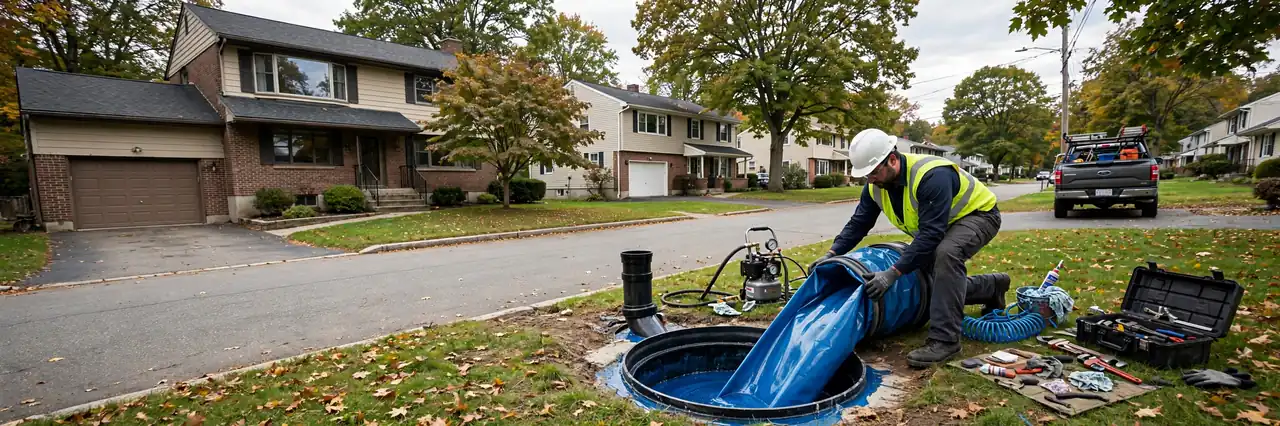
In short: Pipe Lining is cured-in-place pipe (CIPP) lining: an epoxy-saturated liner is inverted into the existing pipe and cured into a smooth, jointless new pipe inside the old one — sealing cracks, offset joints and root entry points. In Danvers, MA 01923 — where a typical home built around 1960, blending 1880s–1900s Victorians with 1950s–80s suburban streets — the first step when you call (833) 713-2101 is a camera survey with precise measurement of the host pipe, so the repair plan matches the actual pipe, soil, and access on your property.
This pipe lining guide covers Danvers, MA 01923. Browse it two ways: Services → Pipe Lining for the service itself, or Areas → Danvers for everything we do in this community.
Why Danvers Homes Need Pipe Lining Done Differently
Homeowners in Danvers (01923) call about pipe lining for the same symptoms everywhere — slow drains, gurgling fixtures, bad smells — but the causes track the local housing: a typical home built around 1960, blending 1880s–1900s Victorians with 1950s–80s suburban streets. The 1950s–60s boom cohort carries Orangeburg risk, the pre-1940 stock leans clay tile and cast iron, and post-1980 homes run PVC, and that history shapes every recommendation.
That is why our approach in 01923 starts below the surface, not with a shovel. Full basements are common across all eras of Danvers housing. Inland glacial till and clay loams with scattered wetlands, and seasonal saturation near the Danvers River lowlands. A pipe lining plan that ignores those two facts is a plan written for some other town.
The Danvers Ground Truth Behind Pipe Lining
Walk Danvers's streets and you are walking a timeline of pipe: a typical home built around 1960, blending 1880s–1900s Victorians with 1950s–80s suburban streets. The 1950s–60s boom cohort carries Orangeburg risk, the pre-1940 stock leans clay tile and cast iron, and post-1980 homes run PVC. Every pipe lining recommendation in 01923 starts from that timeline, not from a brochure.
Below grade, Danvers is demanding: inland glacial till and clay loams with scattered wetlands, and seasonal saturation near the Danvers River lowlands. Full basements are common across all eras of Danvers housing. For pipe lining, that combination decides whether we are fighting infiltration, root mass, or both — and where the line can actually be reached.
Put it together and Danvers's signature looks like this: with the typical home built in 1960 and a quarter of stock pre-1940, Danvers straddles both failure modes: collapsing Orangeburg on the 1950s–70s subdivisions and root-invaded clay on the older village stock — the fix path (bursting vs. lining vs. spot repair) is entirely era-dependent, so camera inspection here is really 'find out which era your pipe is'. That is the pattern our crews watch for along the Route 128/I-95 and US 1 corridors, Danversport waterfront, Endicott Park and Routes 1A, 35 and 62 toward Beverly and Salem whenever pipe lining comes up.
Pipe Lining in Danvers: Five Phases, Zero Guesswork
Every pipe lining job we run in Danvers, MA 01923 follows the same five phases below. The methods are standard; the judgment calls — where to dig, what to expect underground — are pure Danvers.
Camera survey and precise measurement
Camera survey and precise measurement. On Danvers homes, pipe lining lives or dies at this stage: a camera survey with precise measurement, since a liner for a Danvers pipe has to match the host pipe's diameter and length in 01923 exactly. It is unglamorous, but in 01923 it is the difference between a one-visit fix and a callback.
High-pressure cleaning and prep
High-pressure cleaning and prep. On Danvers homes, pipe lining lives or dies at this stage: high-pressure cleaning that strips roots, scale, and debris from the Danvers line so the epoxy bonds to clean pipe wall. It is unglamorous, but in 01923 it is the difference between a one-visit fix and a callback.
Liner inversion and positioning
Liner inversion and positioning. Inversion of the epoxy-saturated liner into place — one access point, no trench across the 01923 property. That is how this phase plays out during pipe lining in Danvers — shaped by 01923's pipe eras and ground conditions rather than a generic checklist.
Curing the epoxy liner
Curing the epoxy liner. For pipe lining in Danvers, expect this phase to account for local reality: curing the liner into a smooth, jointless new pipe inside the old Danvers line, sealing every crack and offset joint. 01923 properties reward crews that adapt here instead of rushing through.
Final camera run and flow check
Final camera run and flow check. On Danvers homes, pipe lining lives or dies at this stage: a final camera run and flow check confirming the lined Danvers pipe is continuous, sealed, and draining properly. It is unglamorous, but in 01923 it is the difference between a one-visit fix and a callback.
Pipe Lining in 01923: The Local Variables
What makes pipe lining in Danvers different from the next town over? Access (the tight lot lines and mature landscaping found across 01923), the local pipe timeline (the 1950s–60s boom cohort carries Orangeburg risk, the pre-1940 stock leans clay tile and cast iron, and post-1980 homes run PVC), and a water table that behaves like this: inland glacial till and clay loams with scattered wetlands, and seasonal saturation near the Danvers River lowlands. Put those together and 01923 jobs have a character all their own.
Timing is a quiet factor in 01923: inland New England freeze-thaw with winter lows near 20°F and heavy nor'easter snow loads Booking pipe lining in Danvers ahead of the worst weather means better diagnostics and cleaner working conditions — not a marketing claim, just ground physics.
Frequently Asked Questions
Will lining reduce my pipe's diameter in Danvers?
The liner takes a few millimeters, but flow usually improves — the old Danvers pipe's interior is rough with scale and deposits, while the cured liner is glass-smooth. Net result in 01923: equal or better drainage. Call (833) 713-2101 and we will show you the before-and-after on camera.
How long does pipe lining take in a Danvers home?
Faster than any dig: Danvers lining jobs in 01923 usually wrap within two days, most of it curing time while the crew monitors. One access point, no excavation, and the line is a smooth jointless pipe at the end. Call (833) 713-2101.
Are there digging or access constraints for pipe lining in Danvers?
With the typical home built in 1960 and a quarter of stock pre-1940, Danvers straddles both failure modes: collapsing Orangeburg on the 1950s–70s subdivisions and root-invaded clay on the older village stock — the fix path (bursting vs. lining vs. spot repair) is entirely era-dependent, so camera inspection here is really 'find out which era your pipe is'. For pipe lining in Danvers, those constraints rule out the 'just trench it' reflex. Our 01923 jobs are planned around the property's actual limits — access pits instead of open trenches, liners instead of excavations — and the camera survey at the start maps precisely where work can happen.
Is my Danvers pipe a candidate for lining, or does it need replacement?
It depends on the footage. Lining rescues pipes with cracks, offsets, and root intrusion; it cannot rescue a pipe that has lost its shape. In Danvers — the 1950s–60s boom cohort carries Orangeburg risk — 01923 homes split both ways — which is why the camera survey comes before any recommendation. (833) 713-2101.
What does Danvers's housing stock mean for pipe lining?
A typical home built around 1960, blending 1880s–1900s Victorians with 1950s–80s suburban streets. The 1950s–60s boom cohort carries Orangeburg risk, the pre-1940 stock leans clay tile and cast iron, and post-1980 homes run PVC. For pipe lining in Danvers, that era mix is the whole game: it tells the crew whether to expect root-bound clay joints, ovalized fiber conduit, or sound PVC — and the camera confirms which one your 01923 property actually has before any method is chosen.
How do Danvers's soil and groundwater conditions affect pipe lining?
Directly: inland glacial till and clay loams with scattered wetlands, and seasonal saturation near the Danvers River lowlands. For pipe lining in Danvers, that means the crew expects infiltration at weak joints, root systems hunting moisture, and access planning that respects a high or variable water table. In 01923, the camera survey is scheduled and interpreted with those ground conditions in mind — what looks like a minor joint offset on dry ground reads very differently in saturated soil.
Area Facts
- ZIP code
- 01923
- Housing stock
- a typical home built around 1960, blending 1880s–1900s Victorians with 1950s–80s suburban streets
- Typical pipe eras
- the 1950s–60s boom cohort carries Orangeburg risk, the pre-1940 stock leans clay tile and cast iron, and post-1980 homes run PVC
- Soil & drainage
- inland glacial till and clay loams with scattered wetlands, and seasonal saturation near the Danvers River lowlands
- Basements
- full basements are common across all eras of Danvers housing
- Landmarks & routes
- the Route 128/I-95 and US 1 corridors, Danversport waterfront, Endicott Park and Routes 1A, 35 and 62 toward Beverly and Salem
Keep Exploring Pipe Lining and Danvers
Pipe Lining in Downtown Beverly, MA
Comparing neighborhoods? Our pipe lining guide for Downtown Beverly, MA 01915 shows how the work changes a few streets over.
Learn morePipe Lining
Pipe Lining in Danvers, MA 01923: the full service picture beyond this Danvers page, from diagnosis through final flow test.
Learn moreSewer Line Problems Don’t Wait. Neither Should You.
Call now and reach a local sewer line specialist serving Beverly, MA and nearby North Shore communities — 24/7.
(833) 713-2101Free to call · No obligation · 24/7 emergency line
Serving Danvers, MA 01923