
Pipe Lining in Gloucester, MA
Gloucester properties from the 01930 blocks to the far streets get pipe lining from local specialists who understand North Shore soil, aging pipe, and tight lots. One call to (833) 713-2101 puts a plan in motion.
- 24/7 emergency line
- Camera-first diagnosis
- Trenchless options
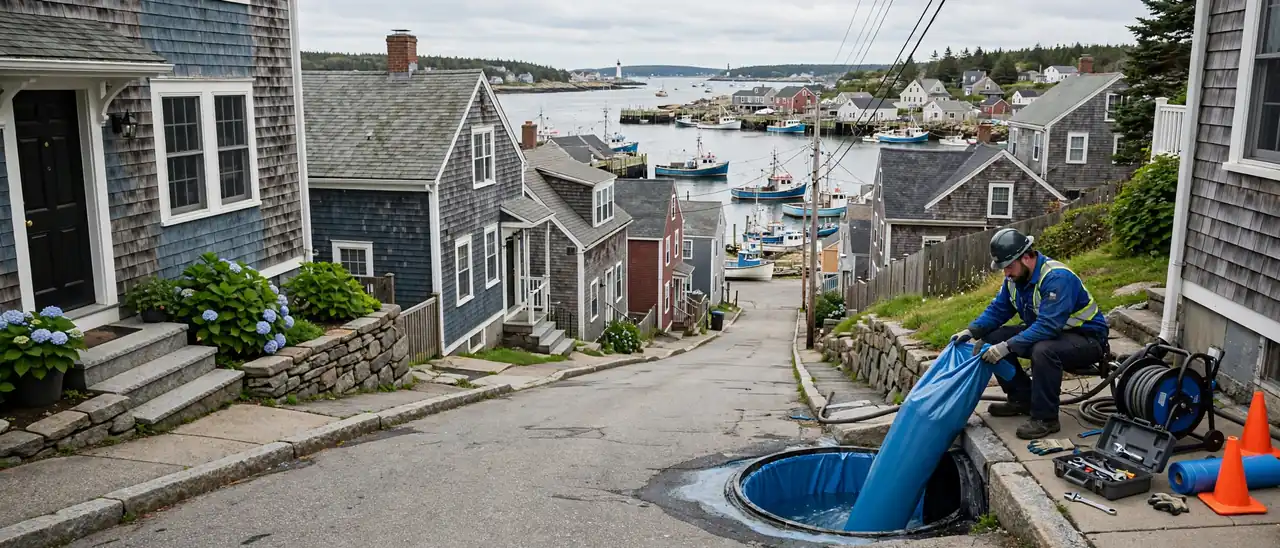
In short: Pipe Lining is cured-in-place pipe (CIPP) lining: an epoxy-saturated liner is inverted into the existing pipe and cured into a smooth, jointless new pipe inside the old one — sealing cracks, offset joints and root entry points. In Gloucester, MA 01930 — where a median home age of 74 years — 1900s fishing-port housing, dense 2–4 family stock and coastal neighborhoods from Magnolia to East Gloucester — the first step when you call (833) 713-2101 is a camera survey with precise measurement of the host pipe, so the repair plan matches the actual pipe, soil, and access on your property.
You are reading our pipe lining page for Gloucester, MA 01930 — filed under Services → Pipe Lining, and also listed in Areas → Gloucester, where every North Shore community we serve gets the same camera-first approach.
Pipe Lining in Gloucester, MA 01930: The Local Picture
Homeowners in Gloucester (01930) call about pipe lining for the same symptoms everywhere — slow drains, gurgling fixtures, bad smells — but the causes track the local housing: a median home age of 74 years — 1900s fishing-port housing, dense 2–4 family stock and coastal neighborhoods from Magnolia to East Gloucester. Dominantly pre-war stock keeps clay-tile laterals with cast-iron DWV, mid-century infill adds cast iron and Orangeburg, and dense conversions mean shared or closely spaced laterals, and that history shapes every recommendation.
That is why our approach in 01930 starts below the surface, not with a shovel. Full basements are typical, with stone and brick foundations under the oldest homes. Cape Ann granite bedrock exposed at the surface, thin discontinuous glacial till over bedrock, and terminal-moraine boulder fields — the hardest digging in the service area. A pipe lining plan that ignores those two facts is a plan written for some other town.
How Gloucester's Streets, Soil, and Pipe Eras Shape Pipe Lining
Dominantly pre-war stock keeps clay-tile laterals with cast-iron DWV, mid-century infill adds cast iron and Orangeburg, and dense conversions mean shared or closely spaced laterals. Across Gloucester — a median home age of 74 years — 1900s fishing-port housing, dense 2–4 family stock and coastal neighborhoods from Magnolia to East Gloucester — that era spread means two neighbors can need pipe lining for opposite reasons: one fighting roots at clay joints, the other watching a fiber pipe ovalize.
Full basements are typical, with stone and brick foundations under the oldest homes — which matters because pipe lining access in Gloucester usually starts at the basement or cleanout. And underground, Cape Ann granite bedrock exposed at the surface, thin discontinuous glacial till over bedrock, and terminal-moraine boulder fields — the hardest digging in the service area, so the pipe has been living in a wet, root-filled environment for decades.
For the crew, Gloucester reads as: Gloucester is the ledge capital of the service area: clay laterals laid in thin soil over exposed Cape Ann granite, with frost heave rocking shallow pipes against immovable bedrock and roots exploiting every joint in the thin till — open-trench replacement is brutally expensive rock excavation, which makes trenchless bursting or lining economically decisive, and camera inspection must map depth-to-ledge because a collapsed section sitting on granite can't be re-graded, only replaced or lined. So along the Route 128 northern terminus, the Route 127 coastal loop, Gloucester Harbor, Good Harbor Beach, Stage Fort Park and Dogtown Common, pipe lining is a locate-and-verify discipline first — the fix follows the footage, not the other way around.
Pipe Lining in Gloucester: Five Phases, Zero Guesswork
Every pipe lining job we run in Gloucester, MA 01930 follows the same five phases below. The methods are standard; the judgment calls — where to dig, what to expect underground — are pure Gloucester.
Camera survey and precise measurement
Camera survey and precise measurement. A camera survey with precise measurement, since a liner for a Gloucester pipe has to match the host pipe's diameter and length in 01930 exactly. That is how this phase plays out during pipe lining in Gloucester — shaped by 01930's pipe eras and ground conditions rather than a generic checklist.
High-pressure cleaning and prep
High-pressure cleaning and prep. For pipe lining in Gloucester, expect this phase to account for local reality: high-pressure cleaning that strips roots, scale, and debris from the Gloucester line so the epoxy bonds to clean pipe wall. 01930 properties reward crews that adapt here instead of rushing through.
Liner inversion and positioning
Liner inversion and positioning. In Gloucester, this phase of pipe lining means inversion of the epoxy-saturated liner into place — one access point, no trench across the 01930 property. For a 01930 property, that step sets up everything after it — skip it and the rest of the job is guesswork.
Curing the epoxy liner
Curing the epoxy liner. On Gloucester homes, pipe lining lives or dies at this stage: curing the liner into a smooth, jointless new pipe inside the old Gloucester line, sealing every crack and offset joint. It is unglamorous, but in 01930 it is the difference between a one-visit fix and a callback.
Final camera run and flow check
Final camera run and flow check. On Gloucester homes, pipe lining lives or dies at this stage: a final camera run and flow check confirming the lined Gloucester pipe is continuous, sealed, and draining properly. It is unglamorous, but in 01930 it is the difference between a one-visit fix and a callback.
Pipe Lining in 01930: The Local Variables
In Gloucester, pipe lining estimates hinge on access, pipe era, and water. Access first: narrow lots and shared driveways typical of Gloucester's streets Then the pipe: dominantly pre-war stock keeps clay-tile laterals with cast-iron DWV, mid-century infill adds cast iron and Orangeburg, and dense conversions mean shared or closely spaced laterals Then the ground: Cape Ann granite bedrock exposed at the surface, thin discontinuous glacial till over bedrock, and terminal-moraine boulder fields — the hardest digging in the service area. Any 01930 plan missing one of those three is a guess wearing a work order.
One more Gloucester reality: full Atlantic exposure — nor'easters, sea spray, 47 inches of annual precipitation, and freeze-thaw plus salt air that corrodes exposed cast iron Plan pipe lining around that cycle in 01930 and everything downstream — diagnosis, access, restoration — gets easier.
Frequently Asked Questions
Will lining reduce my pipe's diameter in Gloucester?
The liner takes a few millimeters, but flow usually improves — the old Gloucester pipe's interior is rough with scale and deposits, while the cured liner is glass-smooth. Net result in 01930: equal or better drainage. Call (833) 713-2101 and we will show you the before-and-after on camera.
How do Gloucester's soil and groundwater conditions affect pipe lining?
Directly: Cape Ann granite bedrock exposed at the surface, thin discontinuous glacial till over bedrock, and terminal-moraine boulder fields — the hardest digging in the service area. For pipe lining in Gloucester, that means the crew expects infiltration at weak joints, root systems hunting moisture, and access planning that respects a high or variable water table. In 01930, the camera survey is scheduled and interpreted with those ground conditions in mind — what looks like a minor joint offset on dry ground reads very differently in saturated soil.
How long does pipe lining take in a Gloucester home?
Most Gloucester liners are a one-to-two-day job in 01930: camera and clean on day one, liner inversion and cure, then a final camera. No trench, no heavy equipment tearing up the lot — the disruption is measured in hours, not weeks. Call (833) 713-2101 to schedule the inspection.
What does Gloucester's housing stock mean for pipe lining?
A median home age of 74 years — 1900s fishing-port housing, dense 2–4 family stock and coastal neighborhoods from Magnolia to East Gloucester. Dominantly pre-war stock keeps clay-tile laterals with cast-iron DWV, mid-century infill adds cast iron and Orangeburg, and dense conversions mean shared or closely spaced laterals. For pipe lining in Gloucester, that era mix is the whole game: it tells the crew whether to expect root-bound clay joints, ovalized fiber conduit, or sound PVC — and the camera confirms which one your 01930 property actually has before any method is chosen.
Is my Gloucester pipe a candidate for lining, or does it need replacement?
The camera decides: lining needs a host pipe that is mostly round and continuous — root-blocked or cracked clay qualifies, fully collapsed sections do not. In 01930 — dominantly pre-war stock keeps clay-tile laterals with cast-iron DWV — Gloucester candidacy varies house to house. Call (833) 713-2101 for the inspection that answers it definitively.
Are there digging or access constraints for pipe lining in Gloucester?
Yes — Gloucester has its own: Gloucester is the ledge capital of the service area: clay laterals laid in thin soil over exposed Cape Ann granite, with frost heave rocking shallow pipes against immovable bedrock and roots exploiting every joint in the thin till — open-trench replacement is brutally expensive rock excavation, which makes trenchless bursting or lining economically decisive, and camera inspection must map depth-to-ledge because a collapsed section sitting on granite can't be re-graded, only replaced or lined. That shapes every pipe lining plan in 01930: trenchless-first thinking, careful locating, and repairs sized to the property rather than the equipment. The site visit is where those constraints get mapped, not discovered mid-job.
Area Facts
- ZIP code
- 01930
- Housing stock
- a median home age of 74 years — 1900s fishing-port housing, dense 2–4 family stock and coastal neighborhoods from Magnolia to East Gloucester
- Typical pipe eras
- dominantly pre-war stock keeps clay-tile laterals with cast-iron DWV, mid-century infill adds cast iron and Orangeburg, and dense conversions mean shared or closely spaced laterals
- Soil & drainage
- Cape Ann granite bedrock exposed at the surface, thin discontinuous glacial till over bedrock, and terminal-moraine boulder fields — the hardest digging in the service area
- Basements
- full basements are typical, with stone and brick foundations under the oldest homes
- Landmarks & routes
- the Route 128 northern terminus, the Route 127 coastal loop, Gloucester Harbor, Good Harbor Beach, Stage Fort Park and Dogtown Common
Related Pipe Lining Resources for Gloucester
Gloucester, MA
Everything we do in Gloucester, MA 01930 — including pipe lining: all twelve services, local pipe eras, and the ground conditions that shape every job.
Learn morePipe Lining in Goat Hill, MA
Comparing neighborhoods? Our pipe lining guide for Goat Hill, MA 01915 shows how the work changes a few streets over.
Learn moreSewer Line Problems Don’t Wait. Neither Should You.
Call now and reach a local sewer line specialist serving Beverly, MA and nearby North Shore communities — 24/7.
(833) 713-2101Free to call · No obligation · 24/7 emergency line
Serving Gloucester, MA 01930