
Pipe Lining in Hamilton, MA
When Hamilton homeowners need pipe lining, the difference between a clean repair and a torn-up yard is diagnosis. We serve 01936 with camera-first pipe lining — call (833) 713-2101 and describe what you are seeing.
- 24/7 emergency line
- Camera-first diagnosis
- Trenchless options
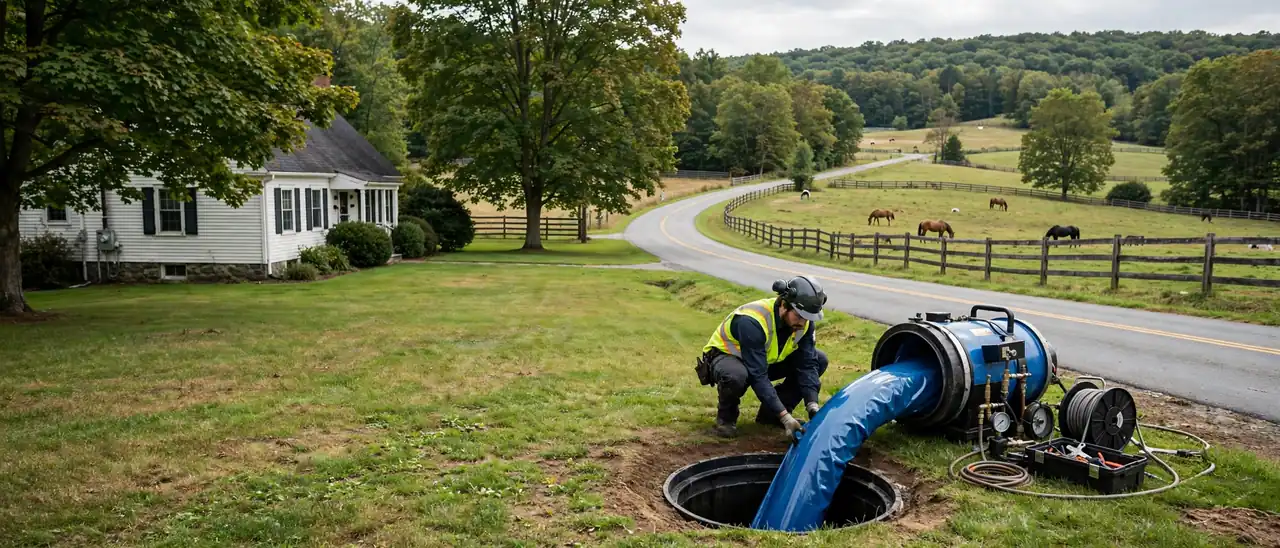
In short: Cured-in-place pipe (CIPP) lining: an epoxy-saturated liner is inverted into the existing pipe and cured into a smooth, jointless new pipe inside the old one — sealing cracks, offset joints and root entry points — and in Hamilton, MA 01936, that work has to account for local housing: a barbell of 17th–18th century farmhouses and 1950s–70s Capes, plus Gilded-Age gentleman's-farm estates like Bradley Palmer and Appleton. Your first step is simple: call (833) 713-2101. We begin with a camera survey with precise measurement of the host pipe and build the plan from what the camera shows.
This pipe lining guide covers Hamilton, MA 01936. Browse it two ways: Services → Pipe Lining for the service itself, or Areas → Hamilton for everything we do in this community.
What Pipe Lining Means for Hamilton Homes
Hamilton (01936) is a place where pipe lining rewards local knowledge. A barbell of 17th–18th century farmhouses and 1950s–70s Capes, plus Gilded-Age gentleman's-farm estates like Bradley Palmer and Appleton. The pre-1939 third typically keeps clay tile and cast iron, while the big 1940–79 cohort leans cast iron and Orangeburg laterals — treat every line like a new subdivision pipe and you will recommend the wrong fix half the time.
Before method comes mapping in Hamilton (01936). Full basements are standard across eras in this rural New England town, which decides where we can access the line — and rural glacial till, drumlin fields and old stone walls, with estate acreage, mature trees and horse-pasture root systems, which decides how water and roots are already attacking it. Pipe Lining here is a site-reading exercise first.
Why Hamilton Changes How Pipe Lining Works
The pre-1939 third typically keeps clay tile and cast iron, while the big 1940–79 cohort leans cast iron and Orangeburg laterals. Across Hamilton — a barbell of 17th–18th century farmhouses and 1950s–70s Capes, plus Gilded-Age gentleman's-farm estates like Bradley Palmer and Appleton — that era spread means two neighbors can need pipe lining for opposite reasons: one fighting roots at clay joints, the other watching a fiber pipe ovalize.
Full basements are standard across eras in this rural New England town — which matters because pipe lining access in Hamilton usually starts at the basement or cleanout. And underground, rural glacial till, drumlin fields and old stone walls, with estate acreage, mature trees and horse-pasture root systems, so the pipe has been living in a wet, root-filled environment for decades.
The local geography sharpens the point: Hamilton's stock is a barbell — 300-year-old farmhouses and 1950s–70s Capes — and both ends fail the same way: long laterals across big lots, 150 to 300 feet of clay or Orangeburg through pasture and woodland where roots and frost heave work every joint for decades — camera with sonde locating is non-negotiable on multi-acre lots, and pipe bursting shines here because open-trenching a 200-foot run through old stone walls and specimen trees is a non-starter. Around the Hamilton/Wenham MBTA station, Route 1A and historic Bay Road, Myopia Hunt Club, the Patton Homestead and Bradley Palmer State Park, we see the same pattern repeat on pipe lining calls — which is why the camera goes in before any commitment in Hamilton.
How Pipe Lining Works in Hamilton, MA 01936
Here is how pipe lining typically unfolds for a Hamilton property in 01936 — the same five phases every time, adapted to local pipe eras, soil, and access.
Camera survey and precise measurement
Camera survey and precise measurement. A camera survey with precise measurement, since a liner for a Hamilton pipe has to match the host pipe's diameter and length in 01936 exactly. That is how this phase plays out during pipe lining in Hamilton — shaped by 01936's pipe eras and ground conditions rather than a generic checklist.
High-pressure cleaning and prep
High-pressure cleaning and prep. This is where Hamilton's specifics enter the job: high-pressure cleaning that strips roots, scale, and debris from the Hamilton line so the epoxy bonds to clean pipe wall. Done right, this phase makes the rest of pipe lining in 01936 straightforward.
Liner inversion and positioning
Liner inversion and positioning. In Hamilton, this phase of pipe lining means inversion of the epoxy-saturated liner into place — one access point, no trench across the 01936 property. For a 01936 property, that step sets up everything after it — skip it and the rest of the job is guesswork.
Curing the epoxy liner
Curing the epoxy liner. This is where Hamilton's specifics enter the job: curing the liner into a smooth, jointless new pipe inside the old Hamilton line, sealing every crack and offset joint. Done right, this phase makes the rest of pipe lining in 01936 straightforward.
Final camera run and flow check
Final camera run and flow check. On Hamilton homes, pipe lining lives or dies at this stage: a final camera run and flow check confirming the lined Hamilton pipe is continuous, sealed, and draining properly. It is unglamorous, but in 01936 it is the difference between a one-visit fix and a callback.
Pipe Lining in 01936: The Local Variables
Three local factors change pipe lining quotes and timelines in Hamilton more than anything else. First, access: limited street frontage and established yards in Hamilton. Second, the pipe era — the pre-1939 third typically keeps clay tile and cast iron, while the big 1940–79 cohort leans cast iron and Orangeburg laterals — which decides the method. Third, groundwater: rural glacial till, drumlin fields and old stone walls, with estate acreage, mature trees and horse-pasture root systems. In 01936, a crew that prices without seeing all three is pricing blind.
Inland freeze-thaw with full frost exposure and nor'easter snow, where frost heave works till soils against buried pipe — which is why Hamilton veterans of pipe lining do not wait for the worst week of winter. In 01936, shoulder-season work gives the crew the best look at the line and the ground at its most cooperative.
Frequently Asked Questions
Are there digging or access constraints for pipe lining in Hamilton?
Hamilton's stock is a barbell — 300-year-old farmhouses and 1950s–70s Capes — and both ends fail the same way: long laterals across big lots, 150 to 300 feet of clay or Orangeburg through pasture and woodland where roots and frost heave work every joint for decades — camera with sonde locating is non-negotiable on multi-acre lots, and pipe bursting shines here because open-trenching a 200-foot run through old stone walls and specimen trees is a non-starter. For pipe lining in Hamilton, those constraints rule out the 'just trench it' reflex. Our 01936 jobs are planned around the property's actual limits — access pits instead of open trenches, liners instead of excavations — and the camera survey at the start maps precisely where work can happen.
How do Hamilton's soil and groundwater conditions affect pipe lining?
Directly: rural glacial till, drumlin fields and old stone walls, with estate acreage, mature trees and horse-pasture root systems. For pipe lining in Hamilton, that means the crew expects infiltration at weak joints, root systems hunting moisture, and access planning that respects a high or variable water table. In 01936, the camera survey is scheduled and interpreted with those ground conditions in mind — what looks like a minor joint offset on dry ground reads very differently in saturated soil.
Will lining reduce my pipe's diameter in Hamilton?
Slightly on paper, negligibly in practice: the liner is thin, and its smooth epoxy surface actually flows better than the rough, scaled old pipe it covers. In 01936, Hamilton lines often drain better after lining than they did when new. (833) 713-2101 for a camera look at your pipe's real condition.
Is my Hamilton pipe a candidate for lining, or does it need replacement?
It depends on the footage. Lining rescues pipes with cracks, offsets, and root intrusion; it cannot rescue a pipe that has lost its shape. In Hamilton — the pre-1939 third typically keeps clay tile and cast iron — 01936 homes split both ways — which is why the camera survey comes before any recommendation. (833) 713-2101.
How long does pipe lining take in a Hamilton home?
Faster than any dig: Hamilton lining jobs in 01936 usually wrap within two days, most of it curing time while the crew monitors. One access point, no excavation, and the line is a smooth jointless pipe at the end. Call (833) 713-2101.
What does Hamilton's housing stock mean for pipe lining?
Everything: a barbell of 17th–18th century farmhouses and 1950s–70s Capes, plus Gilded-Age gentleman's-farm estates like Bradley Palmer and Appleton, and the pre-1939 third typically keeps clay tile and cast iron, while the big 1940–79 cohort leans cast iron and Orangeburg laterals. Pipe Lining in Hamilton is era-dependent work, which is why the first visit to a 01936 home is diagnostic. Two houses on the same street can need opposite fixes, and only the footage tells them apart. Call (833) 713-2101 to find out which era your line belongs to.
Area Facts
- ZIP code
- 01936
- Housing stock
- a barbell of 17th–18th century farmhouses and 1950s–70s Capes, plus Gilded-Age gentleman's-farm estates like Bradley Palmer and Appleton
- Typical pipe eras
- the pre-1939 third typically keeps clay tile and cast iron, while the big 1940–79 cohort leans cast iron and Orangeburg laterals
- Soil & drainage
- rural glacial till, drumlin fields and old stone walls, with estate acreage, mature trees and horse-pasture root systems
- Basements
- full basements are standard across eras in this rural New England town
- Landmarks & routes
- the Hamilton/Wenham MBTA station, Route 1A and historic Bay Road, Myopia Hunt Club, the Patton Homestead and Bradley Palmer State Park
More on Pipe Lining in Hamilton, MA
Hamilton, MA
Hamilton (01936) service hub — pipe lining plus the other eleven services, with local notes on housing stock, soil, and access.
Learn morePipe Lining in Ipswich, MA
Comparing neighborhoods? Our pipe lining guide for Ipswich, MA 01938 shows how the work changes a few streets over.
Learn moreSewer Line Problems Don’t Wait. Neither Should You.
Call now and reach a local sewer line specialist serving Beverly, MA and nearby North Shore communities — 24/7.
(833) 713-2101Free to call · No obligation · 24/7 emergency line
Serving Hamilton, MA 01936