
Pipe Lining in Peabody, MA
When Peabody homeowners need pipe lining, the difference between a clean repair and a torn-up yard is diagnosis. We serve 01960 with camera-first pipe lining — call (833) 713-2101 and describe what you are seeing.
- 24/7 emergency line
- Camera-first diagnosis
- Trenchless options
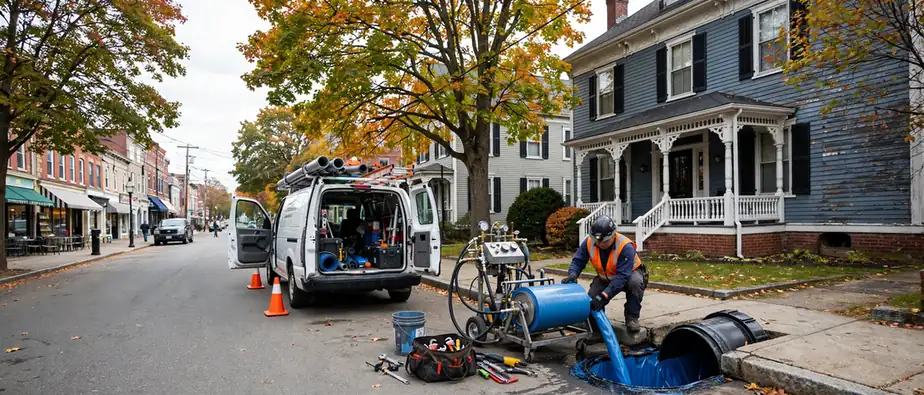
In short: Cured-in-place pipe (CIPP) lining: an epoxy-saturated liner is inverted into the existing pipe and cured into a smooth, jointless new pipe inside the old one — sealing cracks, offset joints and root entry points. That is what pipe lining means for Peabody, MA 01960 — a median year built of 1966 — 1880s–1920s in-town housing, 1960 split-entry suburbia and 1988-plus custom colonials. Call (833) 713-2101 and the first step is a camera survey with precise measurement of the host pipe — no digging, no guessing, just a look inside the line.
Part of our pipe lining coverage for the North Shore, this page focuses on Peabody, MA 01960. Find it via Services → Pipe Lining, or through Areas → Peabody alongside our other work in town.
Pipe Lining in Peabody, MA 01960: The Local Picture
In Peabody (01960), pipe lining is rarely a generic job. A median year built of 1966 — 1880s–1920s in-town housing, 1960 split-entry suburbia and 1988-plus custom colonials. The big 1950s–70s suburban cohort makes Orangeburg and cast iron the prime risks, while pre-1940 in-town stock leans clay tile and cast iron — which means the crew arriving at your door needs to know which era of pipe they are dealing with before a single decision gets made.
That is why our approach in 01960 starts below the surface, not with a shovel. Full basements are common, from partially finished 1920s basements to full unfinished 1980s lower levels. Glacial till over Peabody Granite bedrock — same granite family as Cape Ann — with seasonal wetness in low spots near the North River. A pipe lining plan that ignores those two facts is a plan written for some other town.
Why Peabody Changes How Pipe Lining Works
Walk Peabody's streets and you are walking a timeline of pipe: a median year built of 1966 — 1880s–1920s in-town housing, 1960 split-entry suburbia and 1988-plus custom colonials. The big 1950s–70s suburban cohort makes Orangeburg and cast iron the prime risks, while pre-1940 in-town stock leans clay tile and cast iron. Every pipe lining recommendation in 01960 starts from that timeline, not from a brochure.
Full basements are common, from partially finished 1920s basements to full unfinished 1980s lower levels — which matters because pipe lining access in Peabody usually starts at the basement or cleanout. And underground, glacial till over Peabody Granite bedrock — same granite family as Cape Ann — with seasonal wetness in low spots near the North River, so the pipe has been living in a wet, root-filled environment for decades.
For the crew, Peabody reads as: Peabody's 1966-median stock makes it Orangeburg ground zero: thousands of 1950s–70s split-entries and ranches whose fiber-conduit laterals are ovalizing under root pressure and soil movement, while the in-town Victorians add clay-tile root intrusion — two different pipe failures, one symptom (slow drains plus sewage smell), and only a camera tells them apart: sell the inspection as the diagnostic that decides between bursting (Orangeburg) and lining (clay). So along where Route 128/I-95 meets Route 1, Lowell St and Lynn St, the Northshore Mall corridor, Brown's Pond and Brooksby Farm, pipe lining is a locate-and-verify discipline first — the fix follows the footage, not the other way around.
Pipe Lining in Peabody: Five Phases, Zero Guesswork
Here is how pipe lining typically unfolds for a Peabody property in 01960 — the same five phases every time, adapted to local pipe eras, soil, and access.
Camera survey and precise measurement
Camera survey and precise measurement. For pipe lining in Peabody, expect this phase to account for local reality: a camera survey with precise measurement, since a liner for a Peabody pipe has to match the host pipe's diameter and length in 01960 exactly. 01960 properties reward crews that adapt here instead of rushing through.
High-pressure cleaning and prep
High-pressure cleaning and prep. For pipe lining in Peabody, expect this phase to account for local reality: high-pressure cleaning that strips roots, scale, and debris from the Peabody line so the epoxy bonds to clean pipe wall. 01960 properties reward crews that adapt here instead of rushing through.
Liner inversion and positioning
Liner inversion and positioning. Inversion of the epoxy-saturated liner into place — one access point, no trench across the 01960 property. That is how this phase plays out during pipe lining in Peabody — shaped by 01960's pipe eras and ground conditions rather than a generic checklist.
Curing the epoxy liner
Curing the epoxy liner. Curing the liner into a smooth, jointless new pipe inside the old Peabody line, sealing every crack and offset joint. That is how this phase plays out during pipe lining in Peabody — shaped by 01960's pipe eras and ground conditions rather than a generic checklist.
Final camera run and flow check
Final camera run and flow check. On Peabody homes, pipe lining lives or dies at this stage: a final camera run and flow check confirming the lined Peabody pipe is continuous, sealed, and draining properly. It is unglamorous, but in 01960 it is the difference between a one-visit fix and a callback.
Pipe Lining in 01960: The Local Variables
In Peabody, pipe lining estimates hinge on access, pipe era, and water. Access first: the tight lot lines and mature landscaping found across 01960 Then the pipe: the big 1950s–70s suburban cohort makes Orangeburg and cast iron the prime risks, while pre-1940 in-town stock leans clay tile and cast iron Then the ground: glacial till over Peabody Granite bedrock — same granite family as Cape Ann — with seasonal wetness in low spots near the North River. Any 01960 plan missing one of those three is a guess wearing a work order.
Inland freeze-thaw with winter lows near 20°F and frost heave working against shallow laterals — which is why Peabody veterans of pipe lining do not wait for the worst week of winter. In 01960, shoulder-season work gives the crew the best look at the line and the ground at its most cooperative.
Frequently Asked Questions
What does Peabody's housing stock mean for pipe lining?
Everything: a median year built of 1966 — 1880s–1920s in-town housing, 1960 split-entry suburbia and 1988-plus custom colonials, and the big 1950s–70s suburban cohort makes Orangeburg and cast iron the prime risks, while pre-1940 in-town stock leans clay tile and cast iron. Pipe Lining in Peabody is era-dependent work, which is why the first visit to a 01960 home is diagnostic. Two houses on the same street can need opposite fixes, and only the footage tells them apart. Call (833) 713-2101 to find out which era your line belongs to.
How do Peabody's soil and groundwater conditions affect pipe lining?
More than most towns: glacial till over Peabody Granite bedrock — same granite family as Cape Ann — with seasonal wetness in low spots near the North River. Pipe Lining in Peabody has to be planned for wet ground — infiltration through cracked joints, buoyant saturated soils, and root pressure all show up on the camera differently here. In 01960, we read the footage against the local ground conditions, which is why the same symptom gets a different fix two towns over.
Will lining reduce my pipe's diameter in Peabody?
Not in any way you would notice. Lining trades a thin wall for a perfectly smooth bore, and Peabody's old scaled pipes in 01960 gain flow from that trade. The camera footage before and after tells the story — (833) 713-2101 to see yours.
How long does pipe lining take in a Peabody home?
Most Peabody liners are a one-to-two-day job in 01960: camera and clean on day one, liner inversion and cure, then a final camera. No trench, no heavy equipment tearing up the lot — the disruption is measured in hours, not weeks. Call (833) 713-2101 to schedule the inspection.
Is my Peabody pipe a candidate for lining, or does it need replacement?
Only the camera can say. If the Peabody pipe holds its shape, lining seals it for decades; if it has collapsed or bellied badly, bursting or spot replacement is the honest answer. In 01960, we show you the footage and explain the call — (833) 713-2101.
Are there digging or access constraints for pipe lining in Peabody?
Yes — Peabody has its own: Peabody's 1966-median stock makes it Orangeburg ground zero: thousands of 1950s–70s split-entries and ranches whose fiber-conduit laterals are ovalizing under root pressure and soil movement, while the in-town Victorians add clay-tile root intrusion — two different pipe failures, one symptom (slow drains plus sewage smell), and only a camera tells them apart: sell the inspection as the diagnostic that decides between bursting (Orangeburg) and lining (clay). That shapes every pipe lining plan in 01960: trenchless-first thinking, careful locating, and repairs sized to the property rather than the equipment. The site visit is where those constraints get mapped, not discovered mid-job.
Area Facts
- ZIP code
- 01960
- Housing stock
- a median year built of 1966 — 1880s–1920s in-town housing, 1960 split-entry suburbia and 1988-plus custom colonials
- Typical pipe eras
- the big 1950s–70s suburban cohort makes Orangeburg and cast iron the prime risks, while pre-1940 in-town stock leans clay tile and cast iron
- Soil & drainage
- glacial till over Peabody Granite bedrock — same granite family as Cape Ann — with seasonal wetness in low spots near the North River
- Basements
- full basements are common, from partially finished 1920s basements to full unfinished 1980s lower levels
- Landmarks & routes
- where Route 128/I-95 meets Route 1, Lowell St and Lynn St, the Northshore Mall corridor, Brown's Pond and Brooksby Farm
More on Pipe Lining in Peabody, MA
Peabody, MA
Peabody (01960) service hub — pipe lining plus the other eleven services, with local notes on housing stock, soil, and access.
Learn morePipe Lining in Prides Crossing, MA
Comparing neighborhoods? Our pipe lining guide for Prides Crossing, MA 01965 shows how the work changes a few streets over.
Learn moreSewer Line Problems Don’t Wait. Neither Should You.
Call now and reach a local sewer line specialist serving Beverly, MA and nearby North Shore communities — 24/7.
(833) 713-2101Free to call · No obligation · 24/7 emergency line
Serving Peabody, MA 01960