
Pipe Lining in Salem, MA
When Salem homeowners need pipe lining, the difference between a clean repair and a torn-up yard is diagnosis. We serve 01970 with camera-first pipe lining — call (833) 713-2101 and describe what you are seeing.
- 24/7 emergency line
- Camera-first diagnosis
- Trenchless options
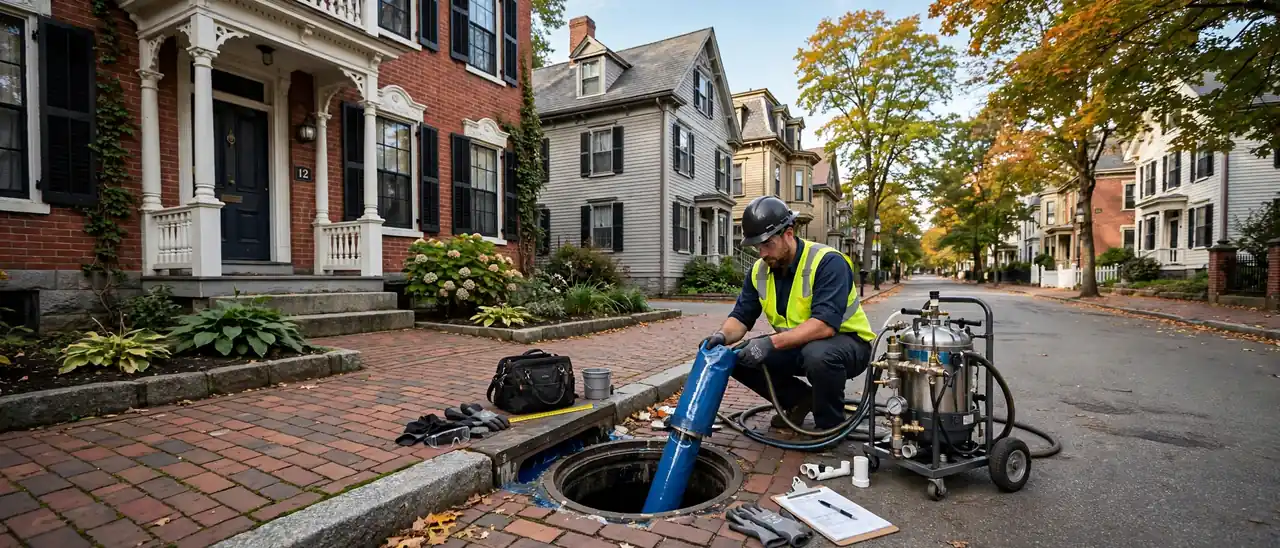
In short: Cured-in-place pipe (CIPP) lining: an epoxy-saturated liner is inverted into the existing pipe and cured into a smooth, jointless new pipe inside the old one — sealing cracks, offset joints and root entry points — and in Salem, MA 01970, that work has to account for local housing: a median year built of 1930 with over half the stock pre-1939 — 1850s Bridge Street Neck homes, 1866 McIntire District Victorians and dense duplexes. Your first step is simple: call (833) 713-2101. We begin with a camera survey with precise measurement of the host pipe and build the plan from what the camera shows.
Salem, MA 01970 is one of 22 communities in our Areas coverage, and this page is its dedicated pipe lining guide — also reachable under Services → Pipe Lining. The process below is adapted to how Salem properties are actually built.
Why Salem Homes Need Pipe Lining Done Differently
Pipe Lining in Salem, MA 01970 has to fit the neighborhood: a median year built of 1930 with over half the stock pre-1939 — 1850s Bridge Street Neck homes, 1866 McIntire District Victorians and dense duplexes. Over half pre-1939 means clay tile — and possibly the oldest brick or combined-era sewers — dominate, with shared or closely spaced laterals in dense multi-family conversions, so the first question on every call is never 'how fast can we dig' but 'what is actually in the ground here.'
Before method comes mapping in Salem (01970). Full basements are standard, on concrete, stone or brick foundations depending on era, which decides where we can access the line — and a coastal city on Salem Harbor with historic fill downtown, a high water table and low-lying flood-exposed neighborhoods, which decides how water and roots are already attacking it. Pipe Lining here is a site-reading exercise first.
How Salem's Streets, Soil, and Pipe Eras Shape Pipe Lining
The pipe story in Salem follows the housing: a median year built of 1930 with over half the stock pre-1939 — 1850s Bridge Street Neck homes, 1866 McIntire District Victorians and dense duplexes, and over half pre-1939 means clay tile — and possibly the oldest brick or combined-era sewers — dominate, with shared or closely spaced laterals in dense multi-family conversions. That mix is exactly why pipe lining here cannot be one-size-fits-all — a clay lateral and a fiber-conduit lateral fail in completely different ways.
The ground in Salem does not forgive old pipe: a coastal city on Salem Harbor with historic fill downtown, a high water table and low-lying flood-exposed neighborhoods. Coastal freeze-thaw, nor'easter storm surge at harbor-adjacent blocks and winter lows near 20°F. Any pipe lining plan in 01970 has to be built for that ground, not for ideal conditions.
With the majority of homes pre-1939 and the densest multi-family stock in the area, Salem's sewers are old clay under tight urban lots — root intrusion, offset joints from 90-plus years of settlement, and shared laterals serving converted duplexes where nobody knows whose pipe is whose: camera inspection with locating untangles shared-lateral responsibility (critical for 2–3 family owners), and trenchless methods avoid tearing up narrow historic streets and brick sidewalks. If you live near Federal St and Essex St, Bridge Street Neck, the McIntire Historic District, Salem Common, Forest River Park and the Salem MBTA station, that description probably sounds familiar — it is the reason pipe lining in Salem starts with diagnosis, not excavation.
Our Pipe Lining Process in Salem
Here is how pipe lining typically unfolds for a Salem property in 01970 — the same five phases every time, adapted to local pipe eras, soil, and access.
Camera survey and precise measurement
Camera survey and precise measurement. For pipe lining in Salem, expect this phase to account for local reality: a camera survey with precise measurement, since a liner for a Salem pipe has to match the host pipe's diameter and length in 01970 exactly. 01970 properties reward crews that adapt here instead of rushing through.
High-pressure cleaning and prep
High-pressure cleaning and prep. For pipe lining in Salem, expect this phase to account for local reality: high-pressure cleaning that strips roots, scale, and debris from the Salem line so the epoxy bonds to clean pipe wall. 01970 properties reward crews that adapt here instead of rushing through.
Liner inversion and positioning
Liner inversion and positioning. On Salem homes, pipe lining lives or dies at this stage: inversion of the epoxy-saturated liner into place — one access point, no trench across the 01970 property. It is unglamorous, but in 01970 it is the difference between a one-visit fix and a callback.
Curing the epoxy liner
Curing the epoxy liner. In Salem, this phase of pipe lining means curing the liner into a smooth, jointless new pipe inside the old Salem line, sealing every crack and offset joint. For a 01970 property, that step sets up everything after it — skip it and the rest of the job is guesswork.
Final camera run and flow check
Final camera run and flow check. On Salem homes, pipe lining lives or dies at this stage: a final camera run and flow check confirming the lined Salem pipe is continuous, sealed, and draining properly. It is unglamorous, but in 01970 it is the difference between a one-visit fix and a callback.
Pipe Lining in 01970: The Local Variables
Three local factors change pipe lining quotes and timelines in Salem more than anything else. First, access: limited street frontage and established yards in Salem. Second, the pipe era — over half pre-1939 means clay tile — and possibly the oldest brick or combined-era sewers — dominate, with shared or closely spaced laterals in dense multi-family conversions — which decides the method. Third, groundwater: a coastal city on Salem Harbor with historic fill downtown, a high water table and low-lying flood-exposed neighborhoods. In 01970, a crew that prices without seeing all three is pricing blind.
Season matters too. coastal freeze-thaw, nor'easter storm surge at harbor-adjacent blocks and winter lows near 20°F In Salem, the smartest pipe lining scheduling happens before the ground freezes or the spring melt arrives — the camera sees more, the soil cooperates, and the fix cures the way it should.
Frequently Asked Questions
How long does pipe lining take in a Salem home?
Most Salem liners are a one-to-two-day job in 01970: camera and clean on day one, liner inversion and cure, then a final camera. No trench, no heavy equipment tearing up the lot — the disruption is measured in hours, not weeks. Call (833) 713-2101 to schedule the inspection.
Is my Salem pipe a candidate for lining, or does it need replacement?
Only the camera can say. If the Salem pipe holds its shape, lining seals it for decades; if it has collapsed or bellied badly, bursting or spot replacement is the honest answer. In 01970, we show you the footage and explain the call — (833) 713-2101.
How do Salem's soil and groundwater conditions affect pipe lining?
More than most towns: a coastal city on Salem Harbor with historic fill downtown, a high water table and low-lying flood-exposed neighborhoods. Pipe Lining in Salem has to be planned for wet ground — infiltration through cracked joints, buoyant saturated soils, and root pressure all show up on the camera differently here. In 01970, we read the footage against the local ground conditions, which is why the same symptom gets a different fix two towns over.
What does Salem's housing stock mean for pipe lining?
A median year built of 1930 with over half the stock pre-1939 — 1850s Bridge Street Neck homes, 1866 McIntire District Victorians and dense duplexes — so over half pre-1939 means clay tile — and possibly the oldest brick or combined-era sewers — dominate, with shared or closely spaced laterals in dense multi-family conversions. That is why pipe lining in Salem starts with the 'age of the house ≈ age of the pipe' rule of thumb, then verifies it with a camera. In 01970, recommending a method before seeing the pipe's generation is how good money follows bad.
Will lining reduce my pipe's diameter in Salem?
Not in any way you would notice. Lining trades a thin wall for a perfectly smooth bore, and Salem's old scaled pipes in 01970 gain flow from that trade. The camera footage before and after tells the story — (833) 713-2101 to see yours.
Are there digging or access constraints for pipe lining in Salem?
Often yes, and they are local: with the majority of homes pre-1939 and the densest multi-family stock in the area, Salem's sewers are old clay under tight urban lots — root intrusion, offset joints from 90-plus years of settlement, and shared laterals serving converted duplexes where nobody knows whose pipe is whose: camera inspection with locating untangles shared-lateral responsibility (critical for 2–3 family owners), and trenchless methods avoid tearing up narrow historic streets and brick sidewalks. In 01970, that is exactly why pipe lining leans trenchless — camera, locate, and minimal-dig methods that respect tight lots, mature landscaping, and shared access. Call (833) 713-2101 and we will map what your property allows before proposing anything.
Area Facts
- ZIP code
- 01970
- Housing stock
- a median year built of 1930 with over half the stock pre-1939 — 1850s Bridge Street Neck homes, 1866 McIntire District Victorians and dense duplexes
- Typical pipe eras
- over half pre-1939 means clay tile — and possibly the oldest brick or combined-era sewers — dominate, with shared or closely spaced laterals in dense multi-family conversions
- Soil & drainage
- a coastal city on Salem Harbor with historic fill downtown, a high water table and low-lying flood-exposed neighborhoods
- Basements
- full basements are standard, on concrete, stone or brick foundations depending on era
- Landmarks & routes
- Federal St and Essex St, Bridge Street Neck, the McIntire Historic District, Salem Common, Forest River Park and the Salem MBTA station
Keep Exploring Pipe Lining and Salem
Sewer Line Problems Don’t Wait. Neither Should You.
Call now and reach a local sewer line specialist serving Beverly, MA and nearby North Shore communities — 24/7.
(833) 713-2101Free to call · No obligation · 24/7 emergency line
Serving Salem, MA 01970