
Sewer Camera Inspection in Danvers, MA
Sewer Camera Inspection in Danvers starts with knowing what is actually wrong underground. Our 01923 specialists camera the line, map it to the inch, and recommend the least invasive fix that fits the property — call (833) 713-2101 to get started.
- 24/7 emergency line
- Camera-first diagnosis
- Trenchless options
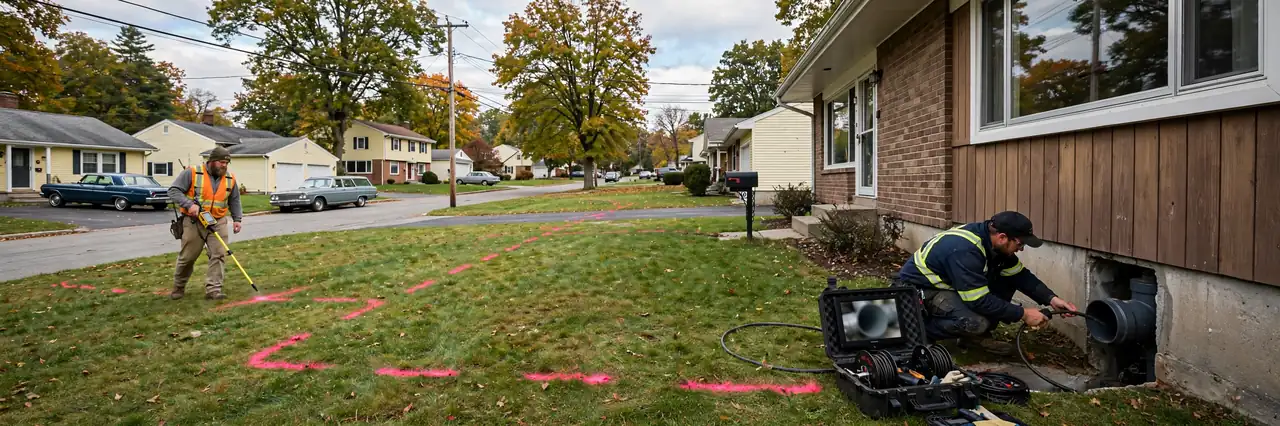
In short: A push camera with a locating sonde travels the full building sewer, recording video of roots, offsets, bellies, cracks and collapses — mapped to exact depth and location so any repair starts from facts, not guesses — and in Danvers, MA 01923, that work has to account for local housing: a typical home built around 1960, blending 1880s–1900s Victorians with 1950s–80s suburban streets. Your first step is simple: call (833) 713-2101. We begin with a full camera run with video recording and sonde locating and build the plan from what the camera shows.
You are reading our sewer camera inspection page for Danvers, MA 01923 — filed under Services → Sewer Camera Inspection, and also listed in Areas → Danvers, where every North Shore community we serve gets the same camera-first approach.
What Sewer Camera Inspection Means for Danvers Homes
Danvers (01923) is a place where sewer camera inspection rewards local knowledge. A typical home built around 1960, blending 1880s–1900s Victorians with 1950s–80s suburban streets. The 1950s–60s boom cohort carries Orangeburg risk, the pre-1940 stock leans clay tile and cast iron, and post-1980 homes run PVC — treat every line like a new subdivision pipe and you will recommend the wrong fix half the time.
Inland New England freeze-thaw with winter lows near 20°F and heavy nor'easter snow loads. In Danvers, sewer camera inspection has to survive that reality, which is why we put the camera in first and let the pipe, the soil, and the season tell us what the fix should be.
Why Danvers Changes How Sewer Camera Inspection Works
Walk Danvers's streets and you are walking a timeline of pipe: a typical home built around 1960, blending 1880s–1900s Victorians with 1950s–80s suburban streets. The 1950s–60s boom cohort carries Orangeburg risk, the pre-1940 stock leans clay tile and cast iron, and post-1980 homes run PVC. Every sewer camera inspection recommendation in 01923 starts from that timeline, not from a brochure.
The ground in Danvers does not forgive old pipe: inland glacial till and clay loams with scattered wetlands, and seasonal saturation near the Danvers River lowlands. Inland New England freeze-thaw with winter lows near 20°F and heavy nor'easter snow loads. Any sewer camera inspection plan in 01923 has to be built for that ground, not for ideal conditions.
Put it together and Danvers's signature looks like this: with the typical home built in 1960 and a quarter of stock pre-1940, Danvers straddles both failure modes: collapsing Orangeburg on the 1950s–70s subdivisions and root-invaded clay on the older village stock — the fix path (bursting vs. lining vs. spot repair) is entirely era-dependent, so camera inspection here is really 'find out which era your pipe is'. That is the pattern our crews watch for along the Route 128/I-95 and US 1 corridors, Danversport waterfront, Endicott Park and Routes 1A, 35 and 62 toward Beverly and Salem whenever sewer camera inspection comes up.
Our Sewer Camera Inspection Process in Danvers
What to expect when you book sewer camera inspection in Danvers (01923): five phases, in order, each one shaped by the housing stock, ground conditions, and lot layouts described above.
Access setup at the cleanout
Access setup at the cleanout. This is where Danvers's specifics enter the job: setup at the Danvers property's cleanout or pulled toilet — the least invasive access point the 01923 layout offers. Done right, this phase makes the rest of sewer camera inspection in 01923 straightforward.
Full camera run with video recording
Full camera run with video recording. On Danvers homes, sewer camera inspection lives or dies at this stage: a full push-camera run with video recording, narrating roots, offsets, bellies, and cracks as they appear in the Danvers line. It is unglamorous, but in 01923 it is the difference between a one-visit fix and a callback.
Sonde locating and depth mapping
Sonde locating and depth mapping. For sewer camera inspection in Danvers, expect this phase to account for local reality: sonde locating that maps the 01923 line's exact path and depth, so any future dig hits pipe, not guesswork. 01923 properties reward crews that adapt here instead of rushing through.
On-site findings review
On-site findings review. An on-site review of the footage with the Danvers homeowner, pointing at the actual problem on screen. That is how this phase plays out during sewer camera inspection in Danvers — shaped by 01923's pipe eras and ground conditions rather than a generic checklist.
Written report with recommendations
Written report with recommendations. For sewer camera inspection in Danvers, expect this phase to account for local reality: a written report with the video file and clear recommendations — the document every later Sewer Camera Inspection decision in 01923 should start from. 01923 properties reward crews that adapt here instead of rushing through.
Sewer Camera Inspection in 01923: The Local Variables
In Danvers, sewer camera inspection estimates hinge on access, pipe era, and water. Access first: limited street frontage and established yards in Danvers Then the pipe: the 1950s–60s boom cohort carries Orangeburg risk, the pre-1940 stock leans clay tile and cast iron, and post-1980 homes run PVC Then the ground: inland glacial till and clay loams with scattered wetlands, and seasonal saturation near the Danvers River lowlands. Any 01923 plan missing one of those three is a guess wearing a work order.
Inland New England freeze-thaw with winter lows near 20°F and heavy nor'easter snow loads — which is why Danvers veterans of sewer camera inspection do not wait for the worst week of winter. In 01923, shoulder-season work gives the crew the best look at the line and the ground at its most cooperative.
Frequently Asked Questions
How do Danvers's soil and groundwater conditions affect sewer camera inspection?
More than most towns: inland glacial till and clay loams with scattered wetlands, and seasonal saturation near the Danvers River lowlands. Sewer Camera Inspection in Danvers has to be planned for wet ground — infiltration through cracked joints, buoyant saturated soils, and root pressure all show up on the camera differently here. In 01923, we read the footage against the local ground conditions, which is why the same symptom gets a different fix two towns over.
What will the camera actually show in my Danvers line?
Everything that matters: root intrusion at joints, offsets, bellies holding water, cracks, scale, and collapses — each tied to exact depth and location by the sonde. In 01923 — the 1950s–60s boom cohort carries Orangeburg risk — the footage usually tells a clear era story. You watch it with us, then keep the video. Call (833) 713-2101.
Should I get a camera inspection before buying a Danvers home?
Absolutely. Sewer lines are the most expensive thing a Danvers home inspection cannot see — and in 01923 — the 1950s–60s boom cohort carries Orangeburg risk — the odds of an aging lateral are real. Our pre-purchase inspection delivers video plus a written report you can take to negotiation. (833) 713-2101.
What does Danvers's housing stock mean for sewer camera inspection?
Everything: a typical home built around 1960, blending 1880s–1900s Victorians with 1950s–80s suburban streets, and the 1950s–60s boom cohort carries Orangeburg risk, the pre-1940 stock leans clay tile and cast iron, and post-1980 homes run PVC. Sewer Camera Inspection in Danvers is era-dependent work, which is why the first visit to a 01923 home is diagnostic. Two houses on the same street can need opposite fixes, and only the footage tells them apart. Call (833) 713-2101 to find out which era your line belongs to.
How often should a Danvers homeowner repeat the inspection?
For Danvers's older stock, every few years is prudent — or immediately when symptoms change. In 01923 — the 1950s–60s boom cohort carries Orangeburg risk — a line that looked fair can turn. Think of it like a dental checkup for the pipe: (833) 713-2101 keeps the schedule.
Are there digging or access constraints for sewer camera inspection in Danvers?
With the typical home built in 1960 and a quarter of stock pre-1940, Danvers straddles both failure modes: collapsing Orangeburg on the 1950s–70s subdivisions and root-invaded clay on the older village stock — the fix path (bursting vs. lining vs. spot repair) is entirely era-dependent, so camera inspection here is really 'find out which era your pipe is'. For sewer camera inspection in Danvers, those constraints rule out the 'just trench it' reflex. Our 01923 jobs are planned around the property's actual limits — access pits instead of open trenches, liners instead of excavations — and the camera survey at the start maps precisely where work can happen.
Area Facts
- ZIP code
- 01923
- Housing stock
- a typical home built around 1960, blending 1880s–1900s Victorians with 1950s–80s suburban streets
- Typical pipe eras
- the 1950s–60s boom cohort carries Orangeburg risk, the pre-1940 stock leans clay tile and cast iron, and post-1980 homes run PVC
- Soil & drainage
- inland glacial till and clay loams with scattered wetlands, and seasonal saturation near the Danvers River lowlands
- Basements
- full basements are common across all eras of Danvers housing
- Landmarks & routes
- the Route 128/I-95 and US 1 corridors, Danversport waterfront, Endicott Park and Routes 1A, 35 and 62 toward Beverly and Salem
Keep Exploring Sewer Camera Inspection and Danvers
Sewer Camera Inspection in Downtown Beverly, MA
Sewer Camera Inspection in Downtown Beverly (01915): the same service adapted to a neighboring community's housing and soil.
Learn moreSewer Camera Inspection
How sewer camera inspection compares to the alternatives for Danvers homes in 01923 — methods, candidacy, and what the camera has to show first.
Learn moreSewer Line Problems Don’t Wait. Neither Should You.
Call now and reach a local sewer line specialist serving Beverly, MA and nearby North Shore communities — 24/7.
(833) 713-2101Free to call · No obligation · 24/7 emergency line
Serving Danvers, MA 01923