
Sewer Camera Inspection in Salem, MA
Salem properties from the 01970 blocks to the far streets get sewer camera inspection from local specialists who understand North Shore soil, aging pipe, and tight lots. One call to (833) 713-2101 puts a plan in motion.
- 24/7 emergency line
- Camera-first diagnosis
- Trenchless options
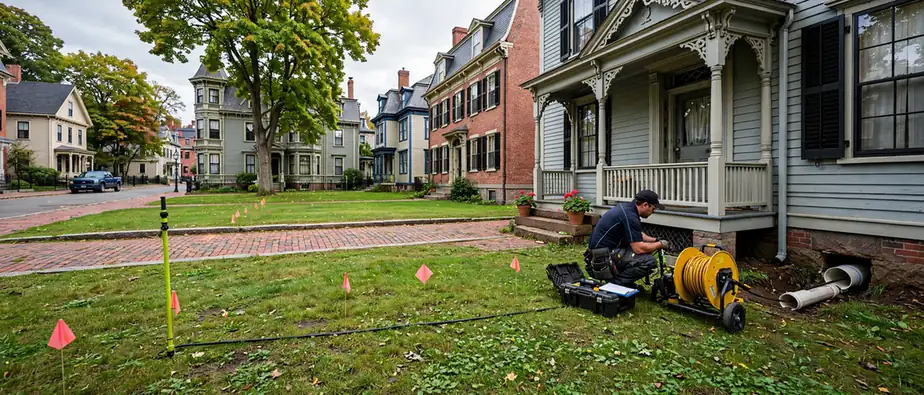
In short: A push camera with a locating sonde travels the full building sewer, recording video of roots, offsets, bellies, cracks and collapses — mapped to exact depth and location so any repair starts from facts, not guesses. That is what sewer camera inspection means for Salem, MA 01970 — a median year built of 1930 with over half the stock pre-1939 — 1850s Bridge Street Neck homes, 1866 McIntire District Victorians and dense duplexes. Call (833) 713-2101 and the first step is a full camera run with video recording and sonde locating — no digging, no guessing, just a look inside the line.
You are reading our sewer camera inspection page for Salem, MA 01970 — filed under Services → Sewer Camera Inspection, and also listed in Areas → Salem, where every North Shore community we serve gets the same camera-first approach.
Why Salem Homes Need Sewer Camera Inspection Done Differently
Sewer Camera Inspection in Salem, MA 01970 has to fit the neighborhood: a median year built of 1930 with over half the stock pre-1939 — 1850s Bridge Street Neck homes, 1866 McIntire District Victorians and dense duplexes. Over half pre-1939 means clay tile — and possibly the oldest brick or combined-era sewers — dominate, with shared or closely spaced laterals in dense multi-family conversions, so the first question on every call is never 'how fast can we dig' but 'what is actually in the ground here.'
That is why our approach in 01970 starts below the surface, not with a shovel. Full basements are standard, on concrete, stone or brick foundations depending on era. A coastal city on Salem Harbor with historic fill downtown, a high water table and low-lying flood-exposed neighborhoods. A sewer camera inspection plan that ignores those two facts is a plan written for some other town.
Why Salem Changes How Sewer Camera Inspection Works
Walk Salem's streets and you are walking a timeline of pipe: a median year built of 1930 with over half the stock pre-1939 — 1850s Bridge Street Neck homes, 1866 McIntire District Victorians and dense duplexes. Over half pre-1939 means clay tile — and possibly the oldest brick or combined-era sewers — dominate, with shared or closely spaced laterals in dense multi-family conversions. Every sewer camera inspection recommendation in 01970 starts from that timeline, not from a brochure.
The ground in Salem does not forgive old pipe: a coastal city on Salem Harbor with historic fill downtown, a high water table and low-lying flood-exposed neighborhoods. Coastal freeze-thaw, nor'easter storm surge at harbor-adjacent blocks and winter lows near 20°F. Any sewer camera inspection plan in 01970 has to be built for that ground, not for ideal conditions.
For the crew, Salem reads as: with the majority of homes pre-1939 and the densest multi-family stock in the area, Salem's sewers are old clay under tight urban lots — root intrusion, offset joints from 90-plus years of settlement, and shared laterals serving converted duplexes where nobody knows whose pipe is whose: camera inspection with locating untangles shared-lateral responsibility (critical for 2–3 family owners), and trenchless methods avoid tearing up narrow historic streets and brick sidewalks. So along Federal St and Essex St, Bridge Street Neck, the McIntire Historic District, Salem Common, Forest River Park and the Salem MBTA station, sewer camera inspection is a locate-and-verify discipline first — the fix follows the footage, not the other way around.
Our Sewer Camera Inspection Process in Salem
Every sewer camera inspection job we run in Salem, MA 01970 follows the same five phases below. The methods are standard; the judgment calls — where to dig, what to expect underground — are pure Salem.
Access setup at the cleanout
Access setup at the cleanout. For sewer camera inspection in Salem, expect this phase to account for local reality: setup at the Salem property's cleanout or pulled toilet — the least invasive access point the 01970 layout offers. 01970 properties reward crews that adapt here instead of rushing through.
Full camera run with video recording
Full camera run with video recording. On Salem homes, sewer camera inspection lives or dies at this stage: a full push-camera run with video recording, narrating roots, offsets, bellies, and cracks as they appear in the Salem line. It is unglamorous, but in 01970 it is the difference between a one-visit fix and a callback.
Sonde locating and depth mapping
Sonde locating and depth mapping. Sonde locating that maps the 01970 line's exact path and depth, so any future dig hits pipe, not guesswork. That is how this phase plays out during sewer camera inspection in Salem — shaped by 01970's pipe eras and ground conditions rather than a generic checklist.
On-site findings review
On-site findings review. For sewer camera inspection in Salem, expect this phase to account for local reality: an on-site review of the footage with the Salem homeowner, pointing at the actual problem on screen. 01970 properties reward crews that adapt here instead of rushing through.
Written report with recommendations
Written report with recommendations. This is where Salem's specifics enter the job: a written report with the video file and clear recommendations — the document every later Sewer Camera Inspection decision in 01970 should start from. Done right, this phase makes the rest of sewer camera inspection in 01970 straightforward.
Sewer Camera Inspection in 01970: The Local Variables
Salem homeowners are often surprised by what actually drives a sewer camera inspection job. It is not the fixture count — it is access (narrow lots and shared driveways typical of Salem's streets), pipe generation (over half pre-1939 means clay tile — and possibly the oldest brick or combined-era sewers — dominate, with shared or closely spaced laterals in dense multi-family conversions), and groundwater (a coastal city on Salem Harbor with historic fill downtown, a high water table and low-lying flood-exposed neighborhoods). In 01970, those three answer nearly every 'why does it cost / take this long' question.
One more Salem reality: coastal freeze-thaw, nor'easter storm surge at harbor-adjacent blocks and winter lows near 20°F Plan sewer camera inspection around that cycle in 01970 and everything downstream — diagnosis, access, restoration — gets easier.
Frequently Asked Questions
Are there digging or access constraints for sewer camera inspection in Salem?
Often yes, and they are local: with the majority of homes pre-1939 and the densest multi-family stock in the area, Salem's sewers are old clay under tight urban lots — root intrusion, offset joints from 90-plus years of settlement, and shared laterals serving converted duplexes where nobody knows whose pipe is whose: camera inspection with locating untangles shared-lateral responsibility (critical for 2–3 family owners), and trenchless methods avoid tearing up narrow historic streets and brick sidewalks. In 01970, that is exactly why sewer camera inspection leans trenchless — camera, locate, and minimal-dig methods that respect tight lots, mature landscaping, and shared access. Call (833) 713-2101 and we will map what your property allows before proposing anything.
What does Salem's housing stock mean for sewer camera inspection?
A median year built of 1930 with over half the stock pre-1939 — 1850s Bridge Street Neck homes, 1866 McIntire District Victorians and dense duplexes. Over half pre-1939 means clay tile — and possibly the oldest brick or combined-era sewers — dominate, with shared or closely spaced laterals in dense multi-family conversions. For sewer camera inspection in Salem, that era mix is the whole game: it tells the crew whether to expect root-bound clay joints, ovalized fiber conduit, or sound PVC — and the camera confirms which one your 01970 property actually has before any method is chosen.
Should I get a camera inspection before buying a Salem home?
Absolutely. Sewer lines are the most expensive thing a Salem home inspection cannot see — and in 01970 — over half pre-1939 means clay tile — and possibly the oldest brick or combined-era sewers — dominate — the odds of an aging lateral are real. Our pre-purchase inspection delivers video plus a written report you can take to negotiation. (833) 713-2101.
How do Salem's soil and groundwater conditions affect sewer camera inspection?
Directly: a coastal city on Salem Harbor with historic fill downtown, a high water table and low-lying flood-exposed neighborhoods. For sewer camera inspection in Salem, that means the crew expects infiltration at weak joints, root systems hunting moisture, and access planning that respects a high or variable water table. In 01970, the camera survey is scheduled and interpreted with those ground conditions in mind — what looks like a minor joint offset on dry ground reads very differently in saturated soil.
What will the camera actually show in my Salem line?
A narrated tour of your pipe's condition: every joint, every root mass, every low spot, mapped to the foot and the inch. For Salem lines (over half pre-1939 means clay tile — and possibly the oldest brick or combined-era sewers — dominate), that footage is the difference between targeted repair and expensive guessing in 01970. (833) 713-2101 to book the inspection.
How often should a Salem homeowner repeat the inspection?
For Salem's older stock, every few years is prudent — or immediately when symptoms change. In 01970 — over half pre-1939 means clay tile — and possibly the oldest brick or combined-era sewers — dominate — a line that looked fair can turn. Think of it like a dental checkup for the pipe: (833) 713-2101 keeps the schedule.
Area Facts
- ZIP code
- 01970
- Housing stock
- a median year built of 1930 with over half the stock pre-1939 — 1850s Bridge Street Neck homes, 1866 McIntire District Victorians and dense duplexes
- Typical pipe eras
- over half pre-1939 means clay tile — and possibly the oldest brick or combined-era sewers — dominate, with shared or closely spaced laterals in dense multi-family conversions
- Soil & drainage
- a coastal city on Salem Harbor with historic fill downtown, a high water table and low-lying flood-exposed neighborhoods
- Basements
- full basements are standard, on concrete, stone or brick foundations depending on era
- Landmarks & routes
- Federal St and Essex St, Bridge Street Neck, the McIntire Historic District, Salem Common, Forest River Park and the Salem MBTA station
Keep Exploring Sewer Camera Inspection and Salem
Sewer Camera Inspection in Swampscott, MA
Comparing neighborhoods? Our sewer camera inspection guide for Swampscott, MA 01907 shows how the work changes a few streets over.
Learn moreSewer Camera Inspection
How sewer camera inspection compares to the alternatives for Salem homes in 01970 — methods, candidacy, and what the camera has to show first.
Learn moreSewer Line Problems Don’t Wait. Neither Should You.
Call now and reach a local sewer line specialist serving Beverly, MA and nearby North Shore communities — 24/7.
(833) 713-2101Free to call · No obligation · 24/7 emergency line
Serving Salem, MA 01970