
Sewer Leak Detection in Peabody, MA
Sewer Leak Detection in Peabody starts with knowing what is actually wrong underground. Our 01960 specialists camera the line, map it to the inch, and recommend the least invasive fix that fits the property — call (833) 713-2101 to get started.
- 24/7 emergency line
- Camera-first diagnosis
- Trenchless options
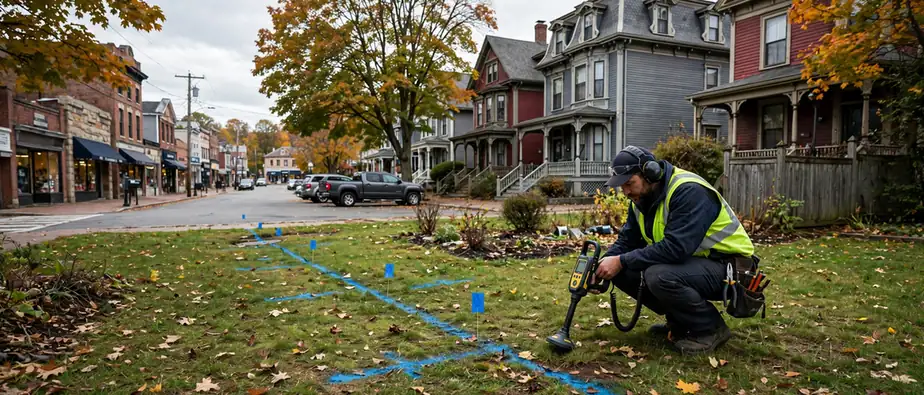
In short: Pinpointing where a building sewer leaks — groundwater seeping in through failed joints, or sewage escaping out — using camera survey, dye testing, smoke testing and acoustic methods before any digging happens. That is what sewer leak detection means for Peabody, MA 01960 — a median year built of 1966 — 1880s–1920s in-town housing, 1960 split-entry suburbia and 1988-plus custom colonials. Call (833) 713-2101 and the first step is a symptom review followed by camera survey and tracer testing — no digging, no guessing, just a look inside the line.
This sewer leak detection guide covers Peabody, MA 01960. Browse it two ways: Services → Sewer Leak Detection for the service itself, or Areas → Peabody for everything we do in this community.
What Sewer Leak Detection Means for Peabody Homes
Sewer Leak Detection in Peabody, MA 01960 has to fit the neighborhood: a median year built of 1966 — 1880s–1920s in-town housing, 1960 split-entry suburbia and 1988-plus custom colonials. The big 1950s–70s suburban cohort makes Orangeburg and cast iron the prime risks, while pre-1940 in-town stock leans clay tile and cast iron, so the first question on every call is never 'how fast can we dig' but 'what is actually in the ground here.'
Inland freeze-thaw with winter lows near 20°F and frost heave working against shallow laterals. In Peabody, sewer leak detection has to survive that reality, which is why we put the camera in first and let the pipe, the soil, and the season tell us what the fix should be.
Why Peabody Changes How Sewer Leak Detection Works
The pipe story in Peabody follows the housing: a median year built of 1966 — 1880s–1920s in-town housing, 1960 split-entry suburbia and 1988-plus custom colonials, and the big 1950s–70s suburban cohort makes Orangeburg and cast iron the prime risks, while pre-1940 in-town stock leans clay tile and cast iron. That mix is exactly why sewer leak detection here cannot be one-size-fits-all — a clay lateral and a fiber-conduit lateral fail in completely different ways.
The ground in Peabody does not forgive old pipe: glacial till over Peabody Granite bedrock — same granite family as Cape Ann — with seasonal wetness in low spots near the North River. Inland freeze-thaw with winter lows near 20°F and frost heave working against shallow laterals. Any sewer leak detection plan in 01960 has to be built for that ground, not for ideal conditions.
Peabody's 1966-median stock makes it Orangeburg ground zero: thousands of 1950s–70s split-entries and ranches whose fiber-conduit laterals are ovalizing under root pressure and soil movement, while the in-town Victorians add clay-tile root intrusion — two different pipe failures, one symptom (slow drains plus sewage smell), and only a camera tells them apart: sell the inspection as the diagnostic that decides between bursting (Orangeburg) and lining (clay). If you live near where Route 128/I-95 meets Route 1, Lowell St and Lynn St, the Northshore Mall corridor, Brown's Pond and Brooksby Farm, that description probably sounds familiar — it is the reason sewer leak detection in Peabody starts with diagnosis, not excavation.
Sewer Leak Detection in Peabody: Five Phases, Zero Guesswork
Every sewer leak detection job we run in Peabody, MA 01960 follows the same five phases below. The methods are standard; the judgment calls — where to dig, what to expect underground — are pure Peabody.
Symptom review and site history
Symptom review and site history. In Peabody, this phase of sewer leak detection means a symptom review with the Peabody caller — odors, soggy spots, foundation dampness — plus the 01960 property's pipe history. For a 01960 property, that step sets up everything after it — skip it and the rest of the job is guesswork.
Camera survey of the suspect line
Camera survey of the suspect line. On Peabody homes, sewer leak detection lives or dies at this stage: a camera survey of the suspect Peabody line to find the joints, cracks, or offsets where water is moving wrong. It is unglamorous, but in 01960 it is the difference between a one-visit fix and a callback.
Dye, smoke or acoustic testing
Dye, smoke or acoustic testing. For sewer leak detection in Peabody, expect this phase to account for local reality: dye, smoke, or acoustic testing that traces the leak's path through Peabody soil without opening the ground. 01960 properties reward crews that adapt here instead of rushing through.
Locate and mark the leak point
Locate and mark the leak point. Locating and surface-marking the exact leak point on the 01960 property, mapped to depth. That is how this phase plays out during sewer leak detection in Peabody — shaped by 01960's pipe eras and ground conditions rather than a generic checklist.
Targeted repair plan
Targeted repair plan. A targeted repair plan for the Peabody leak — fixing feet of pipe, not the whole yard. That is how this phase plays out during sewer leak detection in Peabody — shaped by 01960's pipe eras and ground conditions rather than a generic checklist.
Sewer Leak Detection in 01960: The Local Variables
What makes sewer leak detection in Peabody different from the next town over? Access (shared access and close-set homes around Peabody's older blocks), the local pipe timeline (the big 1950s–70s suburban cohort makes Orangeburg and cast iron the prime risks, while pre-1940 in-town stock leans clay tile and cast iron), and a water table that behaves like this: glacial till over Peabody Granite bedrock — same granite family as Cape Ann — with seasonal wetness in low spots near the North River. Put those together and 01960 jobs have a character all their own.
One more Peabody reality: inland freeze-thaw with winter lows near 20°F and frost heave working against shallow laterals Plan sewer leak detection around that cycle in 01960 and everything downstream — diagnosis, access, restoration — gets easier.
Frequently Asked Questions
How do Peabody's soil and groundwater conditions affect sewer leak detection?
More than most towns: glacial till over Peabody Granite bedrock — same granite family as Cape Ann — with seasonal wetness in low spots near the North River. Sewer Leak Detection in Peabody has to be planned for wet ground — infiltration through cracked joints, buoyant saturated soils, and root pressure all show up on the camera differently here. In 01960, we read the footage against the local ground conditions, which is why the same symptom gets a different fix two towns over.
Can you find the leak without digging up my Peabody property?
That is the point — locate first, dig once (or not at all, with trenchless repair). Peabody leak detection in 01960 maps the failure precisely, so the fix is surgical. Call (833) 713-2101 and keep the yard.
What happens if a Peabody sewer leak goes unfixed?
It never improves on its own: infiltration erodes bedding soil and can open sinkholes over the 01960 line, exfiltration contaminates soil, and root intrusion accelerates at the leak point. In Peabody — glacial till over Peabody Granite bedrock — delay compounds the damage. Call (833) 713-2101 while the fix is still small.
What does Peabody's housing stock mean for sewer leak detection?
A median year built of 1966 — 1880s–1920s in-town housing, 1960 split-entry suburbia and 1988-plus custom colonials. The big 1950s–70s suburban cohort makes Orangeburg and cast iron the prime risks, while pre-1940 in-town stock leans clay tile and cast iron. For sewer leak detection in Peabody, that era mix is the whole game: it tells the crew whether to expect root-bound clay joints, ovalized fiber conduit, or sound PVC — and the camera confirms which one your 01960 property actually has before any method is chosen.
How do I know my Peabody sewer line is leaking, not just clogged?
Watch for what a clog cannot explain: odors with free-flowing drains, saturated soil over the pipe run, or basement moisture that tracks storms. In Peabody — glacial till over Peabody Granite bedrock — those point to a leaking lateral in 01960, not a blockage. (833) 713-2101 for detection that finds the exact point.
Are there digging or access constraints for sewer leak detection in Peabody?
Peabody's 1966-median stock makes it Orangeburg ground zero: thousands of 1950s–70s split-entries and ranches whose fiber-conduit laterals are ovalizing under root pressure and soil movement, while the in-town Victorians add clay-tile root intrusion — two different pipe failures, one symptom (slow drains plus sewage smell), and only a camera tells them apart: sell the inspection as the diagnostic that decides between bursting (Orangeburg) and lining (clay). For sewer leak detection in Peabody, those constraints rule out the 'just trench it' reflex. Our 01960 jobs are planned around the property's actual limits — access pits instead of open trenches, liners instead of excavations — and the camera survey at the start maps precisely where work can happen.
Area Facts
- ZIP code
- 01960
- Housing stock
- a median year built of 1966 — 1880s–1920s in-town housing, 1960 split-entry suburbia and 1988-plus custom colonials
- Typical pipe eras
- the big 1950s–70s suburban cohort makes Orangeburg and cast iron the prime risks, while pre-1940 in-town stock leans clay tile and cast iron
- Soil & drainage
- glacial till over Peabody Granite bedrock — same granite family as Cape Ann — with seasonal wetness in low spots near the North River
- Basements
- full basements are common, from partially finished 1920s basements to full unfinished 1980s lower levels
- Landmarks & routes
- where Route 128/I-95 meets Route 1, Lowell St and Lynn St, the Northshore Mall corridor, Brown's Pond and Brooksby Farm
More on Sewer Leak Detection in Peabody, MA
Peabody, MA
Everything we do in Peabody, MA 01960 — including sewer leak detection: all twelve services, local pipe eras, and the ground conditions that shape every job.
Learn moreSewer Leak Detection in Prides Crossing, MA
Sewer Leak Detection in Prides Crossing (01965): the same service adapted to a neighboring community's housing and soil.
Learn moreSewer Line Problems Don’t Wait. Neither Should You.
Call now and reach a local sewer line specialist serving Beverly, MA and nearby North Shore communities — 24/7.
(833) 713-2101Free to call · No obligation · 24/7 emergency line
Serving Peabody, MA 01960