
Sewer Line Installation in Peabody, MA
Peabody's Orangeburg ground zero homes need Sewer Line Installation built around Orangeburg and cast iron across the big 1950s-70s cohort; clay tile and cast iron on the pre-1940 in-town stock — two different pipe failures with one symptom — only the camera tells them apart. 01960 installation starts with the camera: (833) 713-2101.
- Serving Peabody, MA 01960
- Camera-first diagnosis
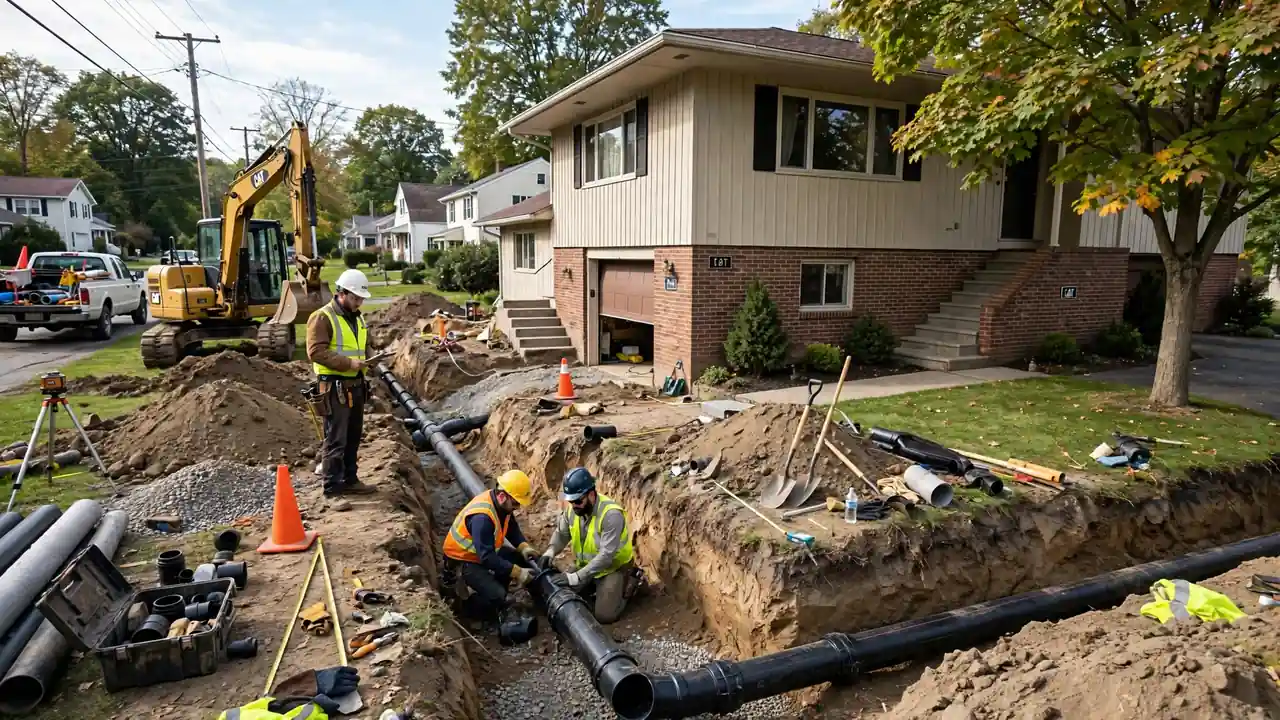
In short: For Peabody (01960), Sewer Line Installation means working Orangeburg and cast iron across the big 1950s-70s cohort; clay tile and cast iron on the pre-1940 in-town stock in ground that is glacial till over Peabody Granite bedrock with seasonal wetness near the North River low spots. Installation begins at (833) 713-2101 with a camera read — diagnosis before tools, on every Peabody visit.
Sewer Line Installation in Peabody, MA 01960
There is no generic Sewer Line Installation in Peabody because no two Peabody laterals match: median year built 1966: thousands of 1950s-70s split-entries and ranches plus 1880s-1920s in-town Victorians. A 01960 address gets a per-property installation read — Peabody camera footage, joint by joint — before any 01960 method is named, which is why Peabody neighbors can need different fixes for the same symptom.
Ask what waiting costs an Peabody homeowner and the 01960 answer is the finished basement, the landscaping, the driveway. Orangeburg and cast iron across the big 1950s-70s cohort; clay tile and cast iron on the pre-1940 in-town stock never improves with age in Peabody — it intrudes, offsets, admits water. Sewer Line Installation in Peabody is cheapest at the 01960 camera stage, and installation here is priced to make the early Peabody call the easy call.
Brooksby Farm, Brown's Pond and the Northshore Mall corridor is the Peabody scenery; the lateral tells its own 01960 story. In Peabody, mature 1950s-70s subdivision trees at peak root pressure plus in-town Victorians with century-old root systems — so Sewer Line Installation in Peabody that ignores the trees gets called back. Every 01960 installation visit maps Peabody root pressure, reads the joints, and only then prescribes.
How Peabody's local conditions change installation
The Peabody camera has a favorite sentence: it is the pipe era. The new Peabody pipe is sized and sloped for the home it serves, and the failed 01960 material it replaces tells the crew what failed last time — Orangeburg and cast iron across the big 1950s-70s cohort; clay tile and cast iron on the pre-1940 in-town stock is the cautionary tale the new Peabody line is designed against. Knowing Orangeburg and cast iron across the big 1950s-70s cohort; clay tile and cast iron on the pre-1940 in-town stock before choosing 01960 tools is what separates an Peabody Sewer Line Installation visit from a 01960 drain-cleaning gamble.
Glacial till over Peabody Granite bedrock with seasonal wetness near the North River low spots works quietly on Peabody laterals between 01960 visits. 01960 trench walls are managed for the Peabody soil at hand, since cave-ins start with the ground, not the pipe — dewatering is planned for the Peabody installation where seasonal high groundwater pushing infiltration through open joints each wet spring. The Peabody crew reads the soil's signature on the pipe — 01960 offsets where ground shifted, bellies where it settled — before naming the installation fix.
A dry-weather diagnosis can miss what an Peabody wet-weather camera catches: seasonal high groundwater pushing infiltration through open joints each wet spring. The Peabody trench plan accounts for groundwater from day one, because a 01960 line set in a wet trench settles differently than one set dry — and where seasonal high groundwater pushing infiltration through open joints each wet spring, Peabody joints are sealed before backfill. In Peabody, the honest 01960 Sewer Line Installation read happens when the water table is up.
Mature 1950s-70s subdivision trees at peak root pressure plus in-town Victorians with century-old root systems — in Peabody, roots hunt what 01960 joints leak, and joints leak what roots want. New 01960 pipe with modern sealed joints gives Peabody roots far fewer entries than the old line — which matters most for installation where mature 1950s-70s subdivision trees at peak root pressure plus in-town Victorians with century-old root systems. That Peabody feedback loop is the root story, and 01960 Sewer Line Installation is planned inside it.
Access decides the Peabody method more than any catalog: split-entry and ranch lots where the camera must separate end-of-life laterals from PVC stock. The Peabody route follows the shortest practical 01960 path that still protects structures, driveways and landscaping — split-entry and ranch lots where the camera must separate end-of-life laterals from PVC stock. In 01960, the Sewer Line Installation plan is drawn on the Peabody lot walk — where the pits go, what stays untouched, what the 01960 ground allows.
The Route 128/Route 1 retail corridor and the Northshore Mall area runs on its own rhythm, and Peabody Sewer Line Installation follows it. 01960 grease and high-flow laterals get cleanouts placed for the Peabody maintenance the line will actually need — the installation plan, not a brochure's. In 01960, commercial installation visits are scheduled so the business never stops for a drain.
Area Facts
- Primary ZIP
- 01960 — the ZIP on every installation quote in Peabody
- Housing stock
- Median year built 1966: thousands of 1950s-70s split-entries and ranches plus 1880s-1920s in-town Victorians — the Orangeburg ground zero homes behind Peabody installation calls
- Typical lateral pipe
- Orangeburg and cast iron across the big 1950s-70s cohort; clay tile and cast iron on the pre-1940 in-town stock — what the Peabody camera usually finds
- Soil and drainage
- Glacial till over Peabody Granite bedrock with seasonal wetness near the North River low spots — the ground installation is planned against in Peabody
- Trees and roots
- Mature 1950s-70s subdivision trees at peak root pressure plus in-town Victorians with century-old root systems — the root pressure behind Peabody installation
- Local note
- Two different pipe failures with one symptom — only the camera tells them apart — the 01960 installation reality
How installation works in Peabody, MA
What an Peabody homeowner sees on 01960 Sewer Line Installation day — four steps, no surprises, with the Peabody camera talking at every stage of installation.
Route layout and utility locating
The Peabody crew maps the 01960 path from house to municipal main, marks every underground utility, and confirms depths. In Peabody, glacial till over Peabody Granite bedrock with seasonal wetness near the North River low spots sets how the installation trench or pull path is engineered — nothing 01960 is dug until the route is understood.
Excavation or trenchless pull
On the Peabody lot, the new line goes in by open trench or trenchless pull along the old 01960 path. split-entry and ranch lots where the camera must separate end-of-life laterals from PVC stock. Either way the Peabody pipe is laid at a steady, verified fall toward the main — the single most important installation number.
Bedding, jointing and the tap
The 01960 pipe rests on Peabody bedding matched to glacial till over Peabody Granite bedrock with seasonal wetness near the North River low spots, joints are sealed against the groundwater where seasonal high groundwater pushing infiltration through open joints each wet spring, and the Peabody tap into the municipal main is made properly. 01960 grade is re-checked along the full run before backfill.
Backfill, compaction and proof
The Peabody trench is backfilled in lifts and compacted against future settlement, then the 01960 line is water-tested and camera-verified end to end. The Peabody yard is left graded and clean, the new installation lateral documented on video.
Signs you need installation in Peabody
Peabody homeowners call about the 01960 symptom; these are the signs the symptom is an Peabody Sewer Line Installation job — and what each tells the 01960 camera to look for.
- A new build or addition that needs its own lateral to the main — in Peabody, this 01960 pattern points the camera at Orangeburg and cast iron across the big 1950s-70s cohort; clay tile and cast iron on the pre-1940 in-town stock before any installation.
- A lateral so collapsed or deformed that repair costs approach replacement — a classic Peabody installation trigger: the 01960 camera checks Orangeburg and cast iron across the big 1950s-70s cohort; clay tile and cast iron on the pre-1940 in-town stock first.
- Recurring failures on a line the camera shows is beyond its service life — the Peabody crew reads this as Orangeburg and cast iron across the big 1950s-70s cohort; clay tile and cast iron on the pre-1940 in-town stock on the 01960 camera during installation.
- An addition or ADU that the old line cannot legally or physically serve — in Peabody, this 01960 pattern points the camera at Orangeburg and cast iron across the big 1950s-70s cohort; clay tile and cast iron on the pre-1940 in-town stock before any installation.
- Septic-to-sewer conversion on a {area} property — a classic Peabody installation trigger: the 01960 camera checks Orangeburg and cast iron across the big 1950s-70s cohort; clay tile and cast iron on the pre-1940 in-town stock first.
- A failed building sewer where {pipe} has reached end of life — the Peabody crew reads this as Orangeburg and cast iron across the big 1950s-70s cohort; clay tile and cast iron on the pre-1940 in-town stock on the 01960 camera during installation.
Related pages for Peabody
Two Peabody bookmarks for a 01960 Sewer Line Installation job: <a href="/sewer-line-installation/">Sewer Line Installation across Beverly, MA</a> for the methods, and <a href="/peabody/">sewer service in Peabody</a> for two different pipe failures with one symptom — only the camera tells them apart in 01960.
The Peabody area page maps 01960 ground and Peabody housing eras; the Sewer Line Installation service page maps the methods. Together they frame this 01960 installation page for Peabody.
Frequently Asked Questions
When does Peabody need installation instead of repair?
When the Peabody camera shows collapse or failures scattered along the 01960 run. In Peabody, Orangeburg and cast iron across the big 1950s-70s cohort; clay tile and cast iron on the pre-1940 in-town stock — once an Peabody line fails in multiple places, one new 01960 lateral costs less over its life than serial spot repairs: (833) 713-2101.
How is the route chosen on a Peabody lot?
Shortest practical 01960 path that protects the Peabody structures, driveways and landscaping — split-entry and ranch lots where the camera must separate end-of-life laterals from PVC stock. Utilities are located first, then the Peabody crew chooses open trench or 01960 trenchless pull for the installation based on glacial till over Peabody Granite bedrock with seasonal wetness near the North River low spots.
What does glacial till over Peabody Granite bedrock with seasonal wetness near the North River low spots change about the Peabody install?
Peabody bedding, compaction and dewatering. glacial till over Peabody Granite bedrock with seasonal wetness near the North River low spots — so the 01960 bedding is specified for that ground, backfill is compacted in lifts, and the Peabody trench plan accounts for water from day one of installation.
How long does a 01960 installation take?
Most residential Peabody installs complete in one to three working days once the 01960 route is set — the variable is Peabody access and ground, not the pipe. split-entry and ranch lots where the camera must separate end-of-life laterals from PVC stock. Your 01960 scheduler at (833) 713-2101 gives a straight timeline after the Peabody site walk.
Will the new line handle mature 1950s-70s subdivision trees at peak root pressure plus in-town Victorians with century-old root systems?
That is designed into the Peabody installation, not hoped for. The 01960 route keeps distance from aggressive root zones where the Peabody lot allows, and modern sealed joints give 01960 roots far fewer entries than the old line had.
Does installation in Peabody include the connection to the main?
Yes — Peabody layout, excavation or pull, bedding, jointing, the 01960 tap into the municipal main, backfill, water test and final Peabody camera pass are one installation job. One call to (833) 713-2101 starts it with a 01960 site walk.
Sewer Line Problems Don’t Wait. Neither Should You.
Call now and reach a local sewer line specialist serving Beverly, MA and nearby North Shore communities — 24/7.
(833) 713-2101Free to call · No obligation · 24/7 emergency line
Serving Peabody, MA 01960 — Sewer Line Installation available 24/7