
Pipe Lining in North Beverly, MA
Slow drains, sewage odors, or soggy patches in North Beverly? Our 01915 crew handles pipe lining for homes like yours every week. Call (833) 713-2101 for a straight answer about your line.
- 24/7 emergency line
- Camera-first diagnosis
- Trenchless options
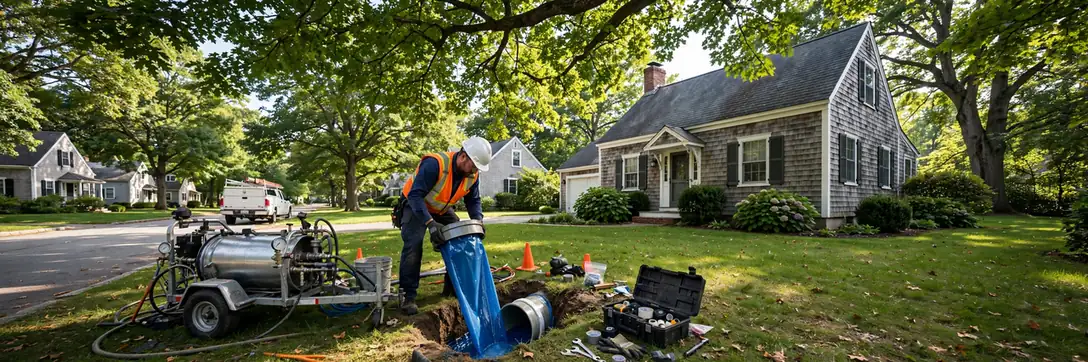
In short: Cured-in-place pipe (CIPP) lining: an epoxy-saturated liner is inverted into the existing pipe and cured into a smooth, jointless new pipe inside the old one — sealing cracks, offset joints and root entry points. That is what pipe lining means for North Beverly, MA 01915 — a typical home built in 1949 — 1940 Cape Cods, mid-century homes and 1970s stock on suburban inland lots. Call (833) 713-2101 and the first step is a camera survey with precise measurement of the host pipe — no digging, no guessing, just a look inside the line.
This pipe lining guide covers North Beverly, MA 01915. Browse it two ways: Services → Pipe Lining for the service itself, or Areas → North Beverly for everything we do in this community.
What Pipe Lining Means for North Beverly Homes
In North Beverly (01915), pipe lining is rarely a generic job. A typical home built in 1949 — 1940 Cape Cods, mid-century homes and 1970s stock on suburban inland lots. The 1949-typical stock sits exactly on the clay-to-cast-iron transition, with Orangeburg risk in the 1960s–70s homes and PVC from the 1980s on — which means the crew arriving at your door needs to know which era of pipe they are dealing with before a single decision gets made.
That is why our approach in 01915 starts below the surface, not with a shovel. Full basements are standard across North Beverly's suburban stock. Inland glacial till and drumlin terrain, with mature suburban tree canopies driving root pressure. A pipe lining plan that ignores those two facts is a plan written for some other town.
Why North Beverly Changes How Pipe Lining Works
The 1949-typical stock sits exactly on the clay-to-cast-iron transition, with Orangeburg risk in the 1960s–70s homes and PVC from the 1980s on. Across North Beverly — a typical home built in 1949 — 1940 Cape Cods, mid-century homes and 1970s stock on suburban inland lots — that era spread means two neighbors can need pipe lining for opposite reasons: one fighting roots at clay joints, the other watching a fiber pipe ovalize.
Inland glacial till and drumlin terrain, with mature suburban tree canopies driving root pressure. Add full basements are standard across North Beverly's suburban stock, and you have the full picture of what pipe lining contends with in North Beverly: water finding every weak joint, roots hunting every seam, and access points limited by how the house meets the ground.
Put it together and North Beverly's signature looks like this: with the typical home built in 1949, North Beverly sits exactly on the clay-to-cast-iron transition — many laterals are original 75-year-old clay at the end of service life, now under mature suburban tree canopies: root intrusion at clay joints is the number-one call driver here, a camera finds it in minutes, and trenchless lining preserves the established landscaping and driveways that 1950s lots are known for. That is the pattern our crews watch for along Tozer Rd, Dodge St and Sohier Rd, the North Beverly MBTA station, North Beverly Elementary, Beverly High School and the Cummings Center whenever pipe lining comes up.
Our Pipe Lining Process in North Beverly
A pipe lining visit in North Beverly is a process, not a guess. These five phases are how we keep 01915 jobs predictable even when the pipe, soil, and access are not.
Camera survey and precise measurement
Camera survey and precise measurement. On North Beverly homes, pipe lining lives or dies at this stage: a camera survey with precise measurement, since a liner for a North Beverly pipe has to match the host pipe's diameter and length in 01915 exactly. It is unglamorous, but in 01915 it is the difference between a one-visit fix and a callback.
High-pressure cleaning and prep
High-pressure cleaning and prep. On North Beverly homes, pipe lining lives or dies at this stage: high-pressure cleaning that strips roots, scale, and debris from the North Beverly line so the epoxy bonds to clean pipe wall. It is unglamorous, but in 01915 it is the difference between a one-visit fix and a callback.
Liner inversion and positioning
Liner inversion and positioning. Inversion of the epoxy-saturated liner into place — one access point, no trench across the 01915 property. That is how this phase plays out during pipe lining in North Beverly — shaped by 01915's pipe eras and ground conditions rather than a generic checklist.
Curing the epoxy liner
Curing the epoxy liner. In North Beverly, this phase of pipe lining means curing the liner into a smooth, jointless new pipe inside the old North Beverly line, sealing every crack and offset joint. For a 01915 property, that step sets up everything after it — skip it and the rest of the job is guesswork.
Final camera run and flow check
Final camera run and flow check. On North Beverly homes, pipe lining lives or dies at this stage: a final camera run and flow check confirming the lined North Beverly pipe is continuous, sealed, and draining properly. It is unglamorous, but in 01915 it is the difference between a one-visit fix and a callback.
Pipe Lining in 01915: The Local Variables
North Beverly homeowners are often surprised by what actually drives a pipe lining job. It is not the fixture count — it is access (limited street frontage and established yards in North Beverly), pipe generation (the 1949-typical stock sits exactly on the clay-to-cast-iron transition, with Orangeburg risk in the 1960s–70s homes and PVC from the 1980s on), and groundwater (inland glacial till and drumlin terrain, with mature suburban tree canopies driving root pressure). In 01915, those three answer nearly every 'why does it cost / take this long' question.
One more North Beverly reality: inland freeze-thaw with full frost exposure and nor'easter snow Plan pipe lining around that cycle in 01915 and everything downstream — diagnosis, access, restoration — gets easier.
Frequently Asked Questions
Is my North Beverly pipe a candidate for lining, or does it need replacement?
Only the camera can say. If the North Beverly pipe holds its shape, lining seals it for decades; if it has collapsed or bellied badly, bursting or spot replacement is the honest answer. In 01915, we show you the footage and explain the call — (833) 713-2101.
Are there digging or access constraints for pipe lining in North Beverly?
Yes — North Beverly has its own: with the typical home built in 1949, North Beverly sits exactly on the clay-to-cast-iron transition — many laterals are original 75-year-old clay at the end of service life, now under mature suburban tree canopies: root intrusion at clay joints is the number-one call driver here, a camera finds it in minutes, and trenchless lining preserves the established landscaping and driveways that 1950s lots are known for. That shapes every pipe lining plan in 01915: trenchless-first thinking, careful locating, and repairs sized to the property rather than the equipment. The site visit is where those constraints get mapped, not discovered mid-job.
How long does pipe lining take in a North Beverly home?
Typically a day or two for a 01915 residential line: the North Beverly crew cleans, inverts the liner, cures it, and verifies with a final camera run. Compare that to open-trench replacement and the appeal is obvious. (833) 713-2101 starts with the camera survey.
What does North Beverly's housing stock mean for pipe lining?
A typical home built in 1949 — 1940 Cape Cods, mid-century homes and 1970s stock on suburban inland lots. The 1949-typical stock sits exactly on the clay-to-cast-iron transition, with Orangeburg risk in the 1960s–70s homes and PVC from the 1980s on. For pipe lining in North Beverly, that era mix is the whole game: it tells the crew whether to expect root-bound clay joints, ovalized fiber conduit, or sound PVC — and the camera confirms which one your 01915 property actually has before any method is chosen.
Will lining reduce my pipe's diameter in North Beverly?
Not in any way you would notice. Lining trades a thin wall for a perfectly smooth bore, and North Beverly's old scaled pipes in 01915 gain flow from that trade. The camera footage before and after tells the story — (833) 713-2101 to see yours.
How do North Beverly's soil and groundwater conditions affect pipe lining?
More than most towns: inland glacial till and drumlin terrain, with mature suburban tree canopies driving root pressure. Pipe Lining in North Beverly has to be planned for wet ground — infiltration through cracked joints, buoyant saturated soils, and root pressure all show up on the camera differently here. In 01915, we read the footage against the local ground conditions, which is why the same symptom gets a different fix two towns over.
Area Facts
- ZIP code
- 01915
- Housing stock
- a typical home built in 1949 — 1940 Cape Cods, mid-century homes and 1970s stock on suburban inland lots
- Typical pipe eras
- the 1949-typical stock sits exactly on the clay-to-cast-iron transition, with Orangeburg risk in the 1960s–70s homes and PVC from the 1980s on
- Soil & drainage
- inland glacial till and drumlin terrain, with mature suburban tree canopies driving root pressure
- Basements
- full basements are standard across North Beverly's suburban stock
- Landmarks & routes
- Tozer Rd, Dodge St and Sohier Rd, the North Beverly MBTA station, North Beverly Elementary, Beverly High School and the Cummings Center
More on Pipe Lining in North Beverly, MA
Pipe Lining in Peabody, MA
Comparing neighborhoods? Our pipe lining guide for Peabody, MA 01960 shows how the work changes a few streets over.
Learn morePipe Lining
How pipe lining compares to the alternatives for North Beverly homes in 01915 — methods, candidacy, and what the camera has to show first.
Learn moreSewer Line Problems Don’t Wait. Neither Should You.
Call now and reach a local sewer line specialist serving Beverly, MA and nearby North Shore communities — 24/7.
(833) 713-2101Free to call · No obligation · 24/7 emergency line
Serving North Beverly, MA 01915