
Trenchless vs Traditional Sewer Repair
The complete comparison: how each approach works, honest cost and disruption analysis, longevity — and the decision framework that picks correctly.
- Practical guide
- Local specialists
- Camera first
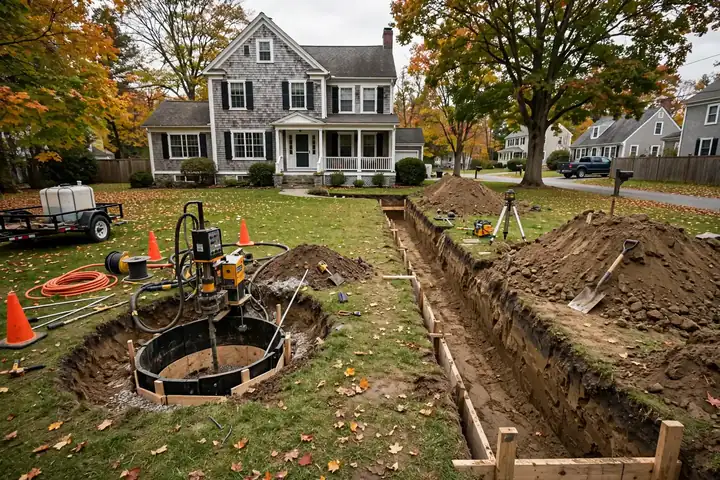
The oldest debate in sewer repair is also the most practically important: fix the line without digging it up (trenchless — lining or bursting), or excavate and replace it openly (traditional open cut)? Both produce a working sewer line. They differ in cost structure, disruption, risk profile, and the situations each handles best. Choosing well saves thousands and spares your property; choosing poorly buys regret by the cubic yard.
This guide compares the two approaches across every dimension that matters, with the Beverly-area scenarios where each wins. For trenchless's honest limits, read our limitations guide alongside.
How Each Approach Works
Trenchless renews the line through its existing underground path. CIPP lining builds a structural tube inside the old pipe from access points — no excavation at the repair zone. Pipe bursting fractures the old pipe outward while pulling new HDPE through the same corridor — two pits, no trench. Traditional open cut excavates the full trench: the old pipe is exposed, removed, and new pipe is laid on prepared bedding with verified grade, then the trench is backfilled, compacted, and the surface restored.
The fundamental difference is not the pipe — both approaches install long-lived pipe — but the relationship with the surface. Trenchless preserves it; open cut remakes it. Every downstream comparison flows from that fact.
Cost Compared Honestly
Open cut's cost structure is excavation-heavy: digging, shoring, dewatering, soil handling, pipe and bedding, backfill compaction, and surface restoration — each a real line item, each scaling with depth, length, and soil difficulty. Trenchless concentrates cost in method: liner and resin, or bursting equipment and HDPE, with minimal excavation and near-zero restoration.
On open lawn with easy digging, open cut can total less — the trench is cheap and restoration is seed and loam. Under driveways, mature landscaping, patios, or historic streetscapes, restoration costs explode and trenchless wins decisively. In ledge rock, open-cut excavation multiplies while trenchless sidesteps the rock entirely. The honest comparison is always total project cost for your specific property — never method cost in the abstract. Our cost factors guide itemizes the drivers.
Disruption Compared
Trenchless disruption is measured in days and square feet: small access points or two pits, equipment staged compactly, the property usable throughout, water-use restrictions during lining cure. Open-cut disruption is measured in weeks and the full trench footprint: heavy equipment, soil stockpiles, the yard as a construction site, driveway or access interruptions, and restoration that settles and needs follow-up.
For operating businesses, the disruption gap is often decisive — trenchless keeps doors open where open cut closes them. For homeowners, it is quality-of-life: the difference between a project you barely notice and one that dominates the property for weeks. Disruption has a price even when it is not on the invoice.
Longevity and Quality Compared
Both approaches, done well, deliver decades: structural liners and HDPE carry multi-decade ratings; properly bedded PVC in an open trench serves for a century of material life. The quality risks differ. Trenchless risks concentrate in qualification — the wrong method for the footage fails expensively — and in installation skill, particularly cure control and bursting pull management. Open-cut risks concentrate in the trench: bedding quality, grade verification, joint assembly, and backfill compaction — every one of them buried and invisible after the fact.
Open cut's unique advantage is verifiability during construction: the inspector sees the bedding, the grade, the joints before backfill. Trenchless verification is the post-installation camera survey — also definitive, but after rather than during. Both approaches, verified properly, produce trustworthy results; the difference is when the verification happens.
The Decision Framework
Start with the footage. The camera disqualifies methods before economics enters: collapsed-in-unburstable-ground and grade problems point to open cut; round-with-joint-failure points to lining; deformed-or-collapsed-in-burstable-ground points to bursting. Then weigh the surface: valuable surfaces — driveways, landscaping, historic districts — push hard toward trenchless; open lawn with easy access keeps open cut competitive. Then compare itemized totals, including restoration. Then consider risk: your confidence in each bidder's execution of their proposed method.
In Beverly-area practice, the pattern is clear: most residential laterals with qualifying footage go trenchless — the North Shore's stone walls, mature landscapes, and historic streetscapes make surface preservation valuable. Open cut earns its jobs on grade corrections, reroutes, collapses in bad ground, and new installations. The footage proposes; the property disposes; the itemized quote confirms.
Frequently Asked Questions
Which lasts longer: trenchless or traditional replacement?
Both deliver decades when done well — structural liners, HDPE, and properly bedded PVC all carry long service ratings. Longevity differences come from installation quality, not approach: a well-installed liner outlasts a poorly bedded open-cut pipe. Vet the installer and demand the post-installation camera verification either way.
Is trenchless just a patch compared to real replacement?
No — that is the industry's most persistent myth. Structural CIPP is a new structural pipe; bursting installs a brand-new HDPE line. Neither is a patch. The “real replacement” framing confuses excavation with quality; the pipe's engineering determines quality, not the size of the hole.
When is traditional open cut definitely better?
Grade corrections (bellies, backfall), reroutes, collapses in ground that will not burst, and new installations with no existing corridor. Also when the camera cannot pass and the ground cannot be burst — excavation is the diagnostic method of last resort. A trenchless-only contractor cannot serve these cases; hire method-neutral.
Can I do part trenchless and part open cut?
Yes — hybrid projects are common: bursting the failed section trenchlessly while open-cutting a short segment that needs regrading, for example. The camera survey segments the line by defect type, and the plan assigns each segment its best method. Hybrid planning is a mark of sophisticated diagnosis.
How do I compare a trenchless quote with an open-cut quote?
On itemized total project cost: method, footage, materials, excavation and restoration scope, permits, final inspection, and warranty terms. Ensure both quotes address the same footage-defined scope — a trenchless quote for lining and an open-cut quote for replacement may be solving different problems, in which case the comparison is invalid.
Does my property's surface really matter that much?
Enormously — restoration is often the largest variable in open-cut cost. A trench under lawn restores for hundreds; under a paver driveway, mature specimen plantings, or a historic brick sidewalk, for thousands. Walk your line's path with each bidder and ask what restoration their price includes.
Sewer Line Problems Don’t Wait. Neither Should You.
Call now and reach a local sewer line specialist serving Beverly, MA and nearby North Shore communities — 24/7.
(833) 713-2101Free to call · No obligation · 24/7 emergency line