
Commercial Sewer Line Services Guide
The complete guide to commercial sewer service — surveys, grease programs, trenchless repair, and maintenance scheduling.
- Practical guide
- Local specialists
- Camera first
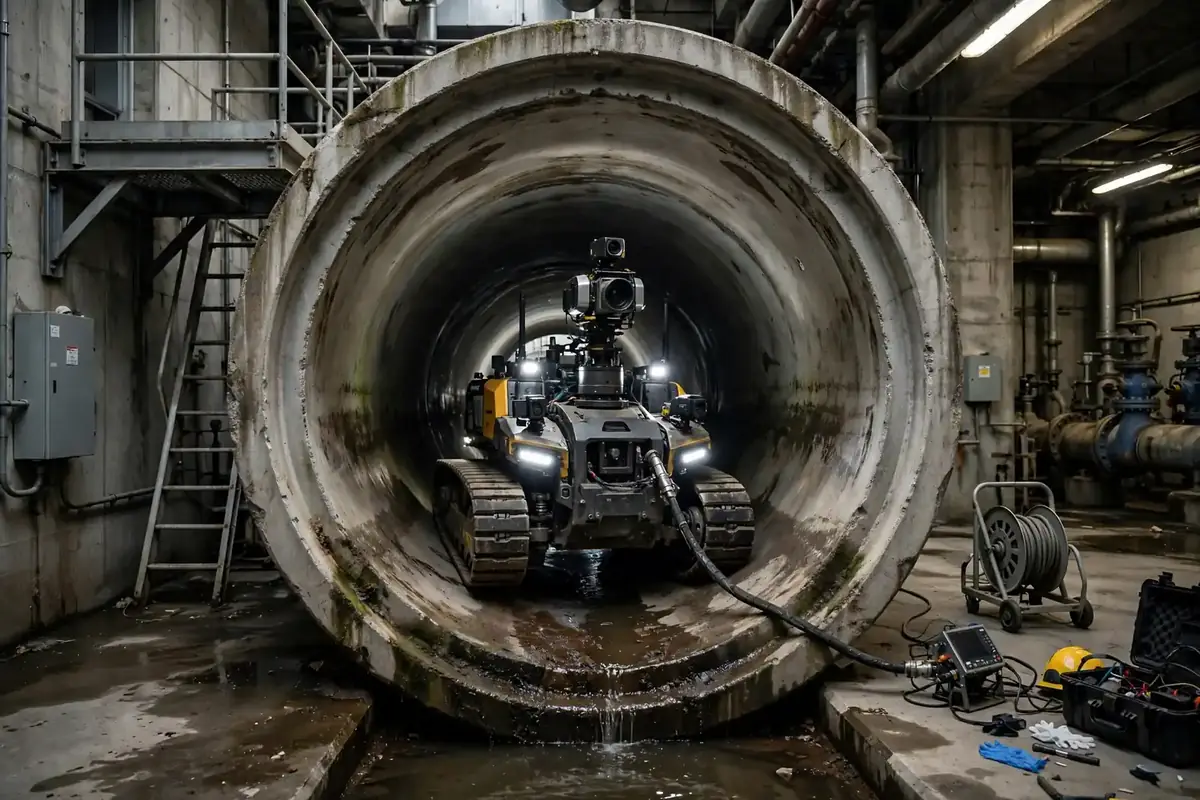
A commercial sewer line is not a bigger residential line — it is a different asset with different failure modes, different stakes, and different service logic. A restaurant on Cabot Street lives or dies by its grease management. An office building's restrooms serve dozens of people who never think about the pipe below. A multi-unit property's common line carries the waste of households the owner never meets. When any of them fail, the cost is measured in closed doors and lost revenue, not just inconvenience.
This guide explains what commercial sewer line service actually covers: the survey disciplines, the maintenance programs, the repair methods adapted to operating businesses, and how to think about a building's sewer as infrastructure rather than emergency. If you manage property in the Beverly area, this is the framework for keeping the line out of your crisis budget.
Why Commercial Lines Fail Differently
Volume and composition separate commercial lines from residential ones. Restaurants generate fats, oils, and grease continuously — even well-maintained traps pass some FOG, which cools, plates onto the pipe wall, and narrows the effective diameter month after month. Office and retail buildings concentrate flushable wipes, paper towels, and hygiene products from high-traffic restrooms; each item snags on any roughness and seeds the next blockage. Multi-unit residential adds the tragedy of the commons: no single tenant owns the common line, so nobody maintains it until it backs up into someone's unit.
Age compounds everything. Downtown Beverly's commercial blocks run on clay and cast-iron building sewers older than the businesses they serve, with joints opened by a century of settlement. Parking lots and delivery alleys add mechanical stress — heavy vehicle loading over shallow lines cracks older pipe, especially clay and Orangeburg segments. A commercial survey reads all of this: material, loading, usage pattern, and maintenance history together.
The Commercial Camera Survey
Commercial service starts with a camera survey scaled to the building: longer runs, larger diameters, and a locator map of every defect's position and depth. The survey documents grease depth, root intrusion, offsets, bellies, and breaks — and critically, it maps them against the surface, because excavation under a parking lot or slab costs multiples of excavation in a yard.
Surveys are scheduled off-hours — before opening, after close — so diagnosis never interrupts trade. The footage becomes a property asset: a baseline record that future surveys compare against, maintenance plans reference, and buyers or insurers can review. For multi-unit buildings, the survey also settles the eternal question of which line serves which units before anyone argues about responsibility.
Grease Management Programs
For food service, the service contract is really a grease management program. Scheduled hydro-jetting clears FOG buildup before it chokes the line; the interval is set by measured accumulation rates, not guesswork. Grease trap maintenance records get reviewed as part of the program — a neglected trap accelerates line fouling regardless of jetting frequency, so the program addresses the source, not just the symptom.
Camera checks between cleanings catch structural problems early: a grease-narrowed line hides developing offsets and root intrusion, and only the camera sees through the buildup pattern to the pipe wall. The program's economics are straightforward — scheduled maintenance costs a fraction of an emergency backup during Friday dinner service, and the health-department risk of a sewage event makes prevention non-negotiable.
Trenchless Repair for Operating Businesses
When a commercial line needs structural repair, trenchless methods keep the doors open. Cured-in-place lining renews the pipe from existing access points — no trench through the dining room, no torn-up parking lot. Pipe bursting replaces failed lines under pavement from two small pits. Both methods schedule around the business calendar: a restaurant's slow days, a retailer's off-season, an office's weekend.
Open-cut replacement still has its place — collapsed sections, lost grade, lines that must be rerouted — but on commercial sites it is planned like a construction project: permits, phasing, surface restoration to commercial standards, and tenant notification. The camera survey's surface map is what makes the plan precise instead of exploratory.
Maintenance Scheduling by Property Type
Different properties need different rhythms. Restaurants: quarterly to semi-annual jetting depending on volume, with annual camera checks. Office and retail: annual inspection and as-needed cleaning, with attention to restroom-adjacent lines. Multi-unit residential: annual camera survey of the common line and scheduled root management where street trees intrude — coordinated with the owner, not left to tenants. Industrial sites along corridors like Route 128: custom programs based on effluent character and loading.
The common thread is documentation. Every visit produces footage, findings, and a next-due date — a maintenance history that proves diligence to insurers, buyers, and health inspectors alike. A commercial sewer line with a paper trail is an asset; one without is a liability waiting for its moment.
Frequently Asked Questions
How often should a restaurant's sewer line be serviced?
It depends on volume and trap maintenance, but quarterly to semi-annual hydro-jetting is typical for food service, with annual camera inspections. The right interval is set by measured grease accumulation — your specialist establishes it from the first survey. Call (833) 713-2101 to schedule a commercial assessment.
Can you work without closing our business?
Yes — that is the point of commercial scheduling. Surveys and most trenchless repairs happen off-hours or in phased windows around your operation. You will know the full schedule, and the full extent of any disruption, before work begins.
Who is responsible for a shared line in a multi-unit building?
Typically the property owner for common lines, but leases and condo documents vary. The camera survey maps which fixtures drain to which line, giving every party a factual basis. We document findings so responsibility discussions rest on evidence.
What does a commercial maintenance program cost?
It depends on the property's size, line condition, and service frequency — which is why programs start with a survey and a written proposal, not a flat rate. Compare it against the cost of one emergency backup during peak hours; prevention wins that comparison every time.
Do you service properties outside Beverly?
Yes — our commercial service covers the full 22-community area including Danvers, Peabody, Salem, and Gloucester, where much of the North Shore's commercial stock sits. Call (833) 713-2101 to discuss your property.
What records do we get from a maintenance program?
Camera footage, written findings, service dates, and next-due scheduling after every visit — a maintenance history suitable for insurers, buyers, and health inspectors. Documentation is part of the service, not an add-on.
Sewer Line Problems Don’t Wait. Neither Should You.
Call now and reach a local sewer line specialist serving Beverly, MA and nearby North Shore communities — 24/7.
(833) 713-2101Free to call · No obligation · 24/7 emergency line