
How to Choose a Sewer Contractor
The questions that separate sewer professionals from pretenders — plus the red flags that should end the conversation immediately.
- Practical guide
- Local specialists
- Camera first
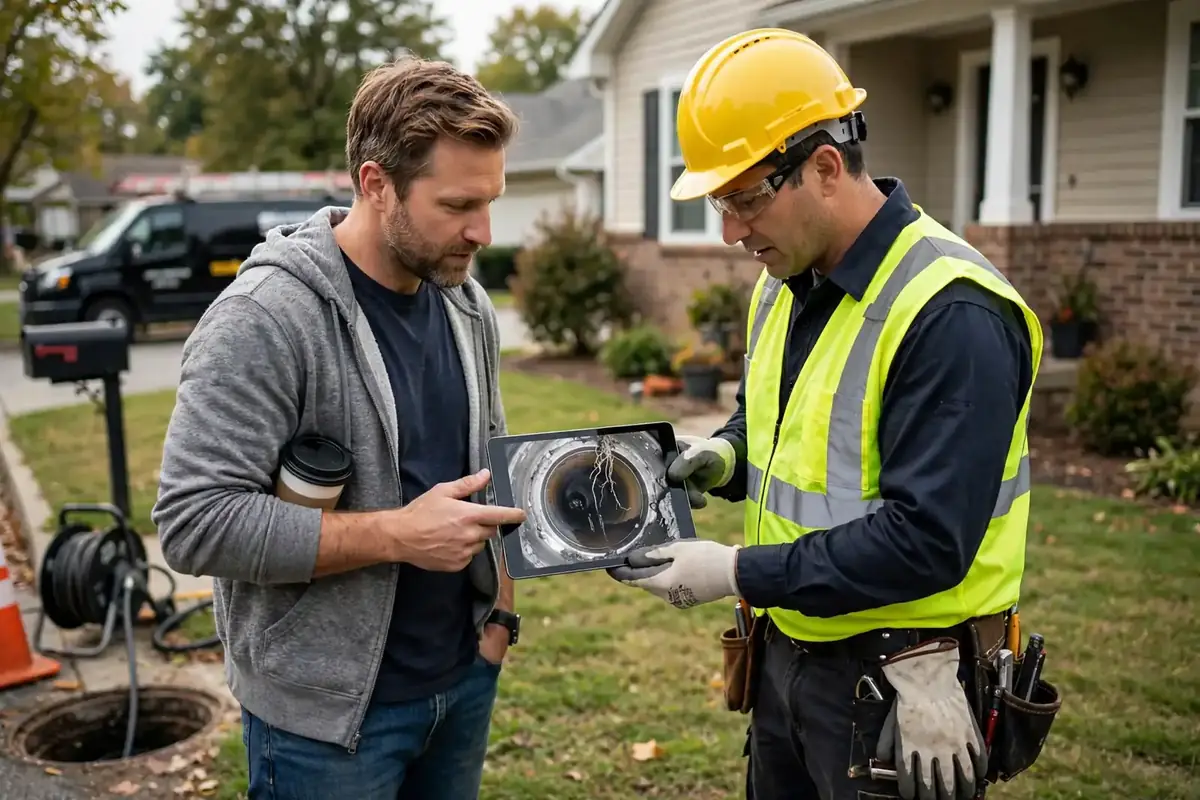
A sewer line is buried, expensive to fix, and impossible for you to inspect yourself — which makes choosing the contractor who works on it an act of trust. The industry has more than its share of guesswork, upselling, and one-method-fits-all recommendations. The difference between a good outcome and an expensive lesson is rarely the price; it is the vetting you do before anyone digs.
This guide gives you the questions that separate professionals from pretenders, the answers that should reassure you, and the red flags that should send you to the next bidder. Use it before you authorize any repair-or-replace decision — the contractor you choose shapes that decision as much as your pipe does.
Question 1: “Will You Camera-Inspect Before Quoting?”
This is the gatekeeper question. Any contractor willing to quote a repair — or recommend a method — without putting a camera in your line is guessing. The right answer is an unequivocal yes, with the inspection scheduled before any quote, and the footage shared with you. Follow up: “Will I see the footage myself?” A professional expects you to watch; an evasive answer about “technical footage” is a red flag.
Also ask how they locate defects — a camera alone shows the problem; a locator shows where it is from the surface. For any repair involving excavation or pit placement, surface locating is not optional. If the contractor does not own locating equipment, they are not equipped for the job.
Question 2: “What Methods Do You Offer — and Which Fits My Line?”
A contractor who offers only one method will recommend that method for every line. You want a contractor fluent in the full toolkit: cleaning, spot repair, CIPP lining, pipe bursting, and open-cut replacement — who can explain, from your footage, why the recommended method fits and why the others do not. Ask directly: “Why not lining?” or “Why not bursting?” The explanation should reference your footage, not generalities.
Be wary of the two classic biases: the excavation-only contractor who has never met a line that did not need digging, and the trenchless-only outfit that lines lines the camera disqualifies. Method neutrality — demonstrated against your footage — is the mark of a diagnostician rather than a salesperson.
Question 3: “What Exactly Is Included in Your Quote?”
Demand itemization: method, linear footage, pipe material and diameter, access points, surface restoration scope, permit handling, and cleanup. Then the two most-skipped items: the post-repair camera inspection (non-negotiable — it proves the work) and the warranty terms in writing (what is covered, for how long, and what voids it).
Compare quotes on scope, not just price. The low bid that omits surface restoration, skips the final inspection, or warranties nothing is not cheaper — it is incomplete. A professional quote reads like a project plan; anything less is a gamble.
Question 4: “Who Does the Work, and When?”
Ask who will actually be on site — the person quoting or a subcontracted crew — and what their sewer-specific experience is. Sewer work is a specialty; a general plumber who “does sewers sometimes” is not equivalent to a crew that cameras and lines daily. Ask for a schedule: start date, duration, water-use restrictions, and what happens if conditions differ from the footage.
Also ask about contingencies. What if the camera missed a collapse? What if ledge rock appears? A professional has answers — unit pricing for defined contingencies, a stop-work-and-discuss policy — while a pretender has only assurances.
Red Flags That End the Conversation
Quoting without inspection. Covered above; disqualifying on its own. Today-only pricing. Legitimate sewer work does not need countdown pressure — the pipe will still be broken tomorrow, and so will the honest quote. Refusal to show footage. Your line, your footage. Cash-only or full payment upfront. Standard practice is a deposit with balance on completion, verified by the final inspection. No written warranty. Verbal promises about buried work are worth nothing. Badmouthing every competitor. Professionals critique methods against footage; they do not need to torch the industry to win your job.
One more subtle flag: the contractor who will not explain. “Trust me, you need bursting” is not an explanation. Every recommendation should trace back to something visible in your footage that the contractor can point to and describe. If they cannot teach you what is wrong, they may not know.
The Vetting Sequence That Works
Get two or three inspections — yes, more than one camera survey is worth it on a major job. Compare not just prices but diagnoses: do the contractors agree on what the footage shows? Agreement on the problem with different proposed solutions is normal and useful; disagreement on the problem itself means someone misread the footage. Check references for similar work — lining references for a lining job — and confirm the warranty terms each offers in writing.
Then choose the contractor whose diagnosis you understand, whose method fits the footage, whose quote is itemized, and who answered every question without flinching. That contractor is rarely the cheapest bid and almost never the most expensive — they are the one who treated your buried line as an engineering problem rather than a sales opportunity. For what that engineering looks like day to day, our camera inspection guide shows the diagnostic standard to expect.
Related reading
Frequently Asked Questions
How many quotes should I get for a sewer repair?
Two or three, each based on a camera inspection. Compare diagnoses first — do they agree on what the footage shows? — then methods, then itemized scope. Agreement on the problem with different solutions is healthy; disagreement on the problem is a warning. Call (833) 713-2101 to start with an inspection.
Should I be present for the camera inspection?
Yes, absolutely. Watching the footage with the technician is how you learn what is actually wrong, and it is your best defense against misdiagnosis. Any contractor who discourages your presence is telling you something important.
Is the cheapest quote ever the right choice?
Only if the scope matches. A low bid with full itemization, matching diagnosis, proper materials, final inspection, and written warranty can be genuine value. A low bid missing any of those is not cheap — it is incomplete, and the missing pieces surface as change orders or failures.
What should a sewer warranty cover?
Workmanship — the installation itself — for a defined term, plus manufacturer coverage on materials like liners and HDPE pipe. Get the term, the coverage, and the exclusions in writing before work starts. Verbal warranties on buried work are meaningless.
Do I need permits for sewer repair?
Often yes — street openings, work in the right-of-way, and some replacements require municipal permits. A professional contractor handles permitting as part of the job; a contractor who suggests skipping permits is cutting a corner you will pay for later.
Can I just hire a general plumber for sewer work?
For fixture plumbing, yes. For the buried lateral, hire sewer specialists — camera diagnostics, trenchless methods, and excavation shoring are a distinct trade. Ask how many sewer lines the crew cameras and repairs in a typical month; daily practice is the standard you want.
Sewer Line Problems Don’t Wait. Neither Should You.
Call now and reach a local sewer line specialist serving Beverly, MA and nearby North Shore communities — 24/7.
(833) 713-2101Free to call · No obligation · 24/7 emergency line