
Sewer Line Repair Cost Factors | Beverly
No prices — just the honest factors: what drives sewer repair cost up or down, and how to read any quote intelligently.
- Practical guide
- Local specialists
- Camera first
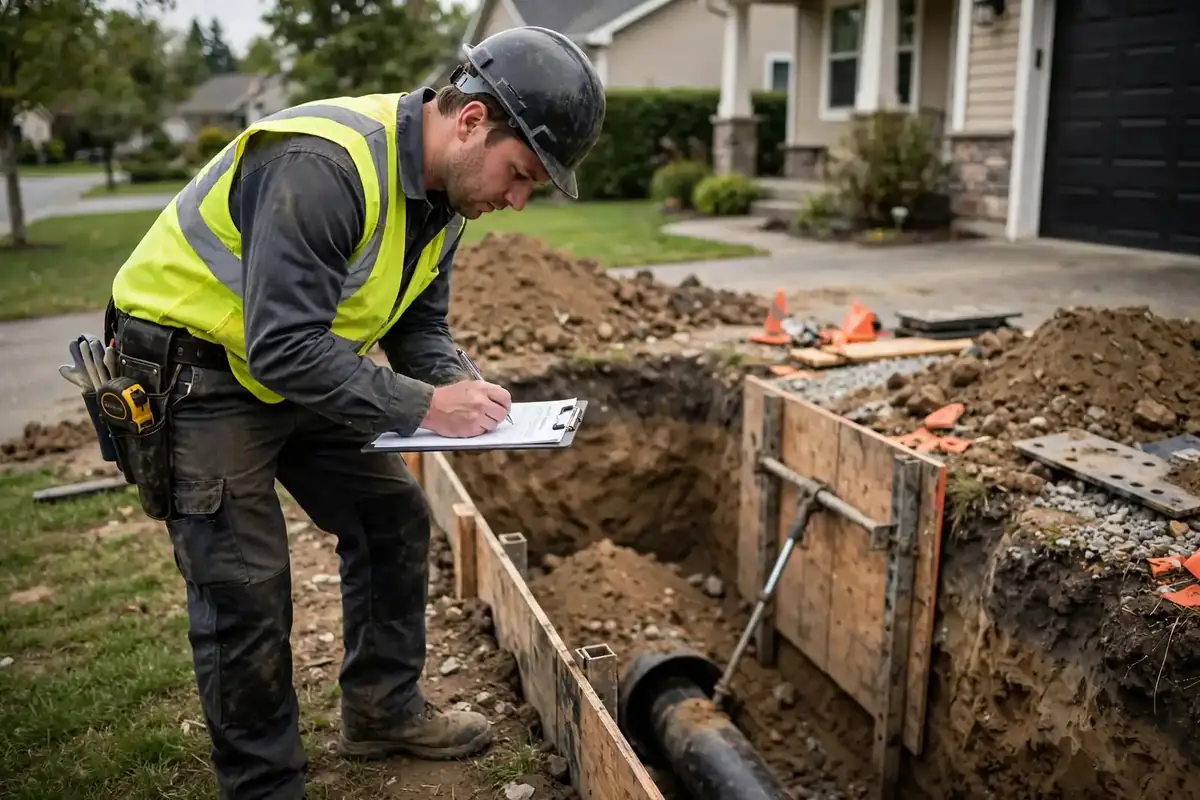
Ask ten contractors what a sewer repair costs and you will get ten numbers — because the honest answer is that cost follows conditions, and conditions vary enormously. A 40-foot lining job under a clear lawn and a 200-foot bursting job under a granite ledge are barely the same trade. Anyone quoting a price without a camera inspection is guessing, and you should treat the guess accordingly.
This guide does not list prices — they would be meaningless without your line's specifics. Instead, it explains the factors that drive cost up or down, so you can read any quote intelligently and understand what you are paying for. When you are ready for real numbers, they come from a camera inspection and a written quote: (833) 713-2101.
Factor 1: The Repair Method
Method is the single largest cost driver. Professional cleaning and root cutting are the least expensive interventions — equipment time and labor, no materials buried. Spot repairs address one defect. Cured-in-place lining costs more: liner material, resin, and the skilled crew to install and cure it, but no excavation. Pipe bursting runs higher still — bursting head, new HDPE pipe, launch and receive pits. Open-cut replacement is usually the most expensive: excavation, shoring, dewatering, pipe, bedding, backfill, compaction, and surface restoration, each a line item.
The method is not a shopping choice; it follows the diagnosis. Lining a collapsed line is impossible at any price, and excavating a line that qualifies for lining wastes money. The camera survey determines which methods are even on the table — cost comparison only makes sense among methods that can actually fix your line.
Factor 2: Length and Depth
Length multiplies nearly everything: liner by the foot, bursting pipe by the foot, excavation by the cubic yard. A 150-foot farm lateral in Hamilton costs structurally more to renew than a 45-foot city lateral in downtown Beverly, whatever the method. Depth compounds it — deeper lines mean deeper pits, more shoring, more dewatering, more soil to move and restore. A line at eight feet is a fundamentally bigger job than a line at four.
Depth also interacts with method choice. Trenchless methods care less about depth than open cut does — one reason bursting and lining shine on deep lines. When comparing quotes, check that each bidder measured the same length and depth; discrepancies here explain many quote gaps.
Factor 3: Access and Surface
What sits above the line matters enormously. Open lawn: easy. Driveway, patio, or parking lot: the surface must be cut and restored, adding thousands. Mature landscaping, stone walls, or historic-district streetscapes: restoration to original condition is skilled, slow work. Under a slab or inside a building footprint: the most expensive access of all.
This factor is where trenchless methods earn their premium. Lining from existing cleanouts can avoid surface disruption entirely — the higher method cost is offset by zero restoration cost. A quote comparison that ignores restoration is not a comparison; always ask what surface work each price includes.
Factor 4: Soil and Water Conditions
North Shore soil is not uniform, and it bills accordingly. Easy digging in sandy loam is one thing; ledge rock in Gloucester or Marblehead is another — rock excavation multiplies open-cut cost and is a primary reason trenchless methods dominate there. High water tables demand dewatering: pumps, well points, and time. Contaminated soil, where it occurs, triggers handling and disposal requirements.
Trenchless methods largely sidestep soil conditions — the liner or bursting head travels through the existing pipe path regardless of what surrounds it. When a quote seems high for open cut in rocky or wet ground, ask what the trenchless alternative prices at; the gap is often smaller than expected.
Factor 5: Condition Complexity
A single clean defect — one offset joint, one root mass — is the cheapest structural scenario. Multiple defects along the run, combinations of roots plus collapse, lines with lost grade requiring re-establishment, or connections that must be robotically reopened after lining all add scope. Emergency work adds its own premium: after-hours dispatch, stabilization before diagnosis, and the sheer inefficiency of crisis scheduling.
Complexity is also where the inspection pays for itself twice. A thorough camera survey with locating means the quote covers the real scope — no mid-job discoveries, no change orders. The cheapest quote is rarely the one with the vaguest scope; it is the one built on the most complete diagnosis.
Reading a Quote Intelligently
A good sewer quote reads like an engineering proposal, not a number on a napkin. It should specify: the method, the linear footage, the pipe material and diameter being installed, the access points, what surface restoration is included, the warranty terms in writing, and that a post-repair camera inspection is part of the job. It should reference the inspection footage it is based on.
Red flags: a price given without any camera inspection. A single lump sum with no scope breakdown. “Today only” pressure. No mention of warranty. And the classic — a quote far below the others, which usually means scope the others included and this one omitted. For guidance on vetting the bidder behind the quote, see our guide on choosing a sewer contractor.
Related reading
Frequently Asked Questions
Why won't anyone give me a price over the phone?
Because an honest price requires knowing the method, length, depth, access, and condition — none of which are visible over the phone. Phone quotes are guesses; written quotes follow camera inspection. Call (833) 713-2101 to schedule the inspection that real numbers require.
Is trenchless always more expensive than digging?
Not necessarily. Trenchless methods can cost more in direct method cost but eliminate excavation and surface restoration — under driveways, landscaping, or historic streetscapes, the total often favors trenchless. Compare total project cost, not method cost alone.
What makes one quote much lower than the others?
Usually omitted scope: no surface restoration, no post-repair inspection, vague materials, or a method that does not actually fit the diagnosis. Ask each bidder to itemize method, footage, materials, access, restoration, and warranty — the gaps become visible immediately.
Does emergency service cost more?
Emergency dispatch typically carries a premium for after-hours response and crisis sequencing — stabilization before diagnosis. It is another reason maintenance and early inspection pay: planned work is always more economical than emergency work.
Can I reduce the cost without cutting corners?
Yes: get the camera inspection early (small problems are cheap problems), keep the work area accessible, choose the method that fits the diagnosis rather than the cheapest method that does not, and compare itemized quotes. What you should never cut is the post-repair inspection or the written warranty.
Do you finance sewer repairs?
Financing options vary by project and provider. Ask the specialist during your quote visit — the written proposal is the right place to discuss payment structure, not the emergency call.
Sewer Line Problems Don’t Wait. Neither Should You.
Call now and reach a local sewer line specialist serving Beverly, MA and nearby North Shore communities — 24/7.
(833) 713-2101Free to call · No obligation · 24/7 emergency line