
Sewer Camera Inspection Explained
What a sewer camera inspection shows, how the equipment works, how to read the footage — and when every homeowner should schedule one.
- Practical guide
- Local specialists
- Camera first
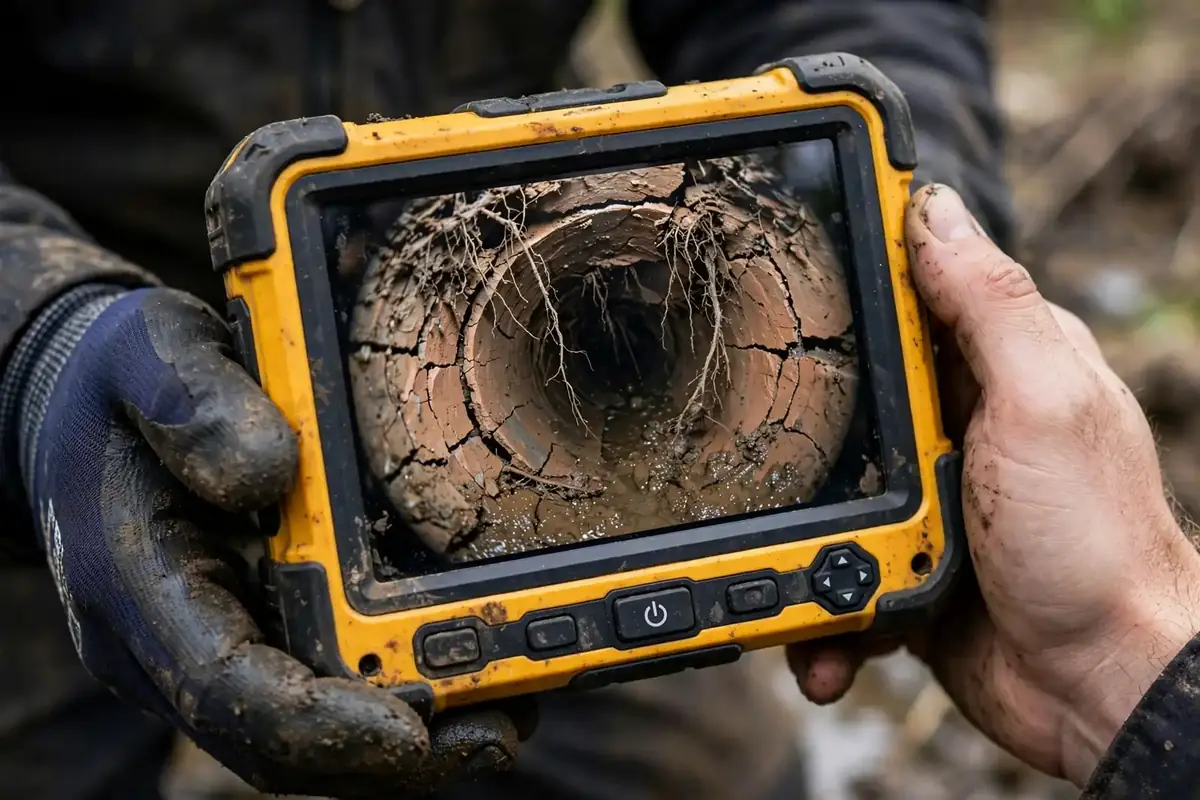
A sewer camera inspection is the closest thing the trade has to an X-ray: a high-resolution camera travels the full length of your buried line, transmitting live video of every joint, crack, root mass, and belly to a monitor you watch in real time. No digging. No guessing. In about an hour, the mystery of what is happening underground becomes a recorded, reviewable fact.
This guide explains what the inspection shows, how it is performed, how to read the footage, and when to schedule one. It is also the foundation of everything else we do — every camera inspection we perform follows this standard, and every repair we recommend starts from footage like this.
How the Inspection Is Performed
The technician locates your main cleanout — the access point to the building sewer — or, if none exists, pulls a toilet or accesses a vent to reach the line. A push-rod camera (for residential laterals) or a self-propelled crawler (for larger lines) enters the pipe, its LED-lit head transmitting video as it advances. A built-in sonde emits a signal the technician tracks from the surface with a locator, mapping the line's path and marking each defect's position and depth.
The camera travels the full run to the municipal main or septic tank, recording continuously. Distance counters overlay footage marks on the video — “at 47 feet, root intrusion; at 63 feet, offset joint” — so every finding is located, not just observed. The whole process typically takes 45 to 90 minutes for a residential lateral, and you are invited to watch the monitor throughout.
What the Camera Sees: Reading the Footage
Healthy pipe reads as smooth, continuous interior wall with visible joints evenly spaced — clay bells, cast-iron hubs, or PVC couplings depending on material. Water flows in the bottom third; the camera head rides level. Root intrusion appears as fibrous masses entering at joints — wispy white tendrils in early stages, dense woody mats in advanced ones. Offsets and separations show as steps or gaps where pipe sections misalign, often with debris catching at the lip.
Bellies — sagging sections — read as stretches where the camera dips and water ponds; the footage literally goes downhill then uphill. Cracks and fractures appear as dark lines across the pipe wall, sometimes with soil visible through them. Scale and tuberculation in cast iron look like rough, rusty barnacles narrowing the bore. Collapse is unmistakable: the camera cannot pass, and the footage shows rubble where pipe should be. Your technician narrates all of it live — the footage is evidence, the narration is education.
The Deliverable: More Than a Video
A professional inspection delivers three things. The recording itself — yours to keep, review, and share with other contractors for second opinions. The written report: material, diameter, length, and every defect located by footage mark with a plain-language description and severity rating. And the recommendation: what needs doing now, what should be monitored, and what can wait — tied to specific footage marks, not generalities.
This package is what makes second opinions meaningful. Any contractor can review the same footage and give their read — which is exactly how you vet recommendations on major work. An inspection without a recording and report is a show; insist on the deliverables.
When to Schedule an Inspection
Symptoms: slow drains across multiple fixtures, gurgling, sewage odors, wet spots in the yard, or any backup — inspect immediately. Home purchase: a pre-purchase inspection is the cheapest insurance in real estate; sewer lines are excluded from standard home inspections, and a five-figure lateral replacement discovered after closing is a brutal surprise. Age milestones: lines over 30 years old deserve a baseline, then periodic re-inspection every few years.
Before major landscaping or construction: know where the line is — the locator map from the inspection marks its path — before anyone digs, pours, or plants. After any sewer work: the post-repair inspection proves the job. In Beverly's older neighborhoods, where clay and cast iron dominate, the baseline inspection is simply prudent ownership.
What an Inspection Cannot Do
Honesty requires the limits. A camera shows the pipe's interior — not the soil conditions outside it, not the exact wall thickness remaining, not what will happen next year. It cannot see through standing water perfectly, and in heavily scaled cast iron the camera sees scale, not wall. It is a diagnostic, not a prophecy: it shows current condition with precision, and from that, experienced judgment projects likely progression.
It also cannot fix anything by itself. The inspection's value is entirely in what follows: the cleaning, the leak detection, the repair plan — each chosen because the footage justified it. An inspection that ends with “everything looks fine” is still valuable: it is the baseline every future inspection compares against.
Frequently Asked Questions
How much does a sewer camera inspection cost?
Pricing varies by access and line length, but the inspection is the least expensive professional sewer service — and the one every other service depends on. Call (833) 713-2101 for current scheduling; the written quote for any recommended work follows the inspection, not precedes it.
Do I need to be home during the inspection?
Yes — watching the footage with the technician is the point. You will learn your line's actual condition, see every defect yourself, and be able to ask questions in real time. Plan to be present for the full visit.
Can the camera damage my pipes?
No. The camera head is smaller than the pipe bore and travels on a flexible push rod; it is designed to pass through without contact force. In collapsed sections the camera simply cannot pass — which is itself diagnostic information.
What if there is no cleanout?
The technician can usually access the line by pulling a toilet or through a vent stack — standard practice. If your home lacks a cleanout, the inspection report will likely recommend installing one; cleanouts make every future service faster and cheaper.
How often should lines be re-inspected?
Every 2–3 years for lines over 30 years old or with known issues; every 5 years for younger healthy lines; immediately with any symptoms. Your inspection report sets the specific interval based on what the footage showed.
Can I get a copy of the video?
Absolutely — the recording is yours. A professional inspection includes the video file and written report as standard deliverables. Keep them with your home records; they are the baseline for every future sewer decision.
Sewer Line Problems Don’t Wait. Neither Should You.
Call now and reach a local sewer line specialist serving Beverly, MA and nearby North Shore communities — 24/7.
(833) 713-2101Free to call · No obligation · 24/7 emergency line