
Pipe Bursting Method Explained | Beverly
How pipe bursting fractures the old line and pulls in a new HDPE pipe — the full process, plus when bursting beats every alternative.
- Practical guide
- Local specialists
- Camera first
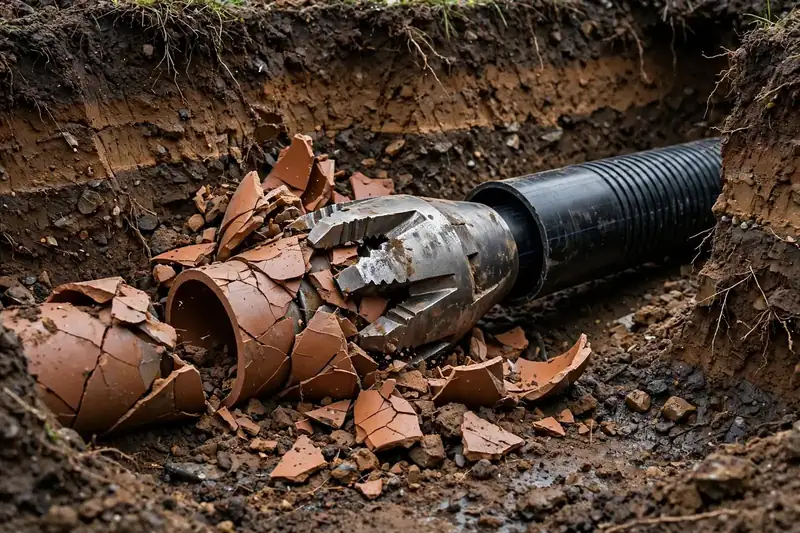
Pipe bursting is the trenchless method for lines that cannot be saved — it does not repair the old pipe, it destroys it and installs a new one in the same underground path. A bursting head fractures the existing pipe outward while pulling a new high-density polyethylene (HDPE) line in behind it. Two small pits. No trench. A brand-new pipe where the failed one was.
Where CIPP lining needs a host pipe that still holds its shape, bursting needs only a path — making it the answer for collapsed sections, severely deformed Orangeburg, and lines that must be upsized. This guide explains the method end to end, the way our crews perform it across Beverly and the North Shore.
The Core Idea: Fracture and Replace In Place
Every pipe bursting job follows one logic: the old pipe's underground corridor is valuable real estate — it already connects your house to the street, already has the right approximate grade, already avoids every obstacle the original installers avoided. Bursting reuses that corridor. A powerful winch or hydraulic puller draws a bursting head through the old line; the head's expanding cone shatters clay, cast iron, concrete, or Orangeburg outward into the surrounding soil, and the new HDPE pipe follows immediately behind, sliding into the space the head just opened.
The result is a continuous, jointless HDPE line — fused sections melted into one homogeneous pipe — with a service life measured in many decades. Because the new pipe is pulled, not laid, there is no open trench to backfill, no bedding to compact, no surface to restore beyond the two pits.
Step 1: Survey, Locating, and Pit Placement
The camera survey comes first, as always — bursting needs to know the line's path, depth, diameter, and what surrounds it. Then comes the step that makes or breaks the job: locating every nearby utility. Gas, water, electric, telecom — the bursting head displaces soil outward, and anything too close to the pipe path must be identified and protected. Professional crews pothole — hand-dig test holes — to confirm utility depths at crossings.
Two pits are excavated: the launch pit, where the bursting head and new pipe enter, and the receive pit, where the head exits. Pit placement is strategic — positioned to avoid utilities, structures, and valuable landscaping, sized to the equipment. In tight Beverly lots, pit placement is a genuine design exercise; the camera-and-locator map from the survey is the design document.
Step 2: The Pull
The bursting head — a hardened steel cone larger in diameter than the old pipe — is attached to the pulling system and to the leading end of the new HDPE pipe string. As the winch draws the assembly forward, the head fractures the old pipe radially outward, compacting fragments into the surrounding soil, while the new pipe slides into the freshly opened bore directly behind it.
The crew monitors pulling force continuously. Steady, predictable resistance means the head is fracturing cleanly; sudden spikes signal an obstruction — a repair clamp, a concrete encasement, an unexpected fitting — that may require a spot excavation. This is why the pre-pull survey matters: surprises mid-pull are expensive, and thorough diagnosis prevents most of them. Typical residential pulls run 50 to 150 feet and complete in hours, not days.
Step 3: Upsizing — Bursting's Signature Advantage
Unlike lining, which slightly reduces diameter, bursting can increase it. The bursting head is sized larger than the old pipe, so the new HDPE can be a full size up — a 4-inch clay line becomes a 6-inch HDPE line. For properties where the original line was undersized for current demand, or where capacity margin prevents future problems, upsizing during bursting is a one-time opportunity that open-cut replacement matches only with a wider, more expensive trench.
Upsizing is not automatic — the surrounding soil must accept the expansion, nearby utilities must have clearance, and the municipal connection must accept the larger diameter. The survey and utility locating determine whether upsizing is safe; when it is, it is one of bursting's most valuable features.
Step 4: Connections, Restoration, Verification
With the new HDPE in place, the crew connects it at both ends — to the house's building drain at the launch side and to the municipal main or septic tank at the receive side — using proper transition fittings. Branch connections along the run, mapped during the survey, are reconnected; unlike lining, bursting does not cover them, so reconnection is direct.
The pits are backfilled in compacted lifts and the surface restored. Then the final camera inspection: the full run of new HDPE, continuous and jointless, documented on footage that becomes your proof of installation. The warranty paperwork records the pipe specification, the fused joints, and the installer's workmanship terms.
When Bursting Is the Right Method
Bursting is the answer when the old pipe cannot host a liner: collapsed sections, severely ovalized Orangeburg, pipes with major structural failure — and when upsizing is desired. It is the wrong method where the pipe path is obstructed by unmovable utilities, where the surrounding soil cannot accept expansion (solid ledge directly against the pipe), or where the line's grade must be corrected — bursting follows the old path's grade, for better or worse.
Against open-cut replacement, bursting's case is surface preservation: the same new pipe, without the trench. Against lining, its case is total renewal and upsizing. The camera survey — showing shape, path, and surroundings — is what qualifies a line for bursting rather than its alternatives.
Related reading
Frequently Asked Questions
Will pipe bursting damage my yard?
Beyond the two pits — typically 4x4 feet each, strategically placed — the yard is untouched. Compare that with an open trench the full length of the line. The pits are backfilled, compacted, and restored; within a season, they are invisible. Call (833) 713-2101 to discuss your property's layout.
Can bursting go through tree roots?
The bursting head fractures the old pipe and displaces the surrounding soil, cutting through root masses in the pipe path. Heavy root intrusion that would complicate lining is simply destroyed and displaced during bursting — one reason bursting suits severely root-damaged lines.
What if there are gas or water lines nearby?
They are located before work begins — every crossing utility is identified, and test holes confirm depths. Clearances are designed into the plan; where clearance is inadequate, the method or the path is adjusted. Utility protection is a designed step, not a hope.
How long does the new HDPE pipe last?
HDPE sewer pipe is rated for many decades of service — it does not corrode, resists chemicals and abrasion, and its fused joints eliminate the joint failure that doomed the old line. The installer's workmanship warranty and the pipe manufacturer's material warranty are documented at completion.
Can you burst under my driveway?
Yes — that is one of bursting's best applications. The new pipe pulls through beneath the driveway with no cutting and no restoration beyond the pits, which are placed to avoid the paved surface. Driveway preservation alone often justifies the method.
Does bursting work on every pipe material?
On nearly all: clay, cast iron, concrete, Orangeburg, and even old PVC fracture or split under the bursting head. The exceptions are unusual — heavily reinforced concrete encasement or steel pipe — which the camera survey identifies before anyone commits.
Sewer Line Problems Don’t Wait. Neither Should You.
Call now and reach a local sewer line specialist serving Beverly, MA and nearby North Shore communities — 24/7.
(833) 713-2101Free to call · No obligation · 24/7 emergency line