
Pipe Bursting vs Pipe Lining | Beverly MA
The honest head-to-head: what each trenchless method requires, what each produces, and the decision map for Beverly-area lines.
- Practical guide
- Local specialists
- Camera first
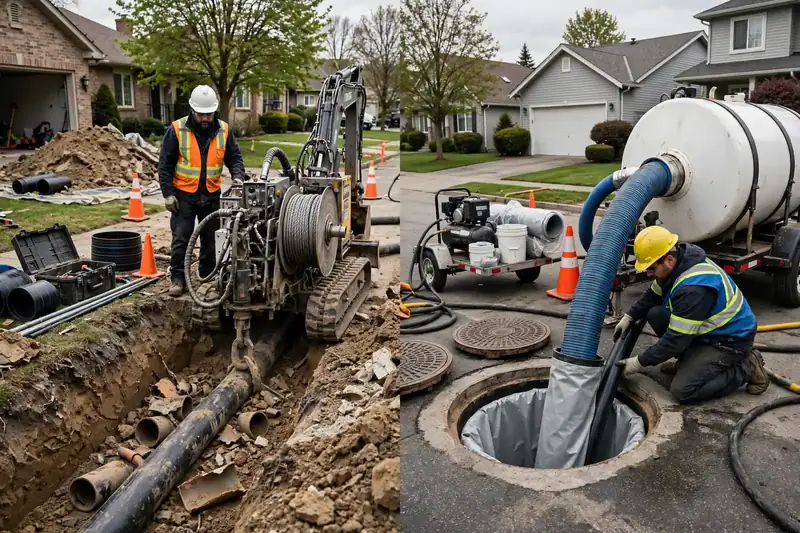
Two trenchless methods, one decision — and it is the most common fork in sewer repair. Pipe bursting destroys the old line and pulls in a new HDPE pipe. CIPP lining builds a new structural tube inside the old line. Both avoid the open trench. Both are excellent. And they are not interchangeable: each has conditions it requires, advantages it owns, and situations where it is simply the wrong tool.
This guide compares them head to head across the dimensions that matter — what each requires of your line, what each produces, cost structure, and the Beverly-area scenarios where each wins. The decision always starts from camera footage; this guide teaches you to read that footage like the choice depends on it, because it does.
What Each Method Needs From Your Line
This is the decision's foundation, and it is non-negotiable. CIPP lining requires a host pipe that holds its round shape. The liner needs something to press against and cure into; a collapsed section, a severely ovalized Orangeburg run, or a pipe with major offsets gives the liner nothing to follow. Pipe bursting requires only a path — the old pipe can be collapsed, deformed, or missing sections, as long as the bursting head can travel the corridor and the surrounding soil accepts the expansion.
In practice, the camera survey sorts most lines immediately. Clay with joint failure but round barrels: lining candidate. Orangeburg gone oval: bursting. Collapsed section: bursting or open cut. The footage does not negotiate — and any contractor recommending lining for a line the camera disqualifies is selling, not diagnosing.
What Each Method Produces
Lining produces a jointless structural tube inside the old pipe — smooth, corrosion-proof, root-proof at the joints, with a slight reduction in internal diameter. The old pipe becomes a form; the liner becomes the pipe. Bursting produces a brand-new continuous HDPE line — also jointless, also root-proof and corrosion-proof — at the same diameter or larger, since bursting can upsize.
Both results are long-lived: structural liners and HDPE each carry multi-decade service ratings. The practical difference is diameter — lining shrinks the bore slightly, bursting maintains or increases it — and totality: bursting replaces the pipe wall entirely, while lining depends on the host pipe's continued structural presence around it.
Cost Structure Compared
Neither method has a fixed price — both scale with length, depth, access, and soil — but their cost structures differ. Lining's costs concentrate in materials (liner, resin) and the skilled cure process; it needs minimal excavation, so surface restoration is near zero. Bursting's costs concentrate in equipment and the two pits; the HDPE pipe itself is economical, but pit excavation, shoring, and restoration add up.
On short, shallow, easily accessed lines, lining often totals less. On long runs where lining's per-foot material cost accumulates, or where upsizing adds value, bursting can close the gap or win. Under valuable surfaces — driveways, historic streetscapes, mature landscaping — both beat open cut so decisively that the lining-vs-bursting comparison is about fit, not savings. Our cost factors guide breaks down what drives each number.
Disruption and Timeline
Lining is the lighter touch: access through existing cleanouts, no excavation at the repair zone, water-use restrictions during cure, typically one to two days. Bursting needs the two pits excavated, the pull itself (hours), connections, and pit restoration — typically two to three days for a residential run. Both keep the property usable throughout; neither requires relocation.
For operating businesses, lining's minimal footprint is often decisive — a restaurant can line overnight and open for lunch. Bursting's pits need staging space that tight commercial sites may not have. The disruption comparison is genuinely situational: the right question is what your property can accommodate, not which method is abstractly tidier.
The Beverly-Area Decision Map
Local housing stock makes this concrete. Pre-war clay with joint failure (Goat Hill, the Cove, old Essex): lining, provided the barrels are round — the classic lining candidate. Deformed Orangeburg (Danvers subdivisions, North Beverly postwar streets): bursting, no contest — lining cannot follow an oval. Collapsed sections anywhere: bursting or open cut. Undersized lines needing capacity: bursting with upsizing. Lines under historic streetscapes (Marblehead, downtown Beverly): whichever trenchless method the footage qualifies — the surface decides that open cut is off the table.
When both methods qualify — a round, joint-failed line with good access — the tiebreakers are diameter needs, surface value, and total project cost from itemized quotes. A good specialist will show you the footage, explain which methods it qualifies, and let the pipe decide.
Related reading
Frequently Asked Questions
Can a line be both lined and burst?
Not the same section — but a long run can use both methods on different segments: lining where the pipe is round with joint failure, bursting where it is collapsed or deformed. The camera survey segments the line, and the plan can mix methods accordingly. Call (833) 713-2101 for a segmented assessment.
Which lasts longer, a liner or HDPE?
Both are multi-decade solutions — structural CIPP liners and HDPE pipe each carry long service ratings. The longevity difference that matters is not material but installation quality: a well-installed liner outlasts a poorly fused HDPE run and vice versa. Vet the installer, not just the method.
Is one method better for root problems?
Both solve roots permanently when properly applied — lining seals every joint, bursting removes the old pipe entirely. The choice depends on the pipe's shape: root-damaged but round lines line beautifully; root-destroyed, deformed lines burst.
Can lining fix a belly (sag) in the line?
No — lining follows the existing grade, so a sag that ponds water remains a sag with a smooth new surface. Bellies that affect function need bursting (which also follows grade, but replaces the pipe) or open-cut regrading. The camera survey measures the sag; the fix follows the measurement.
Which is faster?
Lining is typically a day shorter on residential jobs — no pit excavation. But both complete in days, not weeks, and the difference rarely decides the method. Fit to the footage decides; schedule is a secondary benefit.
What if my contractor only offers one method?
Get a second opinion from a contractor offering both. A one-method contractor recommends their method for every line — and the footage deserves a neutral reader. Our guide on choosing a contractor covers vetting in full.
Sewer Line Problems Don’t Wait. Neither Should You.
Call now and reach a local sewer line specialist serving Beverly, MA and nearby North Shore communities — 24/7.
(833) 713-2101Free to call · No obligation · 24/7 emergency line