
Signs Your Sewer Line Needs Repair
Eight signs ordered from earliest to most urgent — what each means, and the action each one calls for.
- Practical guide
- Local specialists
- Camera first
Sewer lines rarely fail without warning — but the warnings are easy to misread. A slow drain gets blamed on the fixture. A gurgling toilet gets laughed off. A lush patch of lawn gets admired. Each is the line speaking, and fluency in its language is worth thousands of dollars: caught early, most sewer problems are maintenance; caught late, they are emergencies.
These are the eight signs that matter, ordered roughly from earliest to most urgent, with what each one means and what to do about it. If any of them sound familiar, the next step is a camera inspection — the signs tell you to look; the camera tells you what you will find.
1. Slow Drains Across Multiple Fixtures
One slow sink is a fixture problem — a trap, a local clog. Slow drainage across several fixtures simultaneously, especially on the lowest floor, is a main-line problem: the building sewer is restricting flow downstream of where the fixtures join. The restriction is usually partial — roots, grease, scale, a developing offset — which is exactly why this sign is valuable. Partial restrictions are interceptable; total blockages are emergencies.
Action: do not wait for it to become a backup. A camera inspection now finds the restriction while it is still a cleaning or spot-repair job rather than a crisis.
2. Gurgling Sounds
Gurgling — a toilet bubbling when the washing machine drains, a shower drain chattering — is air trapped by a downstream restriction forcing its way through trap water. The plumbing is telling you, audibly, that wastewater is struggling past an obstruction and displacing air to do it. Occasional gurgles after heavy use deserve attention; regular gurgling deserves an inspection.
Action: note which fixtures trigger which gurgles — the pattern maps the restriction's location for the technician. Then schedule the camera visit before the restriction becomes a blockage.
3. Sewage Odors, Indoors or Out
Properly sealed plumbing does not smell. Indoor odors point to dry traps, failed wax rings, vent defects, or line breaches; outdoor odors — particularly near the line's path or cleanouts — point to exfiltration through cracks or open joints. Either way, the barrier between the sewer and your environment is breached, and breaches do not self-heal.
Action: check the simple causes first (run water in unused drains), then call for investigation. Our sewer gas guide covers the health context and the smoke-test diagnostic that locates the source precisely.
4. Recurring Blockages at Shortening Intervals
A blockage cleared six months ago returning in three, then in six weeks — the shortening interval is the signature of structural progression. Roots regrow thicker through the same joint; the offset catches debris faster as it worsens; the belly deepens. Each clearing buys less time because the underlying defect is advancing.
Action: stop buying time and diagnose. Recurring blockages are the line's clearest statement that cleaning is maintenance and repair is the cure — the camera shows which.
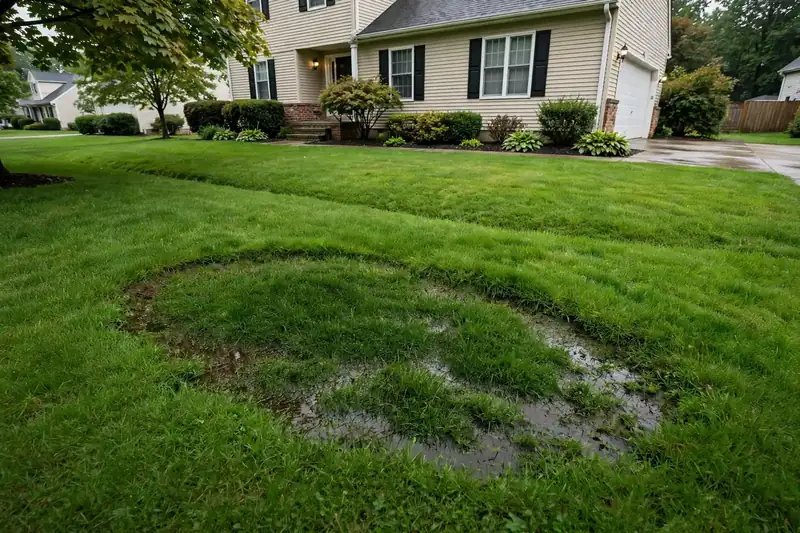
5. Lush Green Patches in the Yard
A stripe of unusually vigorous grass following the sewer line's path — greener, faster-growing than the surrounding lawn — is being fertilized from below by nutrient-rich leakage. It is exfiltration made visible: wastewater escaping through cracks or open joints. Homeowners sometimes admire the patch for a season before connecting it to the line beneath.
Action: a camera inspection confirms the leak's location and severity. Exfiltration is both an environmental issue and a structural warning — the escaping water erodes the bedding supporting the pipe.
6. Soggy Ground, Sinkholes, or Settling
Persistently soggy ground over the line's path, a developing depression, or pavement settling above the sewer alignment all indicate soil being washed into or out of a broken pipe. Infiltration carries soil into the line; exfiltration saturates the surrounding ground. Either way, the pipe-soil system is destabilizing — and destabilization accelerates.
Action: this sign has urgency. The void forming around the pipe will eventually reach the surface or collapse the pipe. Inspection promptly, repair planning immediately after.
7. Sewage Backup — Any Amount
Any sewage entering the home through a drain — even a small amount in a basement floor drain — is the sign that overrides all others. It means the line's capacity is fully defeated at some point downstream, and the next flush could bring more. Backup is not a warning of future failure; it is failure, in progress.
Action: stop water use, avoid the affected area, and call (833) 713-2101 now. Our emergency guide walks through exactly what happens next.
8. The Calendar Sign: Age Without Inspection
The eighth sign is not a symptom but a date: a line over 30 years old that has never been camera-inspected. Clay, cast iron, and Orangeburg all have failure modes that progress silently for years before surfacing as symptoms — and by the time symptoms appear, the cheap intervention window has often closed. An uninspected old line is not a healthy line; it is an unknown line.
Action: the baseline inspection. It converts unknown to known — either the reassurance of a sound line or the early diagnosis that makes repair planned instead of panicked.
Related reading
Frequently Asked Questions
Which sign means I should call immediately?
Any sewage backup, rapidly worsening drainage, or sewage odors with standing water — stop water use and call (833) 713-2101 now. The earlier signs (slow drains, gurgling, lush patches) merit prompt scheduling within days, not emergency dispatch.
Can a sewer line fail with no warning signs?
Rarely without any signs — but the signs are often misread or dismissed for months. Sudden-seeming failures are usually slow failures that went unobserved. The calendar sign (old line, never inspected) is how you catch the failures that have not announced themselves yet.
My drains are slow but there is no backup. How urgent is it?
Moderately urgent: partial restrictions become total blockages on their own schedule, not yours. A camera inspection within days finds the restriction while it is still a maintenance-scale problem. Waiting converts it to an emergency on the line's timeline.
Will homeowners insurance cover the damage if I ignored signs?
Possibly not fully — insurers distinguish sudden events from long-neglected failures, and documented ignored symptoms weaken a claim. Prompt response to signs protects both the home and the claim. See our insurance coverage guide for the full picture.
Do these signs differ for septic systems?
The drain-side signs are identical — slow drains, gurgling, odors, backups all indicate lateral or system trouble. Septic adds its own signs (drain-field sogginess, tank alarms). The camera inspection covers the lateral either way; septic systems need their tank and field evaluated too.
I have one sign but it is mild. Still inspect?
Yes — mild signs are the cheap-intervention window. The inspection costs little, and either it finds a small problem with a small fix or it gives you a clean baseline. Mild signs ignored become the expensive signs on this list.
Sewer Line Problems Don’t Wait. Neither Should You.
Call now and reach a local sewer line specialist serving Beverly, MA and nearby North Shore communities — 24/7.
(833) 713-2101Free to call · No obligation · 24/7 emergency line