
Sewer Line Cleaning vs Hydro-Jetting
Mechanical cutting vs. hydro-jetting: the physics, the best targets, the risks — and the inspect-clean-verify sequence professionals follow.
- Practical guide
- Local specialists
- Camera first
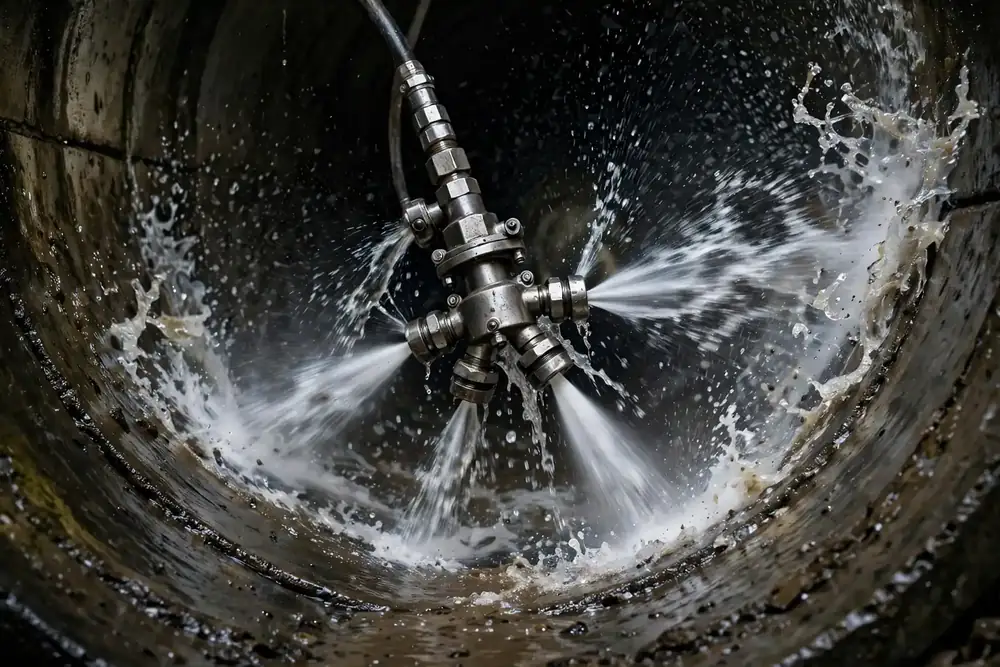
“Cleaning” is not one service — it is two fundamentally different ones, and the wrong choice wastes the visit. Mechanical cleaning cuts and scrapes with rotating blades and cables. Hydro-jetting blasts with high-pressure water. Both clear blockages; they do it by opposite physics, excel at different obstructions, and carry different risks for fragile old pipe. Knowing which your line needs — before the truck arrives — is the difference between a cleared line and a damaged one.
This guide compares both methods the way our crews deploy them across Beverly: what each removes, what each risks, and the decision logic that picks correctly. For the service itself, see our sewer line cleaning page.
Mechanical Cleaning: Cut, Scrape, Retrieve
Mechanical cleaning — drain snakes, sectional cables, root cutters — works by contact. A rotating cable drives a cutting head through the blockage: spiral augers corkscrew into soft clogs, root saws shred root masses, scraping blades plane scale off cast-iron walls. The operator feels the obstruction through the cable — resistance, breakthrough, the texture of what the head is cutting — and that feedback guides the work in real time.
Mechanical cleaning excels at localized, solid obstructions: root masses at a joint, a wad of wipes, a broken section's debris. It is the right tool when the blockage has a location and the head can reach it. Its limits: it clears a path roughly the head's diameter rather than scouring the full bore, it can miss the grease film coating the whole line, and aggressive heads in fragile pipe — thin-wall Orangeburg, cracked clay — can worsen structural damage. Skill matters enormously; the cable tells the truth only to hands that know how to listen.
Hydro-Jetting: Scour the Full Bore
Hydro-jetting works by water: a specialized nozzle propels itself through the line on hoses, firing rearward jets that pull it forward and forward/side jets that scour the pipe wall at pressures from 1,500 to 4,000+ PSI. The result is not a cleared path but a cleaned pipe — the full circumference scoured to bare wall, grease emulsified and flushed, scale stripped, sand and silt washed to the downstream access.
Jetting excels at distributed buildup: grease films in restaurant lines, scale throughout cast iron, silt and sand settled in bellies, sludge coating the full run. Where mechanical cleaning punches a hole through the clog, jetting restores the pipe's full diameter. Its limits: pressure must be matched to pipe condition — full pressure in a fractured clay line drives water into the surrounding soil — and jetting cannot fix structural defects. It cleans; it does not repair. A line jetted without a follow-up camera inspection is a cleaned unknown.
Head-to-Head: Which Blockage, Which Method
Root masses: mechanical cutting first — saws shred what jets merely push around — often followed by jetting to flush the debris and scour the joint. Grease: jetting, decisively; cutters skate on grease without removing the film. Scale in cast iron: jetting with descaling nozzles, sometimes with mechanical scraping for the heaviest tuberculation. Wipes and soft blockages: either works; mechanical is faster for a single wad, jetting better when the line is generally fouled. Sand, silt, sludge: jetting — water moves sediment that cables stir without removing.
Fragile or unknown pipe: camera first, then the gentler method the footage allows. This is the non-negotiable sequence for Beverly's older stock: jetting a line the camera has not qualified risks turning a cracked pipe into a washed-out trench. The inspection determines the pressure, the nozzle, and whether jetting is safe at all.
The Professional Sequence: Inspect, Clean, Verify
The order of operations separates professionals from hole-punchers. Inspect first: the camera shows the blockage type, the pipe's condition, and which method the pipe can survive. Clean with the matched method: mechanical, jetting, or — commonly — mechanical to open the line followed by jetting to finish it. Verify after: the post-cleaning camera pass shows bare pipe wall, which is when structural defects become visible for the first time.
That final inspection is where cleaning becomes diagnosis. The root mass is gone; now the cracked joint it entered through is visible. The grease is flushed; now the offset it was hiding appears. Many repair-vs-replace decisions are born in the post-cleaning footage — the cleaning was necessary, but the footage reveals it was never sufficient.
Maintenance Cleaning: Keeping the Clear Line Clear
Cleaning is also preventive. Lines with known root pressure get scheduled cutting before masses choke flow; restaurant lines get scheduled jetting before grease narrows the bore; cast-iron lines get periodic descaling before tuberculation closes the pipe. The interval is set by the inspection history — measured accumulation rates, not calendar superstition.
Maintenance cleaning is the cheapest professional sewer service and the highest-return one: it converts emergency backups into planned visits, extends the interval before structural repair, and generates the footage history that makes every future decision better informed. A line on a maintenance schedule is a line whose owner will never meet it at 2 a.m.
Related reading
Frequently Asked Questions
Will hydro-jetting damage my old pipes?
At the right pressure, no — which is why the camera inspection comes first. The footage determines safe pressure and nozzle selection for your pipe's material and condition. Jetting a qualified line is safe; jetting an uninspected fragile line is gambling. Call (833) 713-2101 for an inspection-first cleaning.
How often should a sewer line be cleaned?
It depends on the line's enemies: annual or semi-annual for heavy root pressure or restaurant grease, every 2–3 years for typical residential lines with moderate buildup, as-needed for healthy lines. Your inspection history sets the interval — measured accumulation, not guesswork.
Can cleaning fix a broken pipe?
No. Cleaning restores flow; it does not restore structure. A cracked joint, offset, or collapse remains after the debris is gone — visible, finally, on the post-cleaning camera pass. Cleaning is often the step that reveals the repair the line actually needs.
Why did the blockage come back so fast?
Because the cause remains: roots regrow through the same open joint, grease re-plates the same uncleaned film, a structural defect keeps catching debris. Recurring blockages are the line telling you cleaning is maintenance, not cure — the camera shows what the permanent fix requires.
Is chemical drain cleaner an alternative?
No — caustic cleaners damage pipes, kill septic bacteria, and create chemical hazards for the technician who eventually works on the line. They also fail against the blockages that matter: roots, scale, structural debris. Professional mechanical or jetting service is the alternative that actually works.
What is the difference between snaking and jetting?
Snaking (mechanical) cuts a path through localized blockages by contact; jetting scours the full pipe bore with high-pressure water. Snaking opens; jetting restores. Many jobs use both in sequence — mechanical to break through, jetting to finish — chosen by what the camera showed.
Sewer Line Problems Don’t Wait. Neither Should You.
Call now and reach a local sewer line specialist serving Beverly, MA and nearby North Shore communities — 24/7.
(833) 713-2101Free to call · No obligation · 24/7 emergency line