
Tree Roots in Your Sewer Line | Beverly MA
The complete root story: the biology of invasion, professional removal methods, why cutting alone never ends it, and the permanent fixes.
- Practical guide
- Local specialists
- Camera first
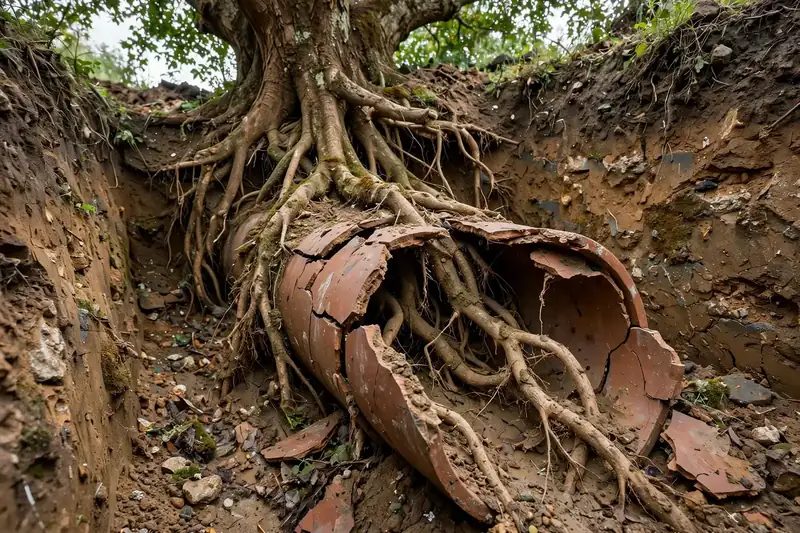
Tree roots do not attack sewer lines out of malice — they follow water, and a clay joint weeping nutrient-rich moisture is the most attractive water source in the yard. A root hair finer than thread enters through a hairline joint opening; inside the pipe it finds a warm, wet, fertilized paradise and grows — thickening year after year into a woody mass that chokes flow, widens the joint, and eventually fractures the pipe. It is the most common sewer failure mode in Beverly's older neighborhoods, and the most misunderstood.
This guide covers the whole root story: why they invade, how professionals remove them, and the permanent solutions that end the cycle. For the service itself, see our tree root removal page.
Why Roots Invade: The Biology
Roots grow toward moisture — hydrotropism — and a sewer joint leaking even tiny amounts of water vapor creates a moisture gradient in the soil that roots follow with exquisite sensitivity. Clay bell joints, with their mortar or aged gaskets, are the classic entry: the joint weeps, the root hair enters, and inside the pipe the root finds everything it needs. Once established, the mass grows on the pipe's nutrients, sending feeder roots back out through the joint to colonize further.
The damage compounds mechanically. Growing roots exert hydraulic-like pressure — a root thickening inside a joint pries the bell apart, widening the opening, admitting more water, inviting more roots. What began as a hair becomes a wedge becomes a fracture. Species matters: willows, maples, oaks, and elms are aggressive seekers with far-reaching systems, but any tree within 20 feet of a vulnerable joint is a candidate.
How Professionals Remove Roots
Mechanical cutting is the workhorse: rotating root saws and augers on sectional cables shred the mass inside the pipe, restoring flow. The operator works by feel — the cable transmits the mass's resistance — cutting thoroughly without damaging the pipe wall. Hydro-jetting follows or substitutes: high-pressure water flushes the shredded debris and scours the joint, with specialized root-cutting nozzles for tenacious masses.
Chemical treatments — copper sulfate or foaming root killers — have a narrow, honest role: applied after mechanical clearing, foam fills the pipe and contacts roots at the joints, inhibiting regrowth for a season. They are a maintenance adjunct, not a solution: no chemical repairs the open joint, and overuse harms the pipe environment and septic systems. The professional sequence is cut, flush, camera-verify, then decide the permanent fix.
Why Cutting Alone Never Ends It
Cut roots regrow — that is the entire problem with cutting as a strategy. The joint that admitted them remains open; the moisture gradient remains; the tree remains. Regrowth timelines are predictable: wispy re-entry within months, functional mass within one to three years depending on species and season. Each cutting cycle buys a shorter interval than the last, because the joint widens with every growth cycle.
Cutting is maintenance, and honest maintenance has its place — scheduled cutting keeps a line functional for years at modest cost. But recognize it for what it is: a subscription to the symptom. The decision point arrives when cutting intervals shorten past the economic crossover — when the annual cutting bill approaches the amortized cost of the permanent fix. At that point, cutting is no longer maintenance; it is postponement.
The Permanent Solutions
CIPP lining is the definitive root solution for lines that qualify: the structural liner seals every joint in a continuous, jointless tube — roots cannot penetrate what has no openings. The tree stays; the entry points close permanently. Pipe bursting achieves the same by replacing the line with jointless HDPE. Both end the root cycle rather than managing it.
The qualifier, as always, is the camera: lining needs round host pipe; bursting needs a viable path. Severely root-fractured clay — bells split by decades of wedging — may need bursting rather than lining. The post-cutting camera pass, with the mass cleared and the joints exposed, is when the permanent-fix decision gets its evidence. Our bursting-vs-lining comparison details the choice.
Living With Trees and Sewers
The long-term strategy has three parts. Plant smart: no new trees within 20 feet of the lateral — and know where the lateral is, from the locator map, before planting anything. Choose shallow-rooted species near infrastructure. Maintain on schedule: cutting or jetting at the interval your inspection history sets, before masses choke flow. Fix the joints: lining or bursting when the economics cross over, ending the cycle.
Note what is not on the list: removing beloved mature trees to save a pipe. The pipe is replaceable and renewable; the 80-year-old oak is not. Trenchless renewal exists precisely so the tree and the sewer can coexist — the tree keeps its roots, the line loses its joints, and both thrive. That is the civilized resolution, and it is available whenever the footage qualifies the line.
Related reading
Frequently Asked Questions
How do I know roots are my problem?
The camera shows it definitively — fibrous masses entering at joints are unmistakable. The circumstantial signs: recurring blockages, gurgling, slow drains, and large trees near the line's path. If cleanings keep finding roots, the joints are open and the cycle is running. Call (833) 713-2101 for a camera diagnosis.
Will root killer from the hardware store fix it?
No — retail root killers cannot clear an established mass and cannot close the open joint. Professional foaming treatments have a legitimate maintenance role after mechanical clearing, but nothing poured down a drain repairs the breach. The mass needs cutting; the joint needs sealing.
How often will roots come back after cutting?
Typically one to three years to functional re-blockage, depending on species, season, and joint condition — with intervals shortening as joints widen. Your inspection history sets the real number for your line; when intervals drop under a year, the permanent fix has become the economical choice.
Can roots break a PVC pipe?
Rarely — properly jointed PVC resists root entry; roots exploit the joints they can open, and solvent-welded or well-gasketed PVC joints do not open. Root problems in PVC lines usually trace to a transition coupling, a damaged section, or a poorly made joint — the camera finds the specific vulnerability.
Should I cut down the tree?
Almost never necessary. Trenchless lining or bursting eliminates the entry points while the tree keeps its canopy — the civilized solution that preserves both. Tree removal is the last resort, not the first response, and it does not repair the already-open joints anyway.
Does lining really stop roots permanently?
Yes — a continuous structural liner has no joints for roots to penetrate, and the epoxy barrier is impenetrable to root tips. Post-lining camera inspections confirm the seal. It is the definitive end of the root cycle for qualifying lines.
Sewer Line Problems Don’t Wait. Neither Should You.
Call now and reach a local sewer line specialist serving Beverly, MA and nearby North Shore communities — 24/7.
(833) 713-2101Free to call · No obligation · 24/7 emergency line