
Trenchless Sewer Repair Limitations
The honest catalog: host-pipe requirements, grade limits, ground constraints, and complexity — when trenchless cannot work and what to do instead.
- Practical guide
- Local specialists
- Camera first
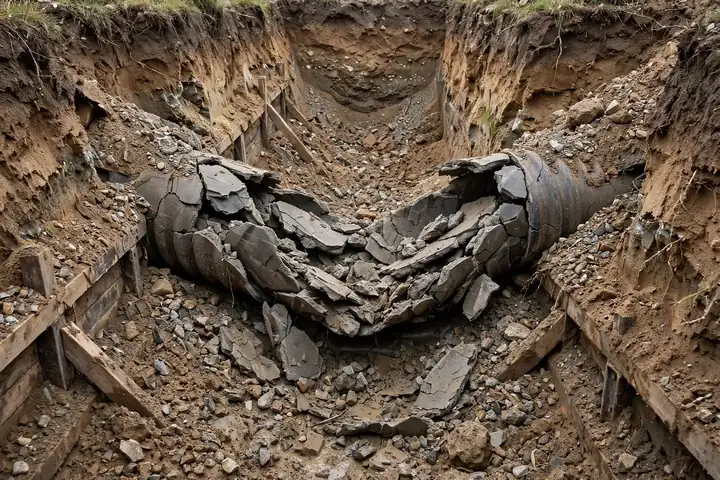
Trenchless sewer repair is excellent — and it is not magic. As specialists who perform it daily, we have a professional obligation to state its limits plainly, because the industry's overselling of trenchless methods has left a trail of failed liners in unqualified pipes and burst attempts in unburstible ground. Knowing when trenchless cannot work is as valuable as knowing when it can.
This guide catalogs the honest limitations of both CIPP lining and pipe bursting: the pipe conditions, site conditions, and geometric problems that disqualify each method — and what the right alternative is in each case.
Limitation 1: The Host Pipe Must Qualify (Lining)
CIPP lining's fundamental requirement — a host pipe holding its round shape — disqualifies a meaningful fraction of failed lines. Collapsed sections offer no path for the liner. Severely ovalized Orangeburg cannot be rounded by inflation pressure; attempting it produces a wrinkled, weak liner in a still-deformed pipe. Pipes with major offsets or separated joints beyond the liner's bridging capacity will not be spanned reliably.
The failure mode of ignoring this limit is the failed liner: installed at cost, then requiring excavation anyway to fix what the camera disqualified in the first place. The qualification survey is not a formality — it is the load-bearing judgment of the entire method. Any contractor proposing lining without a thorough camera survey is skipping the step that prevents this failure.
Limitation 2: Grade Problems Survive Trenchless (Both Methods)
Neither lining nor bursting corrects grade. A belly — a sagging section that ponds water — lined becomes a smooth, jointless belly that still ponds water. Bursting follows the old pipe's path and therefore its grade; it replaces the pipe, not the profile. Lines whose dysfunction is fundamentally about slope — bellies, backfall, lost grade from settlement — need open-cut regrading, because only excavation re-establishes the designed fall.
The camera survey measures grade with its self-leveling head and distance counters; bellies read as footage ranges where water ponds. When the survey shows grade as the primary defect, the honest recommendation is excavation — and the specialist who says so is the one to trust with the trenchless jobs too.
Limitation 3: The Ground Must Cooperate (Bursting)
Pipe bursting displaces soil outward — and the soil must accept displacement. Solid ledge rock tight against the pipe, heavily compacted fill with immovable obstructions, or nearby utilities without adequate clearance all constrain or disqualify bursting. In the North Shore's ledge-heavy geology — Gloucester granite, Marblehead outcrops — the pre-pull investigation must confirm the ground will yield; where it will not, the bursting head stalls or veers, and the job becomes an excavation.
Nearby utilities are the parallel constraint: the expansion zone around the bursting head must clear gas, water, electric, and telecom. Where clearance is inadequate and rerouting is impossible, bursting is off the table regardless of the pipe's condition. Utility locating and test-hole confirmation are designed steps, not optional extras.
Limitation 4: Diameter and Length Constraints
Lining slightly reduces internal diameter — a real constraint in already-undersized lines where every fraction of bore matters for capacity. Very small diameters challenge equipment access; very large diameters move into a different equipment class with different economics. Extremely long runs without intermediate access can exceed liner handling limits or pulling capacities, requiring segmentation that adds cost and complexity.
These are engineering constraints, not prohibitions — they are solved with proper equipment selection and job design. But they are why the survey measures diameter at multiple points and maps access: the method must fit the line's actual dimensions, not its nominal ones.
Limitation 5: Connections and Complexity
Lining covers branch connections — each must be robotically reopened after curing, mapped from the pre-installation survey. Lines with many branches, or branches whose exact positions were poorly mapped, turn reinstatement into the job's hardest phase; a missed or damaged reinstatement is a callback. Bursting handles branches by direct reconnection, but each reconnection is a small excavation — a line with numerous branches accumulates pit costs that erode the trenchless advantage.
Severely complex geometries — multiple sharp bends, diameter transitions, unusual fittings — challenge both methods' equipment. The survey's job is to map complexity honestly so the method selection respects it. Simplicity favors trenchless; complexity audits it.
When Excavation Is the Right Answer
Open-cut replacement — the traditional trench — remains the right method for: collapsed lines in unburstable ground, grade corrections, lines requiring rerouting, and severely complex geometries. It is also the diagnostic method of last resort: when the camera cannot pass and the ground cannot be burst, excavation reveals what the instruments could not.
The honest framing is not trenchless-versus-traditional but fit-versus-unfit. Our trenchless-vs-traditional comparison works through the selection in full. A specialist fluent in all methods — and willing to recommend excavation when the footage demands it — is the specialist whose trenchless recommendations you can trust.
Related reading
Frequently Asked Questions
Can every sewer line be fixed trenchlessly?
No — collapsed sections in unburstable ground, grade problems needing regrading, and severely complex geometries still need excavation. Most residential lines qualify for one trenchless method or the other, but “most” is not “all,” and the camera survey is what sorts them. Call (833) 713-2101 for an honest qualification.
What happens if a liner is installed in a bad host pipe?
It fails — wrinkling, weak cure, or inability to bridge the defect — and the excavation that follows costs more than doing it right the first time. This is why qualification surveys are non-negotiable, and why lining quotes without camera footage should be refused.
Can trenchless fix a sagging (bellied) line?
No. Both lining and bursting follow the existing grade; neither re-establishes slope. Bellies that impair function need open-cut regrading. The camera survey measures the belly; the measurement decides the method.
Is trenchless always cheaper than digging?
Usually less than open cut in total project cost, but not always — complex reinstatements, difficult bursting ground, or very short runs can narrow or reverse the gap. Compare itemized total costs for the methods your footage qualifies, not slogans.
How do I know my contractor is honest about limitations?
They camera-survey before recommending, they explain which methods your footage disqualifies and why, and they are willing to recommend excavation when it fits. A contractor who has never met a line that needed digging is not assessing — they are selling.
Does failed trenchless work void future options?
Not necessarily, but it complicates them — a failed liner inside a collapsed pipe must be dealt with before proper repair proceeds. Getting the method right the first time, from honest qualification, is always cheaper than recovering from the wrong one.
Sewer Line Problems Don’t Wait. Neither Should You.
Call now and reach a local sewer line specialist serving Beverly, MA and nearby North Shore communities — 24/7.
(833) 713-2101Free to call · No obligation · 24/7 emergency line