
How Long Do Sewer Lines Last? | Beverly
Sewer line lifespan by material — clay, cast iron, Orangeburg, concrete, PVC — plus the four accelerants that shorten every line's life.
- Practical guide
- Local specialists
- Camera first
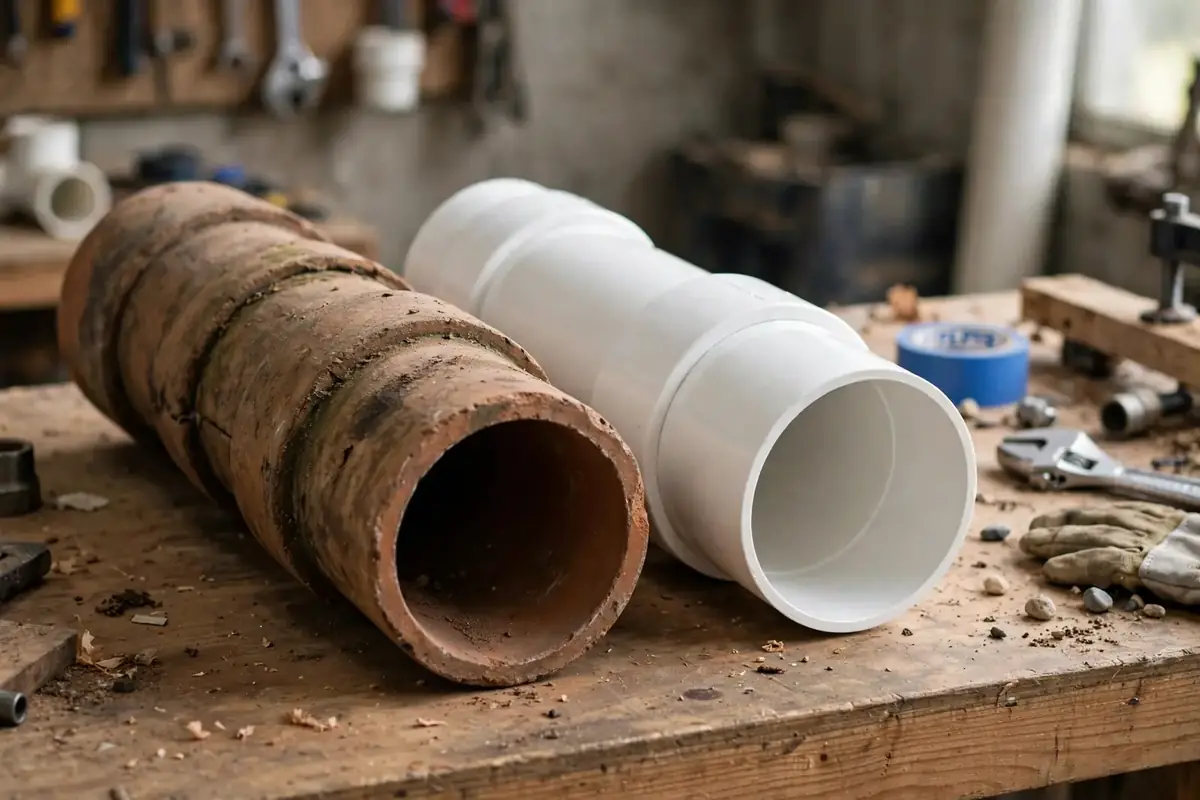
“How long should my sewer line last?” is the question behind half the camera inspections we perform. The honest answer has two parts: the material sets the theoretical lifespan, and your specific conditions — soil, trees, water table, installation quality — determine how much of that lifespan your line actually gets. A clay line in well-drained soil with no nearby trees can outlive its installer; the same clay under a maple in saturated till may fail decades early.
Beverly's housing stock spans every pipe era, so this guide covers them all: the lifespans of clay, cast iron, Orangeburg, concrete, and PVC, what shortens each one, and how to tell where your line is in its life. For the full material reference, see our complete guide to sewer pipe materials.
Clay (Vitrified Clay): 50–100 Years, Joints First
Clay pipe itself is nearly immortal — vitrified clay resists chemical attack and corrosion indefinitely. What fails is the joints: mortar or rubber gaskets that crack, shift, and open over decades, admitting roots and groundwater. A clay line's functional life is really its joints' life, typically 50 to 80 years before joint failure becomes systemic.
In Beverly's pre-war housing — clay laterals under 1890s–1920s homes from Goat Hill to the Cove — most clay lines are living on borrowed joint time. Root intrusion is the accelerant: each root mass widens the joint it entered, admitting more water, growing more roots. Clay lines with lined or well-maintained joints can reach the century mark; neglected ones fail at the joints decades sooner.
Cast Iron: 50–75 Years, Corrosion From Inside
Cast iron fails from the inside out. Wastewater chemistry, hydrogen sulfide gas, and simple oxidation corrode the pipe wall, building up tuberculation — rough mineral scale — that narrows the bore while the wall thins. Typical functional life runs 50 to 75 years, shorter in aggressive soil or with heavy grease loads that accelerate internal attack.
Beverly's mid-century Capes and ranches carry the cast-iron cohort, and the camera tells the story plainly: scale-choked bores, pinhole leaks, sections where the wall has thinned to lace. Descaling can buy time, but once the wall is perforated, the line's life is measured in years, not decades — replacement by bursting or open cut is the honest recommendation.
Orangeburg: 30–50 Years, Deformation Is Death
Orangeburg — bituminized fiber pipe, the postwar wonder material — has the shortest life and the most definitive failure mode: it deforms. Under soil loading and moisture, the fiber pipe ovalizes, blisters, and eventually collapses. Thirty years is a reasonable expectation; fifty is a gift. Once ovalization starts, it does not stop.
Danvers and Peabody subdivisions, North Beverly's postwar streets — anywhere built in the 1950s–70s boom — may hide Orangeburg. The critical fact: deformed Orangeburg cannot be lined, because lining needs a round host pipe. Bursting replaces it trenchlessly, which is why camera qualification matters so much for this material. If your home dates to the Orangeburg era, an inspection is not optional curiosity — it is planning.
Concrete and Asbestos Cement: 50–70 Years
Concrete pipe resists crushing well but suffers chemical attack from hydrogen sulfide — the crown of the pipe corrodes where sewer gas concentrates. Asbestos cement, used mid-century, faces similar chemistry with the added complication of regulated handling during replacement. Both typically deliver 50 to 70 years before the chemistry wins.
These materials appear in municipal mains more than residential laterals, but larger properties and some mid-century developments used them. Replacement planning should account for handling requirements — a specialist familiar with the regulations keeps the project compliant.
PVC and ABS: 100+ Years, Installation Is Everything
Modern plastic pipe — PVC and ABS — does not corrode, resists chemicals, and has fused or gasketed joints that defeat roots. Its theoretical life exceeds a century. The failure mode is almost never the material; it is the installation: poor bedding that lets the pipe settle and belly, inadequate slope, or damage during backfill.
For Beverly's newer construction and anyone replacing a line today, PVC is the default for good reason — but the installer's bedding and slope discipline is what converts a hundred-year material into a hundred-year line. This is also why proper installation process matters more than the pipe brand stamped on the side.
What Shortens Any Line's Life
Across all materials, four accelerants dominate. Trees: root intrusion exploits every joint and crack, and the damage compounds — roots widen the openings they enter. Water: high water tables and infiltration saturate bedding, accelerate settlement, and feed corrosion chemistry. Loading: heavy vehicles over shallow lines, construction activity, and soil movement stress every material. Neglect: the absence of inspection means small problems — a root hair, a minor offset — grow into line-ending failures unobserved.
The countermeasure is the same regardless of material: periodic camera inspection. A line inspected every few years gets its problems caught small, when cleaning or spot repair suffices. A line never inspected announces its problems as emergencies. The inspection costs a fraction of the emergency — that arithmetic holds for every pipe ever buried.
Related reading
Frequently Asked Questions
My house was built in 1920. How much life does my sewer line have left?
It depends on the material and maintenance history, not just the house's age — the line may have been replaced since. A camera inspection shows the actual condition: joint integrity, root intrusion, wall condition. That footage answers the question for your specific line. Call (833) 713-2101 to schedule.
Does pipe lining extend a line's lifespan?
Yes — a structural CIPP liner is rated for decades of additional service, effectively resetting the clock on a line whose host pipe still holds its shape. It is the standard life-extension for aging clay and cast iron that qualify on camera.
Can tree roots really destroy a sewer line?
Absolutely. Roots enter through joints and cracks seeking moisture, then expand — widening the openings, admitting more water, growing thicker. Over years, root masses can fracture clay bells and displace joints entirely. Managed early with cutting and lining, roots are a maintenance item; ignored, they are a line-ending event.
Is Orangeburg always an emergency?
Not always — but it is always a planning priority. Intact, round Orangeburg can still function; deformed Orangeburg is on a one-way path to collapse. Only a camera inspection distinguishes the two, and the distinction determines whether you plan a replacement or schedule one urgently.
Do newer PVC lines ever fail?
Rarely from material failure — but poor installation (bad bedding, wrong slope, backfill damage) can doom a PVC line early. That is why the installer's process matters more than the pipe brand, and why even newer lines deserve a baseline camera inspection.
How often should I have my line inspected?
Every 2–3 years for lines over 30 years old or with known root pressure; every 5 years for younger lines in good condition; immediately when symptoms appear. The schedule is set by material, age, and the last inspection's findings.
Sewer Line Problems Don’t Wait. Neither Should You.
Call now and reach a local sewer line specialist serving Beverly, MA and nearby North Shore communities — 24/7.
(833) 713-2101Free to call · No obligation · 24/7 emergency line