
Sewer Pipe Materials: Complete Guide
Every sewer pipe material — clay, cast iron, Orangeburg, concrete, PVC, HDPE — how to identify it, how it fails, and what it means for repairs.
- Practical guide
- Local specialists
- Camera first
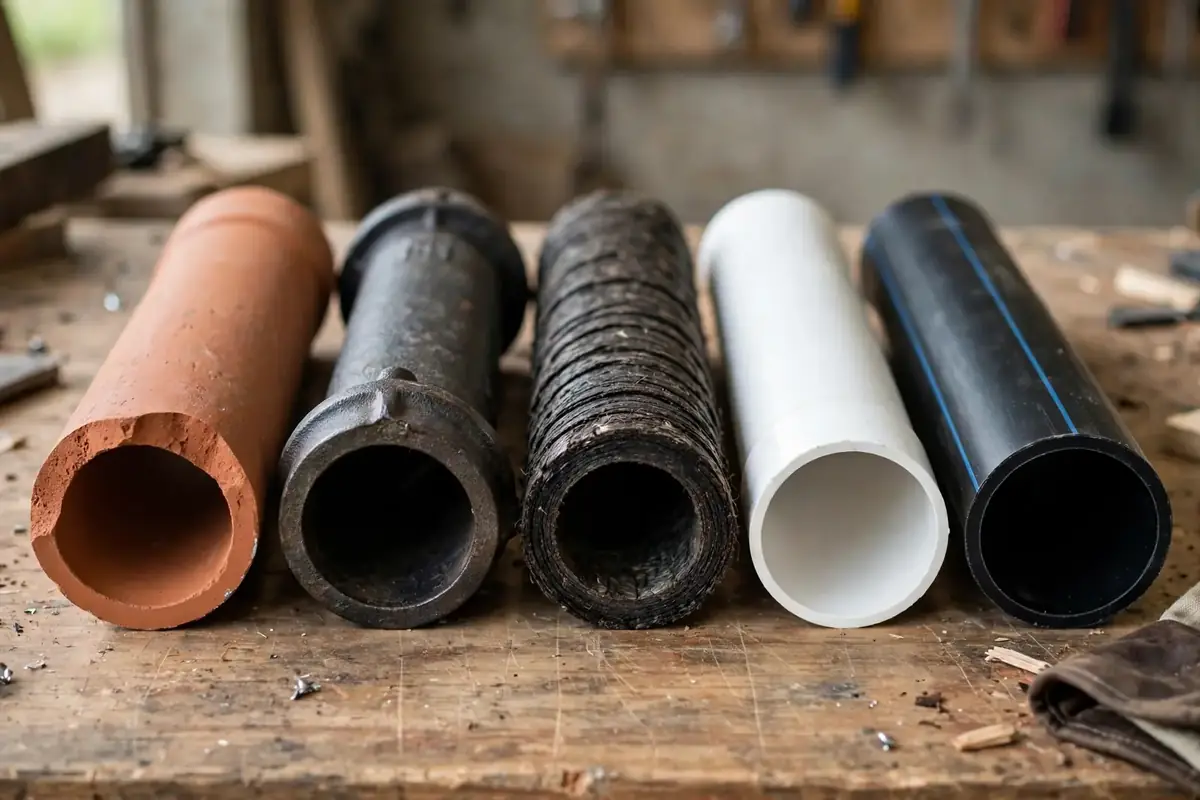
Every sewer line is a product of its era — and in Beverly, the eras are all still buried. Clay from the 1890s, cast iron from the postwar boom, Orangeburg from the subdivision years, PVC from modern construction: each material brought its strengths, each carried its failure modes, and each is still serving (or failing) under someone's yard today. Knowing which material is under your lawn is the first fact of sewer ownership.
This is the complete reference: every significant pipe material, how to identify it, how it fails, and what it means for repair choices. For lifespan specifics, pair it with our guide on how long sewer lines last.
Vitrified Clay: The Century Pipe
Vitrified clay — salt-glazed ceramic pipe in 3-foot sections joined at bells — dominated residential sewers from the 1890s through the 1940s. Its virtues are real: the material itself is chemically inert, immune to corrosion, and crush-resistant. A clay barrel can last a century; the joints are the biography. Mortar joints crack and wash out; rubber-gasket joints fare better but still shift with settlement. Every clay failure mode — root intrusion, infiltration, offset — enters through the joints.
Identification: the camera shows reddish-brown pipe with visible bell joints every few feet. Repair logic: round barrels with joint failure are the classic lining candidates — the liner seals every joint at once. Fractured barrels or severe offsets go to bursting or spot repair. Clay rewards maintenance: cut roots on schedule and the barrels serve indefinitely.
Cast Iron: Strong, Then Corroded
Cast iron — hub-and-spigot sections, later no-hub couplings — served mid-century construction and interior building drains still today. Its strength is mechanical: it handles loading and resists crushing. Its enemy is chemistry: hydrogen sulfide and wastewater corrode the interior wall, building tuberculation that narrows the bore while the wall thins toward perforation. Cast iron fails from the inside out, invisibly, until the camera shows scale-choked bore or the wall gives way.
Identification: dark, rough interior with rusty scale; hubs at joints. Repair logic: descaling buys time but cannot restore wall thickness — perforated cast iron needs bursting or replacement. Sound-but-scaled iron can be lined if the wall retains structural integrity, a judgment the camera informs and experience makes.
Orangeburg: The Fiber Pipe
Orangeburg — bituminized fiber pipe, layers of wood pulp and pitch — was the postwar economy choice, laid extensively in 1950s–70s subdivisions. It installed easily and cheaply, then spent decades proving the adage about cheap. Under soil loading and moisture, Orangeburg ovalizes, blisters, delaminates, and collapses. Its failure is progressive and one-directional: deformation never reverses.
Identification: the camera shows dark, fibrous walls with a distinctive texture; ovalization is visible as the cross-section goes egg-shaped. Repair logic: deformed Orangeburg cannot be lined — the liner needs roundness. Bursting is the trenchless answer, replacing fiber with HDPE. If your home dates to the Orangeburg era and the line is original, inspection is planning, not curiosity.
Concrete and Asbestos Cement
Reinforced concrete pipe serves municipal mains and larger laterals; asbestos cement appeared mid-century in some developments. Concrete resists crushing admirably but suffers crown corrosion from hydrogen sulfide gas. Asbestos cement faces similar chemistry plus regulated handling requirements during replacement — disturbing it triggers abatement protocols that the project must budget and schedule.
Identification: gray, smooth-bore larger pipe; municipal records often document the material. Repair logic: structural lining suits sound concrete with surface deterioration; replacement of asbestos cement must follow regulated handling protocols. These materials are less common in residential laterals but appear on larger properties and in shared lines.
PVC and ABS: The Modern Standards
PVC (polyvinyl chloride) and ABS (acrylonitrile butadiene styrene) — plastic pipe with solvent-welded or gasketed joints — are the modern residential standards. They do not corrode, resist chemicals, and their joints defeat roots when properly made. Material life is measured in a century-plus. The failure mode is installation: poor bedding causes settlement bellies, inadequate slope strands solids, backfill damage cracks walls.
Identification: smooth white (PVC) or black (ABS) plastic with barely visible joints. Repair logic: rarely needed structurally; cleaning and the occasional spot repair for installation defects. For new installations, PVC is the default — and the installer's bedding discipline is what converts a hundred-year material into a hundred-year line.
HDPE: The Trenchless Replacement
High-density polyethylene — the pipe pulled in during pipe bursting — deserves its own entry because it is increasingly what is under Beverly yards after trenchless replacement. HDPE sections are heat-fused into one continuous, jointless pipe: no bells, no hubs, no joints for roots to exploit. It flexes rather than fracturing under loading, resists chemicals and abrasion, and carries multi-decade ratings.
Identification: smooth black interior (often with a striped marker), visibly continuous — the camera glides without joint interruptions. Repair logic: HDPE rarely needs repair; its maintenance is inspection and cleaning. When you burst a failed line, HDPE is what the future is made of.
Reading Your Own Line's Material
The camera inspection identifies your material definitively — color, texture, joint pattern, and diameter tell the story in minutes. But the era shortcut works surprisingly well: pre-1940 homes usually mean clay; 1940s–60s mean cast iron or early Orangeburg; 1950s–70s subdivisions mean Orangeburg risk; post-1980 means PVC/ABS. Renovations and partial replacements complicate the picture — the camera resolves it.
Material determines the failure modes to watch, the maintenance rhythm to keep, and the repair methods that qualify. A clay line's owner manages joints and roots; an Orangeburg owner's priority is deformation monitoring; a PVC owner's job is mostly habit discipline. Same street, different materials, different ownership — the camera tells you which material owns you.
Related reading
Frequently Asked Questions
How do I find out what material my sewer line is?
A camera inspection identifies it definitively in minutes — color, texture, and joint pattern are unmistakable. The home's era gives a strong hint (pre-1940: clay; mid-century: cast iron or Orangeburg; post-1980: PVC), but renovations can surprise. Call (833) 713-2101 for an inspection.
Which pipe material is best?
For new installation: PVC for gravity laterals, HDPE for trenchless replacement — both offer century-scale material life with proper installation. For existing lines, “best” is the material already performing: a sound clay line with maintained joints needs no material envy.
Can different materials be joined together?
Yes, with proper transition couplings — shielded, sized, and rated for the pairing. The transitions are the vulnerability: dissimilar materials settle differently, so the coupling quality and the bedding beneath it determine whether the joint lasts. The camera inspects transitions with extra attention.
Is Orangeburg always bad?
As a material, it is the weakest of the common pipe materials — but an intact, round Orangeburg line still functions. The problem is trajectory: deformation is progressive and irreversible. Round today is not a clean bill of health; it is a monitoring status with a replacement plan.
Does pipe material affect home value?
Indirectly: buyers fear unknown sewer risk, and documented material-plus-condition removes the fear. A camera report showing sound PVC, or a warranted HDPE replacement, is a selling asset regardless of what the neighbors have buried.
What material will replace my failed line?
Typically PVC for open-cut replacement or HDPE for pipe bursting — both modern, jointless-or-nearly, and rated for decades. Your specialist specifies the material, diameter, and standard in the written proposal before work begins.
Sewer Line Problems Don’t Wait. Neither Should You.
Call now and reach a local sewer line specialist serving Beverly, MA and nearby North Shore communities — 24/7.
(833) 713-2101Free to call · No obligation · 24/7 emergency line